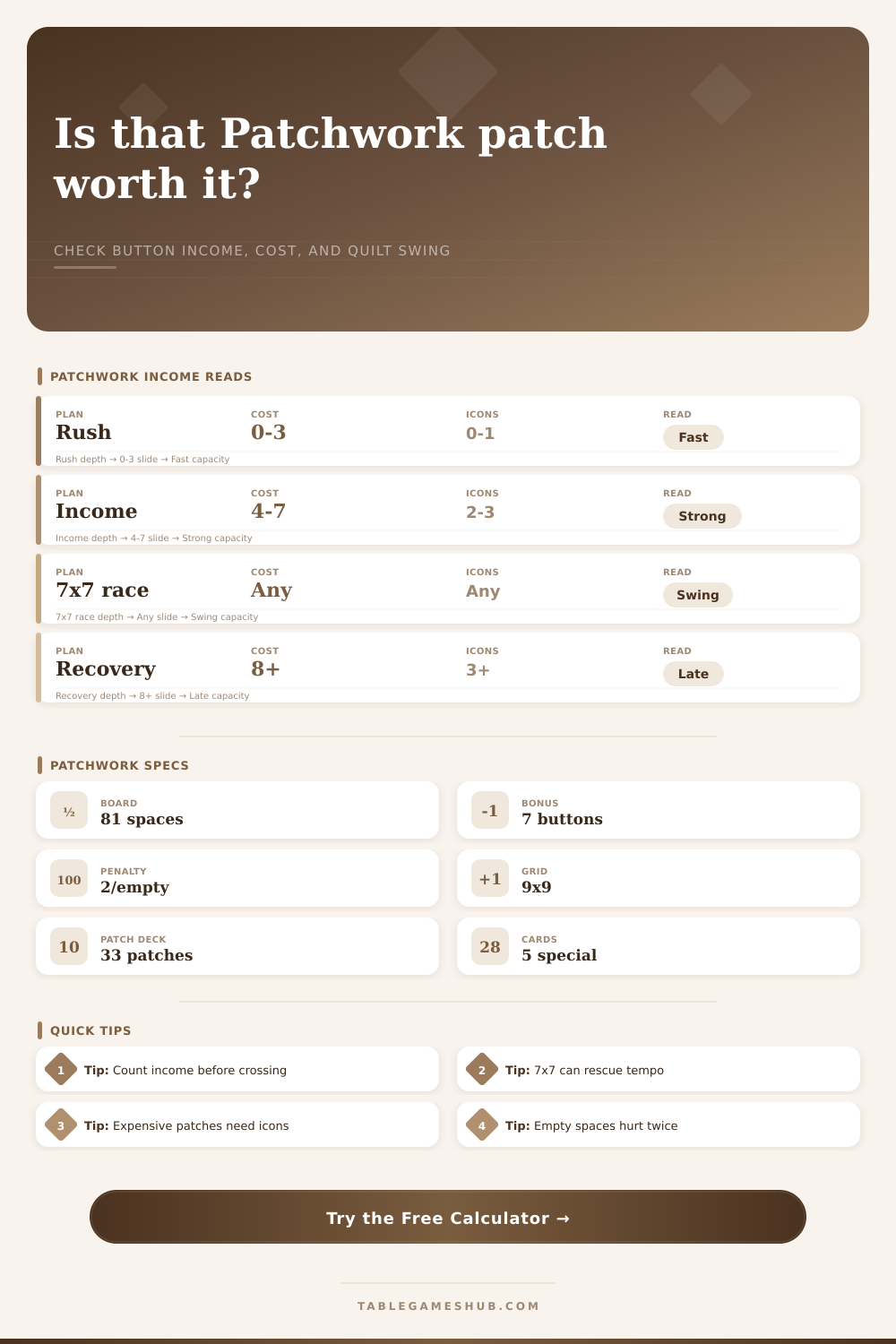
Sit down to play a game of Patchwork. Stare at top of deck. This one require 7 buttons. Two of them are income icons. Your hand contain 4 button.
At this moment, most players pause. They’re deciding: do I spend money now? Or do I wait for it to pay off later? The calculator above does the math for you after you input how many buttons you have and where you are on the time board. That way you don’t have to guess whether expensive action will be a win or a trap.
How to Choose the Best Patches
The tool converts possible value of a card into actual point changes, which allow you to clearly see the tradeoff ahead of time… Before you commit. Patchwork’s core tension lie in balancing two currencies: buttons used to buy patches now, and points they turn into at the end of the game. Unless they produce sufficient income to reimburse themselves, every button you spend will be a potential point lost.
To model this, tool tracks how many phases of income remain. A patch with icons is extremely valuable if it has lots of icons and you’re still early in the game, those icons will continue firing over and over again. But if you’re near the end of the game and have just one or two turn left, those same icons will be almost worthless. Everything depends on context.
Finally, it is about form as well as function. Sure, maybe you’ve got all those buttons, but what if there are weird-shaped holes in your board? You’ll want to fill ’em first. This calculator factors in board coverage… And it penalize for exposed squares late in the game. Every uncovered square is worth two points, and that’s expensive. Sometimes a more affordable patch (one that covers three key holes) may prove a better purchase than an expensive one that increases your income while leaving you with hole in your quilt.
Consider the short- vs. Long-term reward: What does the quick-and-dirty look advantage provide relative to the future economic boost? The table on the page show what the coverage will do for your final count. It repeats the idea that sometimes it is better to have a full quilt, even a lousy-looking one, then one that is half-finished.
It’s all about psychology, too: some people see the seven-button bonus for filling in the middle 7×7 square and race to claim it… The bonus is worth seven points, but if you burn out your income engine racing to it, you’ll have nothing left. You have to go slowly enough to maintain a steady flow of income, otherwise you’ll end up broke at a slow clip.
The calculator allow you to enter how far along you are from zero on the time board. It will tell you if you are burning your buttons faster than you can earn more. If you don’t check, you might buy something that leave you unable to catch up, which is a common error.
To further complicate things, there are special patches. Specials can grant additional buttons or even free moves in one-off actions that alter the whole game. The calculator considers regular patch income, but you must also think this way to understand how valuable each special is. Does it make sense for your immediate gain versus missing out on a regular patch that could boost your economy or improve your shape? Reading full board and not just your hand is key.
Finally, this all boils down to an effective pressure-based way to manage your resources. You have a finite amount of time in which you need to complete a grid as best as possible while amassing the highest number of points. No one way is the right way, but many ways is the wrong way. The most frequent error I see people make is not having enough money to sustain their purchase of more expensive patches. Another way is over-investing in shape at the expense of your button economy.
The tool provide a framework for weighing every choice objectively. It won’t tell you what to play, but it could of told you what that play is going to probably cost you down the line. If you’re feeling stale, take a step back and ask yourself, what’s the end game? How many gaps are there? What are the gaps? Which income triggers do you still need?
If results indicate you’re short, focus more heavily on the patch work that fixes the holes instead of the pretty shapes you like on paper. The numbers don’t lie (though they’re not unfair). Each button must pay for itself. Run through the calculator to see if your assumptions are solid. Eliminate the guesswork and play confidently. Stop chasing shiny objects and follow a plan; that’s often the difference between good players and great ones.
Eventualy the quilt will fill up quickly enough all by itself. Your responsibility is to weigh the benefit of shape against your economic gain to make sure every square counts toward victory, rather than just prioritizing aesthetics.