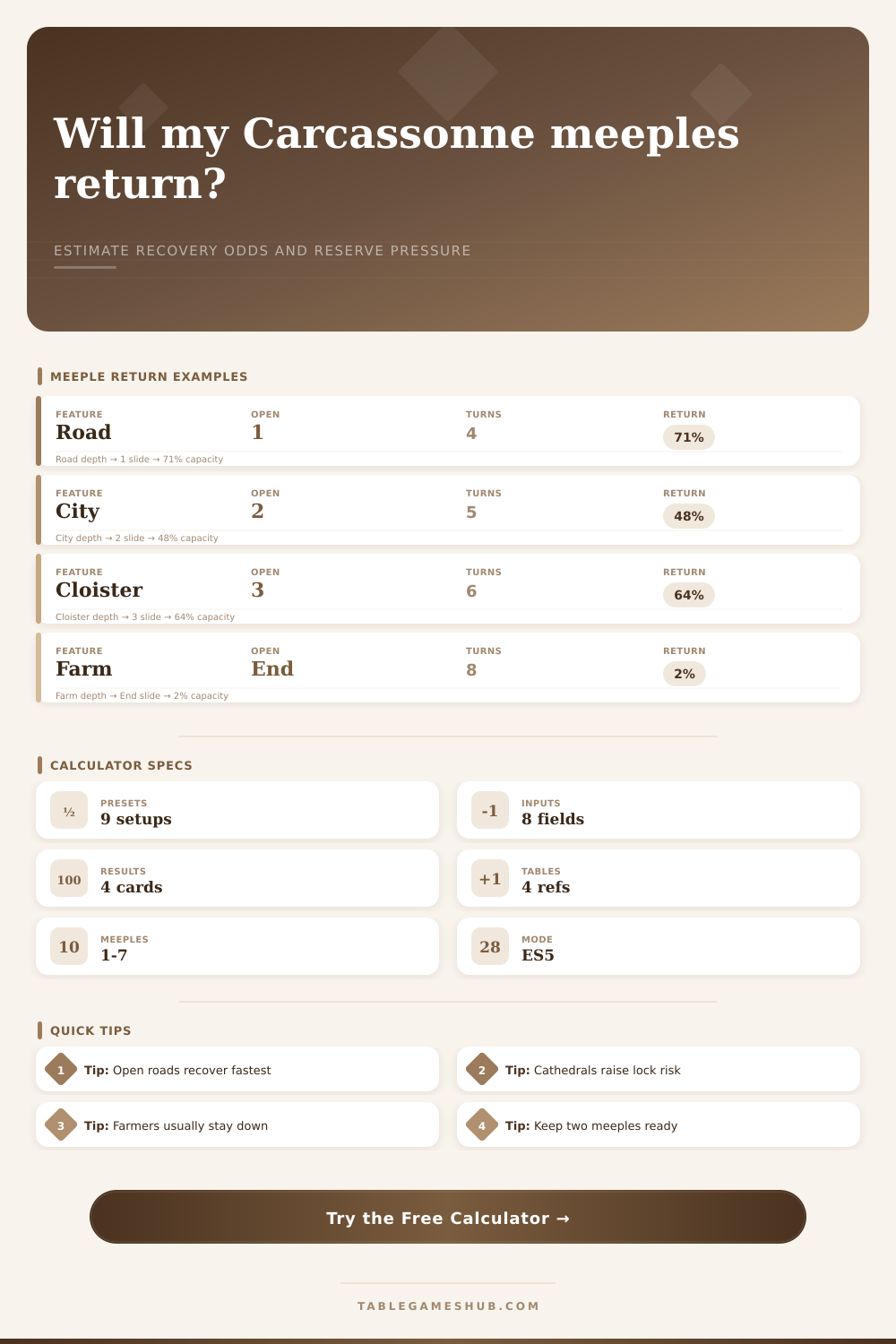
Carcassonne Meeple Return Calculator
Estimate whether committed meeples are likely to come back before your next scoring window, using feature type, open edges, remaining turns, contested space, and inn, cathedral, builder, or abbey pressure.
| Feature | Normal return route | Openings to watch | Recovery feel | Reserve warning |
|---|---|---|---|---|
| Road | Close both road ends with junction, city, cloister, or road cap tiles. | 1 to 3 open ends | Fast when an end cap is visible, slower when branching. | Usually safe if one meeple is committed. |
| City | Fill every city edge so the wall has no gaps. | 1 to 6 city gaps | Strong points but more tile-specific than roads. | Watch if a cathedral or contest is involved. |
| Cloister | Surround all eight neighboring spaces with tiles. | Missing adjacent spaces | Reliable with open board space, awkward when blocked. | Can trap a meeple when edge access is poor. |
| Farm | Standard farmers score at game end and do not return during play. | Field connection needs | Long commitment, not a short-term recovery plan. | Count it as locked unless using house rules. |
| Modifier | Return effect | Score pressure | Best use | Risk note |
|---|---|---|---|---|
| Builder | Raises tempo by creating extra-turn opportunities on the same feature. | Moderate | Long roads and cities you can extend safely. | Still needs matching tiles to actually close. |
| Inn | Does not close the road faster, but makes completion more urgent. | High | Short road races with visible end caps. | Incomplete inn roads are worth no points. |
| Cathedral | Reduces practical recovery because cities need a clean finish. | Very high | Nearly closed cities with spare wall tiles. | Incomplete cathedral cities score no points. |
| Abbey tile | Can erase one awkward hole or complete a tight gap. | Situational | Saving locked cities, roads, or cloister spaces. | Spend it only when the meeple matters. |
| Contest level | Completion drag | Typical board state | Reserve target | Tempo cue |
|---|---|---|---|---|
| No contest | Low | Your feature has clean tile access. | 1 or 2 meeples | Close only if the points or meeple are needed. |
| Light pressure | Moderate | An opponent may share or block one side. | 2 meeples | Prefer flexible tiles that help multiple features. |
| Active contest | High | Players are racing for majority or denial. | 2 or 3 meeples | Recover if your next placement options are thin. |
| Hostile denial | Very high | The feature is being blocked or stretched on purpose. | 3 meeples | Avoid adding more meeples unless it wins control. |
| Scenario | Feature setup | Likely result | Reserve read | Main input to adjust |
|---|---|---|---|---|
| Small Road Race | One meeple, one open road end, four turns. | Good chance to return before the next scoring push. | Usually stable | Completion openings |
| Cathedral City Lock | Two meeples, large city, cathedral, active contest. | High value but vulnerable to a long lock. | Often short | Opponent contest |
| Cloister Recovery | One meeple, three missing surrounding spaces. | Good if tile access is open and turns remain. | Watch board space | Turns remaining |
| Farmer Commitment | One field meeple before final scoring. | Counts as locked for the rest of the game. | Plan around it | Reserve target |
“Ok I’ve got 3 meeples left. What do I do now? Should I grab this tile to complete this city? Or add on to that road? Or should I try to surround another cloister? That’s where Carcassonne gets tough. With just a few meeple left, each decision is risky. And sometimes the board looks full even when it is actualy more open than it appears, but how do you know? The board seems filled up; yet there is space available but you don’t see the paths to get to them. So you guess… and guess some more:
The tool above evaluates contest pressure, remaining turns, and the type of feature being built all at once. It figures out the gap in your reserves, and calculates the odds you’ll get those meeples back, turning vague “what if” into something tangible: math.
How to Use Your Last Meeples Wisely
Not all meeple commitments are equal. The most common trap players falls into is treating all meeples as equal commitments. That’s not true. A road blocker might return in two turns if you need it for a specific junction tile, yet a meeple on a big city wall might not come off till the very last turn. The calculator accounts for this distinction by asking how many remaining openings exist on a feature. Why? Because this number directly impact your chances of getting the correct piece. With three open road ends and only five more turns, the likelihood drops sharply. This is where the expected number of meeples returned comes into play; it tells you when the average result is still going to fall short, which beats learning this lesson in-game. That’s why, for instance, you should of know if your reserve will likely shrink before you find out the hard way during play.
Farms shift the equation. Players get that most of the time; they just forget it in the moment as they spot an open farm space. Once you place a meeple on a farm, it’s gone from your available pieces permanently. Farmers yield close to zero according to the calculator, meaning those last few points must be weighed against instant board control. So if you’ve got two spare meeples in your pocket and commit one to a farm, you’re down to one buffer now. One tiny number will need to handle all incoming road races, city caps, and cloister saves for the rest of the round. It is a lot to ask of such a small piece.
Other special tiles (e.g., cathedrals and inns) increase the risk of not finishing something. For instance, an inn increases the danger of an uncompleted road: leaving it blank scores nothing and usually benefits your opponent. The modifier inputs in the tool accounts for this pressure by adjusting the urgency of recovery. Similarly, a city with a cathedral may be quite rewarding, but there’s great potential to get trapped in a lengthy standoff which could lock your meeple away from other options. The Tempo modifiers in the reference table on the page will guide your thinking about whether tying up your forces is worth the promise of points. Ask yourself, “Can I afford to wait for just the right tile? Or do I have to cut my losses and move on?”
Finally, contested features are dangerous, as opponents will actively try to deny you completion. Extending a city in the wrong direction or having an opponent block the end of a road will lower your chances of being able to come back quick. The calculator takes this into account and shows how long it will take to recover depending on how much it’s contested. The more contested it is, the higher the likelihood of getting locked out. And when this happens, you better have some reserve to survive. You want those open meeples available so you can create new openings on the board if you’re pushed into a serious battle. Otherwise, you sit there hoping for that miracle tile that might never appear as your opponent scores points left and right.
You don’t want to waste meeples, but you also don’t want to hang onto meeples just to hang onto meeples. Before placing every tile, run the math. What is it costing you? How many points is that meeple worth? Does he/she/it have a way home? Is it enough to make up for being gone? If not, maybe this isn’t the right move. And I bet you will find that sometimes, pushing out an additional road segment costs more then it’s worth with the number of meeples you have left over. Other times, you’ll look at a board space and realize there is no way someone can surround a cloister fast enough to save him, so go ahead and put it down. That kind of insight into the trade-offs makes you think about things different and forces you to stop making moves purely on the basis off how cool something looks at first glance. It forces you to plan around resources. That is what distinguishes people who set the tempo of the game vs people who get rekt by them.