Terraforming Mars Prelude Calculator
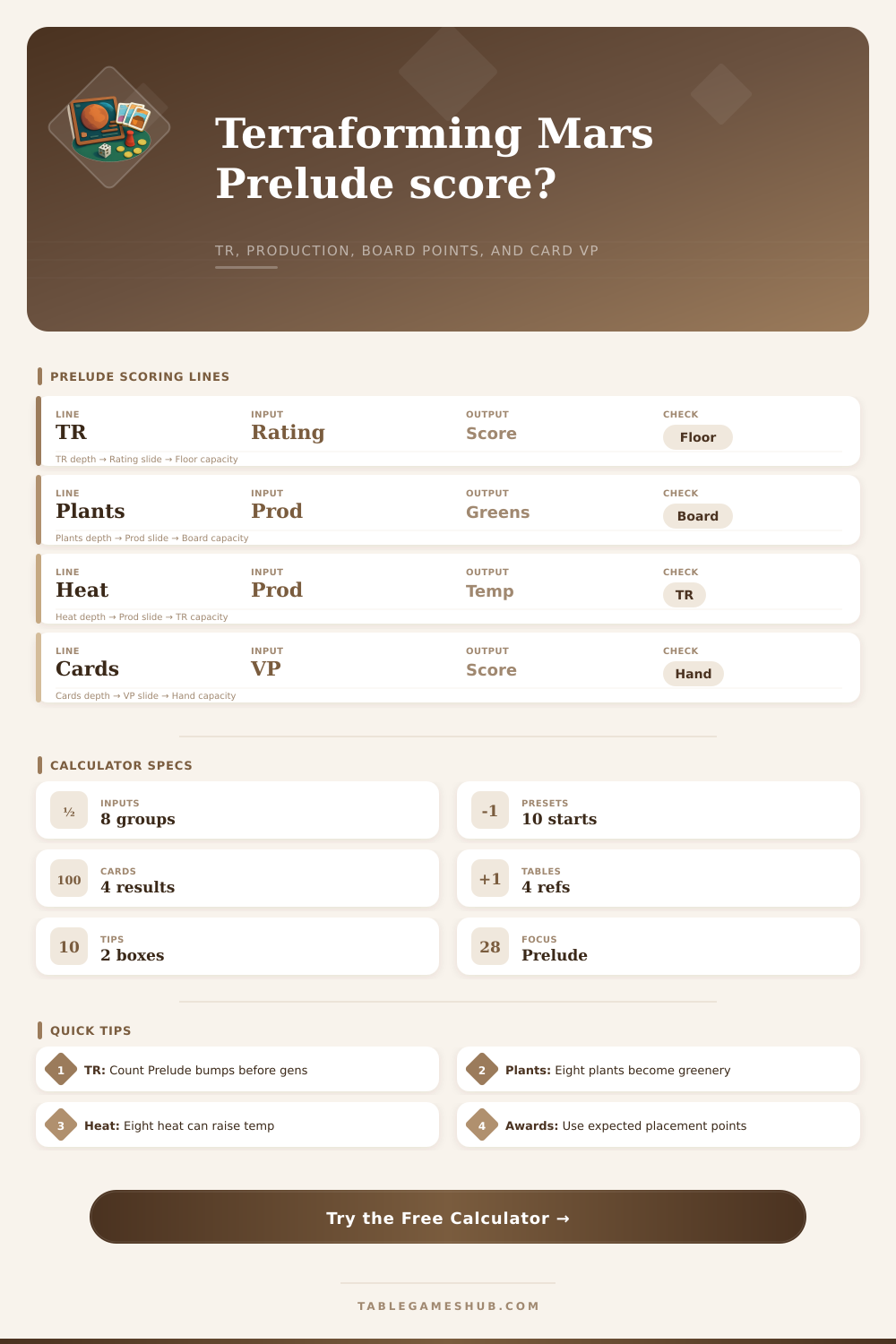
Project a Terraforming Mars: Prelude position from starting TR, MC production, steel, titanium, plant, energy, heat, selected Prelude cards, milestones, awards, greenery, cities, and VP cards.
| Prelude pair | TR direction | Production direction | Best score pressure |
|---|---|---|---|
| Business Empire + Allied Bank | Low opening TR | Strong MC production | Banker or card VP engine. |
| Metals Company + Mining Operations | Moderate TR | Steel and titanium tempo | Builder, space tags, and city support. |
| Ecology Experts + Experimental Forest | Greenery-leaning TR | Plant and tag pressure | Gardener, greeneries, and oxygen steps. |
| Power Generation + Huge Asteroid | Fast heat/TR push | Energy into heat | Terraformer and Thermalist pressure. |
| Research Network + Donation | Flexible TR | Card access and timing | Science tags and late VP cards. |
| Track | Game conversion | Score signal | Calculator handling |
|---|---|---|---|
| MC production | Income each generation | Supports flexible card play | Rolled into tempo index and Banker pressure. |
| Steel production | Building-tag support | Builder and city infrastructure | Valued at two tempo units per produced steel. |
| Titanium production | Space-tag support | Large card and Jovian VP line | Valued at three tempo units per produced titanium. |
| Plant production | Eight plants form greenery | Oxygen, board VP, Gardener | Projects extra greenery and oxygen TR. |
| Heat production | Eight heat raises temperature | TR and Thermalist position | Projects temperature bumps from heat plus energy. |
| Track | VP assumption | Typical support | Risk note |
|---|---|---|---|
| Terraformer milestone | 5 VP | TR 35 or higher | Count only when secured or clearly reachable. |
| Gardener milestone | 5 VP | Three greeneries | Plant removal can delay the line. |
| Builder milestone | 5 VP | Eight building tags | Steel tempo helps but tags still matter. |
| First-place award | 5 VP | Dominant table category | Only use first-place when lead is durable. |
| Second-place award | 2 VP | Contested category | Use when placement is likely but not locked. |
| Scoring line | Base point rule | Prelude impact | Audit cue |
|---|---|---|---|
| Greenery tile | 1 VP plus oxygen TR | Plant production accelerates both | Separate placed greeneries from projected plants. |
| City tile | Adjacent greenery VP | Tharsis and settlement starts help | Use actual adjacency, not total greeneries. |
| VP cards | Printed and conditional VP | Science, Jovian, microbe, animal paths | Include confident endgame card points only. |
| TR | 1 score per TR | Asteroids, heat, plants, oceans, oxygen | Do not double-count TR and card VP. |
Finally, the Prelude expansion for Terraforming Mars alters way that opening moves function: Rather than react to a shuffled deck, you can now execute pre-planned strategy. You receives two free cards before the first generation starts. This gives you an early advantage that pressures both the board and your resource. It also makes it difficult to keep track of your position in your head, the calculator above runs the math for you, showing a clear view of where you stand.
Engine building versus direct scoring is tension at the center of all of these games. A large number of Prelude cards present you with the chance to make some Terraforming Rating immediately vs build up more production over time. To address that, the tool allow you to pick out which two cards you’re going to run together. Want to be super-rich? Pick Business Empire + Allied Bank. Ready to push ratings hard? Pick Huge Asteroid + Power Generation.
How to Calculate Your Score and Strategy
Every combo reset your math starting point. It’s not just about having a hand of cards, it’s about betting on a path. If you want to understand whether you’re ahead or behind, you need to measure that bet. The inputs specify the cap on your engine. Input your current production of heat, energy, steel, plants, and titanium. This tells the system how much you can affords to generate in later generations.
The calculator takes this into account, since steel and titanium has different uses and are therefore weighted differently based off the tempo index. Titanium increases based on Jovian multipliers and space cards, whereas steel is used for city infrastructure and building tags. In other words: the calculator doesn’t want you to overvalue a resource that you aren’t able to use effectivey.
A lot of people fall down on conversion rates between heat and plants. Plants get converted to oxygen and greenery (which increase the Terraforming Rating) while heat goes straight toward raising temperature, or it can be banked for future rating increases. This is all laid out nicely in reference table on page. A single greenery tile give you one VP plus adjacency bonuses. Remember that eight plants equal one greenery, which equals 1VP plus adjacencies. You’ll constantly overestimate what your board will look like if you don’t know how those conversions work.
Milestones and awards add a layer of risk management that pure engine builders often ignore. For example, the Terraformer milestone is unlocked by hitting a certain rating threshold, meaning you may have to burn some cash getting rated different than building out your engine. You can account for anticipated placement on those tracks, but they’ll warn you against getting too cocky here. Expecting to win an award that you are currently losing will make your end result appear bloated. That discipline is what makes the difference between a good game and a great one.
Finally, the result provide an expected final score along with a breakdown of that score in terms of card victory points, board points, rating floor, and any contribution from milestones/awards earned. Why is this important? It will reveal how much lead you have. If you’re getting a lot of points from your rating floor, then even if your cards are weak, you might still be fine. On the other hand, if you’ve got an awesome engine but your rating’s too low right now, as long as you get some more generations in, you’ll pull away.
You tell the calculator which turn to project, and based off that, it helps you determine if you should go for the win immediately or if you would of been better off stalling for an engine explosion. And it makes a difference when you’re playing your first couple of rounds, understanding those dynamics. You don’t guess anymore, you calculate. You know exactly which Prelude cards is going to work with your corporation choice, and you know exactly what kind of hand to draw in order to maintain that advantage.
The tool doesn’t just remove the guesswork from resource management; it allows you to focus on making tactical plays against your opponent. It’s about control. When a game is defined by limited resources and chaos, a clear picture of where you stand numerically gives you the confidence to make bold moves. That clarity is what turns a good start into a winning strategy.