Carcassonne River Calculator
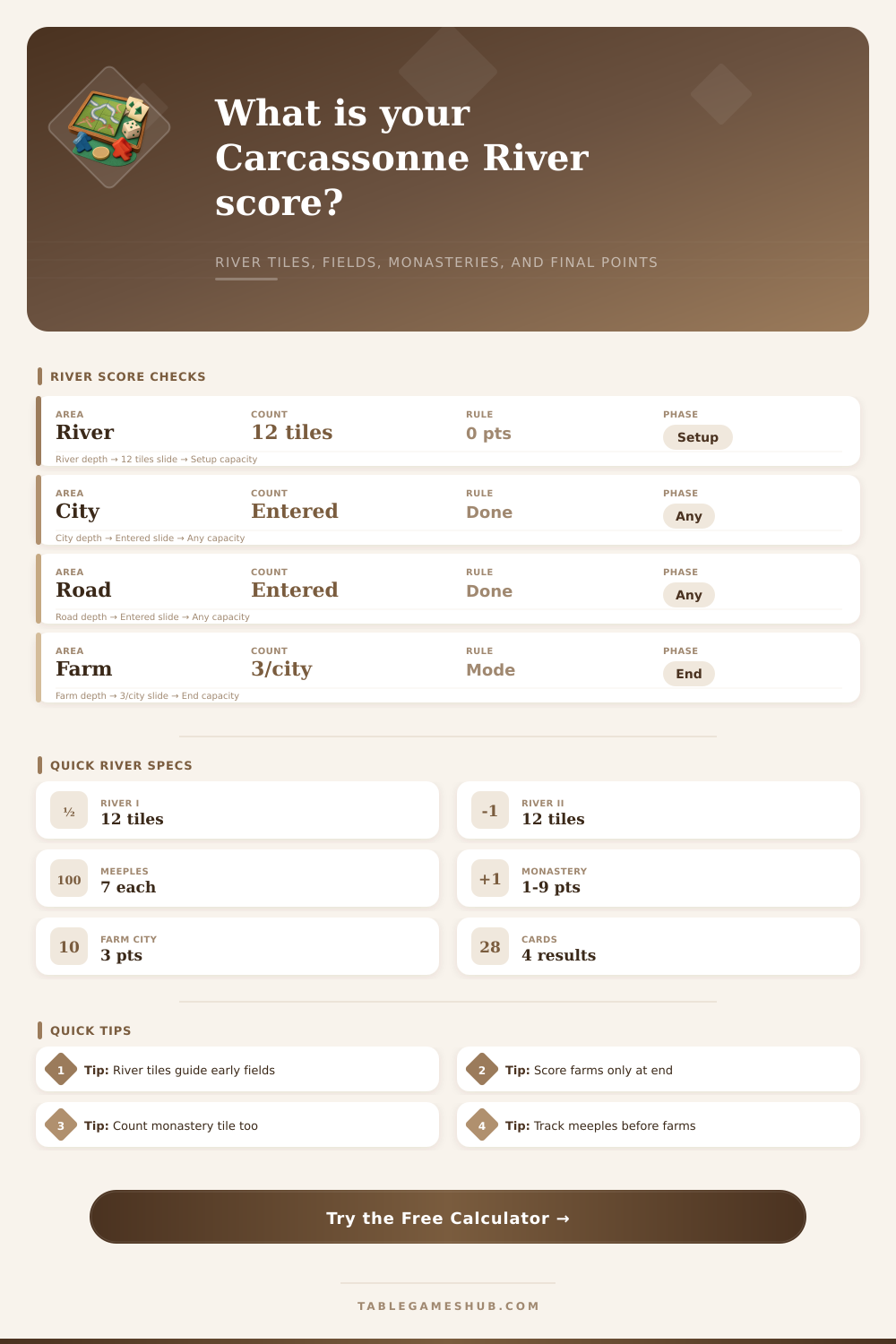
Audit a River or River II board state with river tiles placed, completed city and road points, field scoring mode, monastery progress, meeple pressure, expansion mix, and final scoring subtotal.
Live scoring breakdown
| Scoring item | Count | Rule used | Points |
|---|---|---|---|
| Completed cities | entered | scored already | 18 |
| Completed roads | entered | scored already | 8 |
| Fields | 4 cities | 3 each | 12 |
| Monastery | 7 tiles | 1 each | 7 |
River tile mix reference
| River set | Typical tiles | Scoring effect | Calculator check |
|---|---|---|---|
| River I | 12 tiles | No printed points | Opening layout and field borders |
| River II | 12 tiles | No printed points | Branch count and fork pressure |
| River plus base | 84 tiles total | Normal feature scoring | City, road, monastery, field totals |
| River plus expansions | Varies by mix | Mode-dependent modifiers | Expansion note and risk flag |
Feature scoring reference
| Feature | Completed value | Endgame value | River note |
|---|---|---|---|
| City | 2 per tile and shield | 1 per tile and shield | River can divide field access |
| Road | 1 per road tile | 1 per road tile | River roads often end at crossings |
| Monastery | 9 when complete | 1 to 9 by coverage | Count the monastery tile itself |
| Field | Normally end only | Farm mode value | River fields can stretch across banks |
Farm and meeple modes
| Mode | City value | Meeple concern | Use when |
|---|---|---|---|
| Modern farmers | 3 per completed city | Farmer remains committed | Most current rulesets |
| Classic farmers | 4 per completed city | High field swing | Older table convention |
| Pig or barn | Often 4 per city | Expansion control check | Expansion mix includes it |
| No farm control | 0 field points | Meeple may be lost tempo | Opponent controls field |
In Carcassonne, the river act as a main structure for the board. It tells you where cities can develop and where roads has to bend. And at the end of the game, players tend to treat the river like it’s just decoration. That’s a mistake. The river makes you think strategicly way longer before you place a meeple on one of its tiles. It establishes barriers that look permanent but are realy temporary obstacle awaiting a bridge or a farm somewhere. Once you get the flow, you don’t just react; you plan ahead.
The first few moves for most new player are all about scoring points right now. Take whatever point is sitting there. Immediately grab the point for finishing a road. Finish a city and gets its points. Finish a segment and get those points. But here’s the thing: the tiles for rivers don’t give you any points at all! What they do is create tension between things.
Why the River Matters in Carcassonne
There is a long river tile separating two halves of field. One half of that field borders three cities; the other side border one. If you ignore that division from the start, then you have no shot whatsoever at endgame. The calculator above lets you put in your field projections along with your completed feature points, and it tells you how much opportunity cost you’re losing by neglecting the shape of the river. It does more than just tally up numbers; it shows you what you could of missing out on.
The river really matter when it is time to score farms. Each farmer scores three points for each city he touches (or four if you’re playing under classic rules). Sounds easy enough until you realize that even a small tributary can split a big field into separate section. One farmer on the bank may appear to be connected to five cities, but that twist in the river may cut him off from half of them.
The tool gives you the option to choose between moddern and classic modes. Modern mode give three points to each city, while classic mode grants four points. It’s important to pick the right one because it affects the risk of each placement. When you throw in the Pig and/or Barn expansions, the math change once more. That can affect the cost of placing just one tile wrong down the road.
And then there’s this other common pitfall: monasteries on the riverbank. Because half the cloister tile is blocked by water, that means your max potential points will be reduced by one (from nine to eight) unless you eventually find a way to reach the other side. Players often leave their followers there and forget to readjust their expectations about how much they’ll have to cover. You can enter the number of tiles you’re covering into the calculator. It will tell you that each blank tile beside water represents a point you may not receive. It is a small penalty, but a subtle one that will separate first from second place if the game comes down to it.
Meeple. Meeple is your scarcest resource. There’s only seven meeples for every player which means that putting them down on cheap points in the early game because the river was nice at the time will leave you out of luck as the big scores pile up. A simple number line showing how many meeples you’ve used so far compared to how many you have shows at-a-glance how you’re doing, and reminds you that if you’re using five followers by turn 10, then better use the remaining two wisely. This is not about hoarding but about timing.
Tile count, for example: River I and River II has different tile counts. The tiles also move differently. Throw in some Traders + Builders or Inns + Cathedrals, and you’ve got a whole new game. The tiles also move differently. Throw in some Traders + Builders or Inns + Cathedrals, and you’ve got a whole new game. It’s all laid out clearly in the reference tables on that same page. They show the impact of each variant on scoring modifiers and tile capacity. That’s all the information you’re going to need to know: which rules is applicable at your table this evening. No need to remember them all.
The fields score only once at the end of the game. By then, chances are they’re just adding up the rest. Those various pieces of information merge into one last subtotal, were there enough cities banking points for when agriculture swings hard against you? Or were you all-in on farms and drew badly on the tiles? There’s no right move, only moves that is less wrong. The river doesn’t care what you planned. All it cares about is which direction it’s flowing. The only way to remain a step ahead is to know its direction before setting foot.