All Fours Score Calculator
Total High, Low, Jack, Game, gift points, turned jacks, optional pitch contracts, and the exact match-order winner for an All Fours hand.
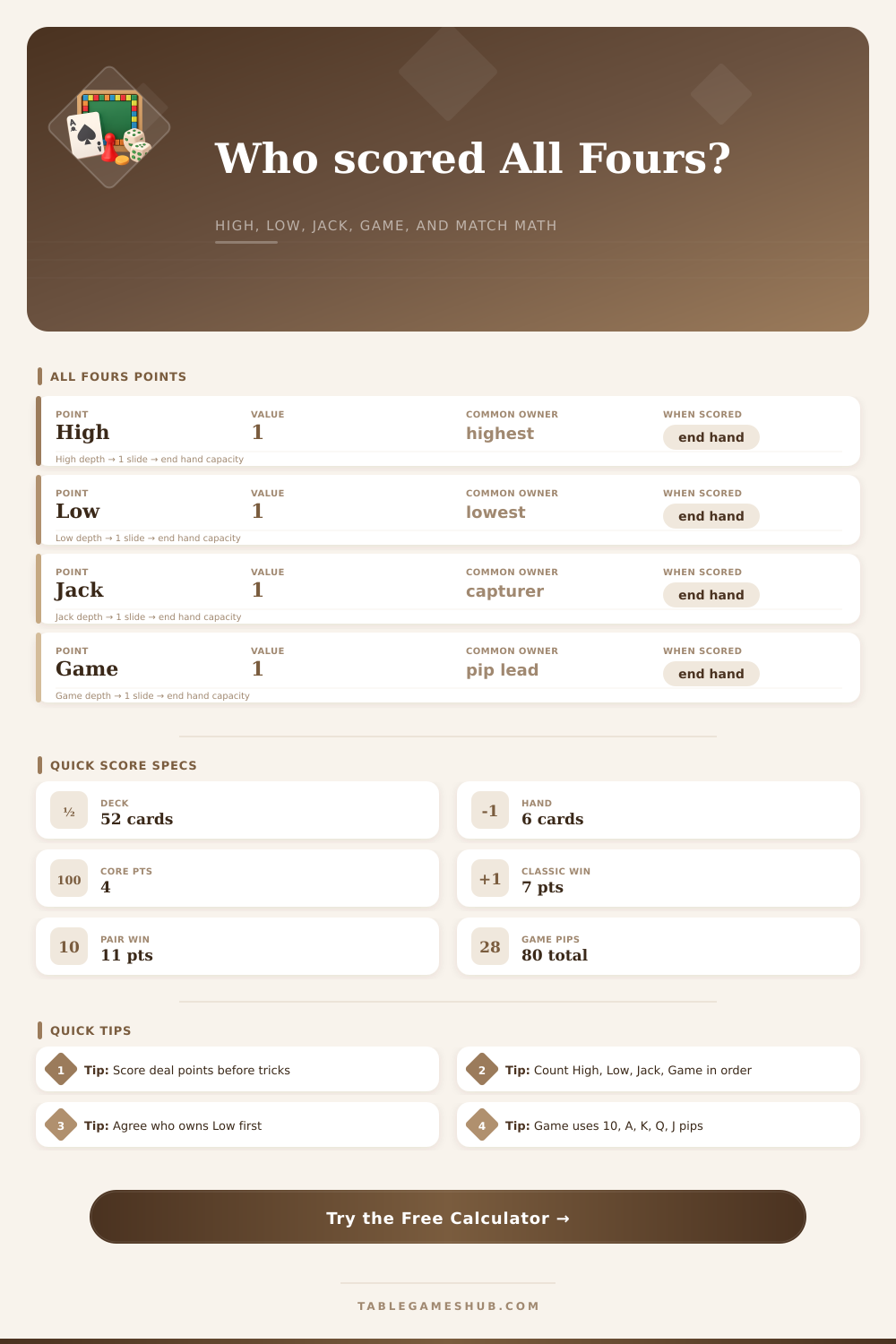
| Point | What wins it | Value | Calculator field |
|---|---|---|---|
| High | Highest trump in play | 1 | High trump point |
| Low | Lowest trump, by house rule | 1 | Low rule plus owner |
| Jack | Trump jack captured | 1 | Jack of trumps point |
| Game | Most pips in tricks | 1 | Side A and B pips |
| Card rank | Pip value | Cards counted | Full deck pips |
|---|---|---|---|
| Ten | 10 | 4 | 40 |
| Ace | 4 | 4 | 16 |
| King | 3 | 4 | 12 |
| Queen | 2 | 4 | 8 |
| Jack | 1 | 4 | 4 |
| Profile | Target | Low default | Game tie |
|---|---|---|---|
| Classic All Fours | 7 | Original holder | Elder or house rule |
| Seven Up | 7 | Original holder | No point common |
| Partnership | 11 | Table rule | No point common |
| Pitch family | 11 | Captured common | No point common |
| Trinidad table | 14 | Table rule | No point common |
| Preset | Core lesson | Typical swing | Watch item |
|---|---|---|---|
| Beg Gift Hand | Deal point timing | 1 to 5 pts | Count-out before play |
| Game Pip Tie | Tie rule impact | 0 or 1 pt | Elder or non-dealer |
| Pitch Bid Set | Contract penalty | -2 to -4 pts | Bidder made points |
| Low Captured Rule | Low ownership | 1 pt flip | Original vs capturer |
The hand follows the Jack. The capture of the Jack become the deciding card in that hand. It is treated like a key card as it shifts the pace of the game. Now all fours looks easy but among groups it has different scoring.
In one setup, the low goes to the one who originaly had it. In another, it goes to the one who took it out of someone’s trick. Begging for the turn card can alter some of the rules. Little things, but these determine which side will win and who might argue about point totals. Four points become fixed numbers when they is really changeable depending on your house rules.
How to Score in All Fours
After inputting your unique set of table rule, the calculator does all the math for you. You no longer has to keep track of turned jacks and gift points to play well. While most players are focused on winning tricks, they don’t realize how the deal points will determine who wins the game early. You may beg for the turn card and score a gift point. Before you know it, you have seven points before High or Low round begins. Scoring immediately handles that too. So there is no confusion with one team thinking they won when in fact someone else scored enough to cross the line on the deal.
Game pips make it an arithmetic match instead of a memory test. From ace to jack, four to one. Ten to ten means ten points, which makes getting a high card more valuabel than just collecting the low ones. Knowing your own score and roughly where your opponent(s) are, there’s no need to write out each pip as you go. Two tens is a lot of buffer that takes some doing to get around. That is, unless you catch the other two. A quick glance at table above gives the overall distribution of pips per rank, allowing for an estimate of who’s ahead, all with less pencil and paper.
Risk profiles can shift dramaticly with variants such as Pitch or Seven Up contracts. With classic play, you hope for one of four spots. When playing contracts, you take risks on your bid that hurt you right then; it’s dangerous to be cautious. So the app allows you to switch back and forth between modes to experience the loss from failing a bid versus losing a trick point. That way teams can determine whether they prefer the suspense of a bid or the comfort of classic scoring. Think of it as choosing between a sprint and a marathon. Going long.
Confusion about ties: Many people get hung up on how to handle a tie. If neither player has more points for a given suit (e.g. If they each pip out at 4 in hearts, who gets the point? Is it the dealer? Is it the older of the two hands? No one? That’s a house rule; there is no intuitive answer. Set your preset with the tie rule so the final tally reflects what both players agreed upon. This prevents technical disagreements from holding up a game that should of ended easily.
The game rewards both aggressive play for the Jack and careful arithmetic for the Game point. To win consistantly, you can’t neglect one or the other. Knowing exactly how many points you need allows you to make calculated risks which is just as important as learning the cards themselves. If a player needs one point, he’ll play different than a player who needs three. Understanding the scoring is just as important as knowing the cards.
The thing with keeping score is to make sure it’s part of the plan and not a barrier to having fun. When everyone knows what’s going on and the math makes sense the game runs smoother. It was easy for you two to define low and so now you don’t have to argue over who has it. Now you do have arguments, and that’s all part of the fun, except they’re friendly arguments. The card captures the score, and when the tool does the math you can concentrate on taking down the Jack.