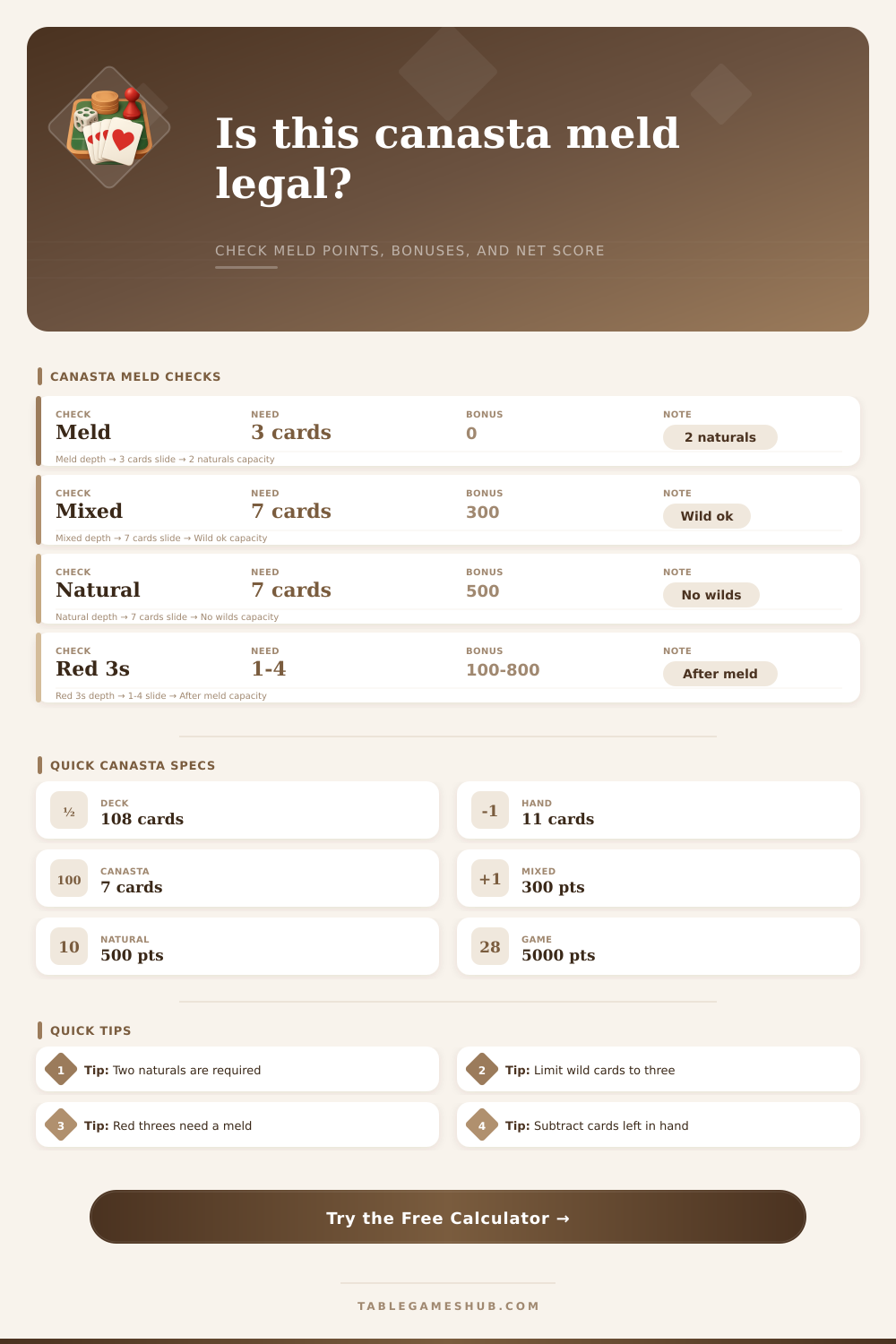
Canasta Meld Calculator
Check a canasta meld for legal natural and wild-card balance, opening meld minimums, canasta bonuses, red threes, going-out bonuses, hand deductions, and net team score.
natural value + deuce value + joker value
active meld + other table points >= required minimum
natural canastas + mixed canastas + red threes + going out
melded card points + bonuses - cards left in hand
Classic canasta uses two standard decks plus four jokers.
A canasta is complete when a meld reaches seven or more cards.
A standard mixed meld may not contain more than three wild cards.
The calculator updates this from the team's score before the hand.
| Card group | Meld value | Left-in-hand deduction | Calculator field | Scoring note |
|---|---|---|---|---|
| Black 3, 4, 5, 6, 7 | 5 each | 5 each | Low cards held | Black threes are only melded when going out. |
| 8, 9, 10, J, Q, K | 10 each | 10 each | Mid cards held | Most natural melds in this range build quickly. |
| Ace or deuce | 20 each | 20 each | Aces or deuces held | Deuces act as wild cards when used in melds. |
| Joker | 50 each | 50 each | Jokers held | High value, but still limited by wild-card rules. |
| Team score before hand | Minimum initial meld | Calculator test | Common result | Audit note |
|---|---|---|---|---|
| Negative score | 15 points | Opening total >= 15 | Easy recovery meld | Still must be a legal meld. |
| 0 to 1495 | 50 points | Opening total >= 50 | Early hand threshold | Red threes do not open by themselves. |
| 1500 to 2995 | 90 points | Opening total >= 90 | Mid-game threshold | Combine multiple melds if needed. |
| 3000 or more | 120 points | Opening total >= 120 | Late-game threshold | High-value wilds may be needed. |
| Meld state | Natural cards | Wild cards | Bonus | Calculator status |
|---|---|---|---|---|
| Basic legal meld | At least 2 | 0 to 3 | None | Legal if total cards are 3 or more. |
| Natural canasta | 7 or more | 0 | 500 | Natural bonus applies. |
| Mixed canasta | At least 4 | 1 to 3 | 300 | Mixed bonus applies. |
| Illegal wild-heavy meld | 0 or 1 | Any wilds | None | Needs two natural cards. |
| Too many wilds | Any count | 4 or more | None | Fails standard wild-card cap. |
| Score item | Classic value | When it applies | Calculator control | Check before posting |
|---|---|---|---|---|
| Mixed canasta | 300 points | Seven-card meld with wild cards | Mixed canastas | Include card points too. |
| Natural canasta | 500 points | Seven-card meld without wild cards | Natural canastas | Do not also count it as mixed. |
| Red threes | 100 each or 800 for all four | Positive only if team has melded | Red threes and melded toggle | Debit if no meld by hand end. |
| Going out | 100 or 200 concealed | Hand ends by emptying cards legally | Going-out status | Team usually needs a canasta first. |
| Cards in hand | Face value deduction | Every unmelded card at hand end | Held-card inputs | Subtract after adding bonuses. |
The math behind canasta scoring will get people arguing. There’s so much to keep up with: meld values, opening minimums, wild card limits. While playing, you has seven cards in your hand and you’re trying to figure out all that while also taking into account joker deductions for any unmelded card left at the end of round. Did they just make it easier for you to open, or did they knock down your score?
Enter in your card counts above and let the calculator do the math. No more forgetting which points is worth what in the middle of an intense round. Structural bonuses and raw card points create tension: for example, having seven sevens naturaly creates a canasta that’s good for 500 bonus points, provided you don’t play any wild cards. That’s the heart of negotiation within your hand; you’d like to play your jokers and deuces to fill out your melds as fast as possible, but each wild card makes the possible bonus pool smallerer.
How Canasta Scoring Works
By toggling between mixed and natural canastas, the tool also visualizes that trade-off: you get to see exactly how much the total change when those cards are either wilds or naturals. You learn that sometimes it’s better to hold back a deuce even though you really need it right now.
New teams gets tripped up by opening melds. Before any hand starts, you must reach a minimum number of points to go down. This depends on how many points your team has scored so far in the game. If it’s zero, the bar is set at fifty; if you’ve racked up three thousand, it shoots up to one hundred and twenty.
Players think that a set of aces will always clear the hurdle, not realizing that each ace count as twenty points. You have three aces, giving you sixty points, enough to get past the low hurdle, but just scraping into middle range. Keeping an eye on your total score avoids embarrassing moments when you table your cards and learn they don’t reach the legally required minimum.
Depending on whether or not you combine a red three at the end of hand, they’re either a help or a hindrance. If you do, then all four will earn you 800 points. This is a huge swing in favor of your team that might be enough to win a game. But if you don’t get them down, they cost you. The points goes against you.
That creates a hard choice: Discard or hold onto your red three? It’s a big bet, and you’re gambling on being able to meld before having to put it down. Then there is what you have left in your hand when the round ends. You lose five points for every unmelded low card, and every joker that does not make it into a meld cost fifty points. And this is where a lot of teams end up giving back much more then they’d anticipated.
After reveling in a big bonus from two mixed canastas, one player realizes he’s holding a joker and four unmelded face cards. Those bonuses dissapears in an instant. The math doesn’t care; it’s why the number-one mistake made by beginners at the casual table is forgetting about the hand penalty.
Once you get this, though, canasta becomes less a game of haphazardly dumping cards and more a game of strategy… One of managing risk. Should I discard now for quick gratification or wait for the chance to create a bonus-eligible meld that might yield a bigger reward? It’s a question of balancing short-term happiness with long-term reward.
And the numbers on the calculator tell you exactly how much each option is worth, but knowing what they represent will let you know if it’s in your team’s best interest to take it. After all, winning isn’t as important as winning in such a way that you don’t have to fight over it after.