♟ Median Buchholz Calculator
Calculate Median Buchholz, full Buchholz, Buchholz Cut-1, and US-style Modified Median from one Swiss tournament score sheet.
Enter each opponent's final tournament score. Add dummy values for unplayed rounds only when your event rules require them, then compare the trimmed middle score against the full strength-of-schedule total.
| Formula | Calculator action | Best use | Reference basis |
|---|---|---|---|
| Full Buchholz | Sum every opponent score | Raw schedule strength | FIDE Article 8.1 |
| BH-C1 | Remove the lowest score | Common first cut | FIDE Cut-1 modifier |
| BH-M1 | Remove lowest, then highest | Classic median score | FIDE Median-1 modifier |
| BH-M2 | Remove two lowest and two highest | Longer Swiss events | FIDE Median-2 modifier |
| Mode | Low cuts | High cuts | Minimum useful scores |
|---|---|---|---|
| Raw BH | 0 | 0 | 1 opponent score |
| Cut-1 | 1 | 0 | 2 opponent scores |
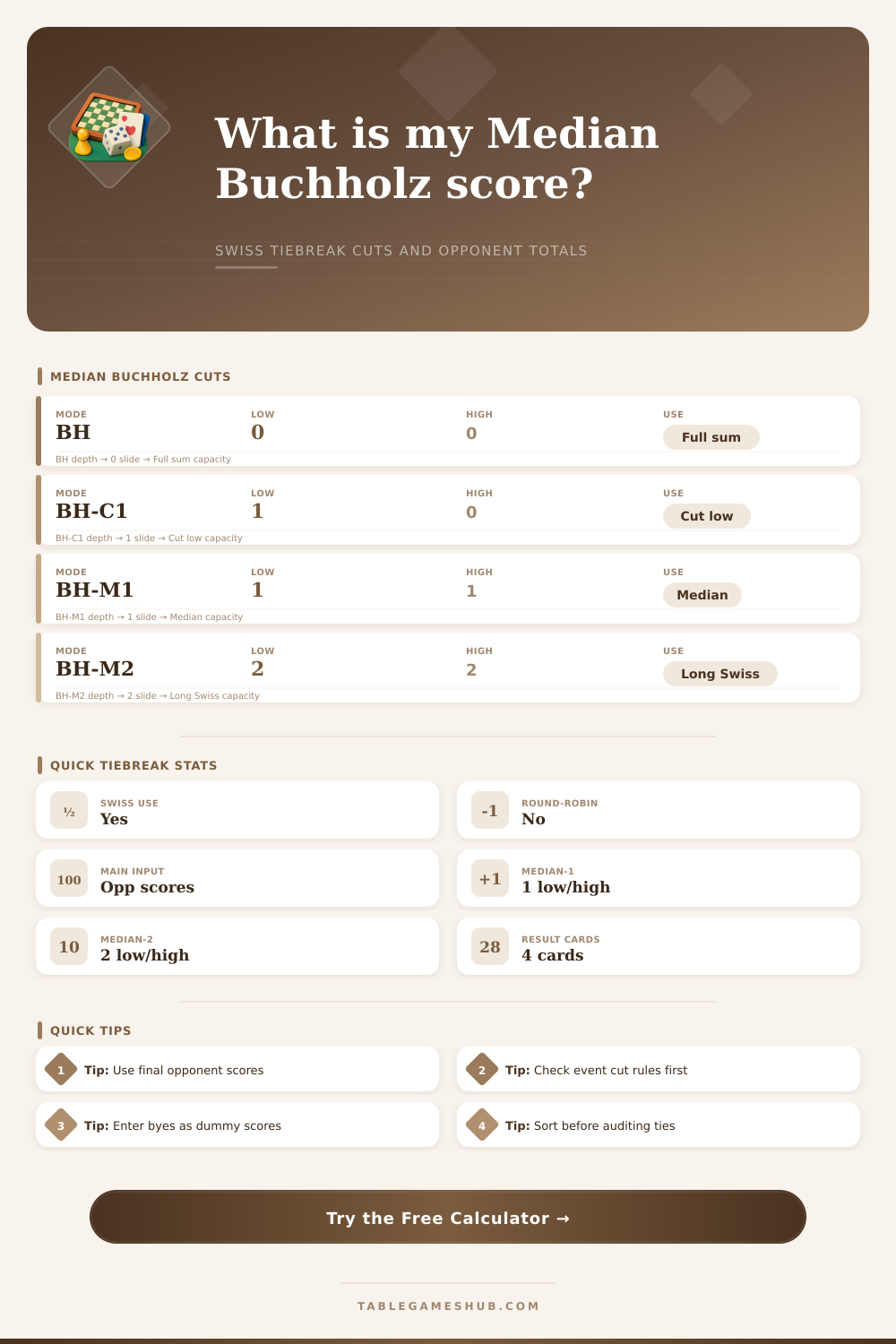
| Median-1 | 1 | 1 | 3 opponent scores |
| Median-2 | 2 | 2 | 5 opponent scores |
| Entry type | Example | Meaning | Calculator treatment |
|---|---|---|---|
| Opponent scores | 4, 3.5, 3, 2, 1 | Final scores of faced players | Included in all Buchholz sums |
| Result string | W,D,L,H,B | Player's round outcomes | Used for score check and SB estimate |
| Dummy scores | 2.5 | Unplayed round value | Appended and marked in breakdown |
| Match points | 8, 7, 6, 5, 3 | Team opponent totals | Works with 2-1-0 scale |
| Preset | Rounds | Typical score | Why it matters |
|---|---|---|---|
| Club Swiss | 5 | 3.5 / 5 | Median-1 keeps three central opponents |
| Open Swiss | 7 | 5 / 7 | Cut-1 and raw BH often both appear |
| National Swiss | 9 | 6.5 / 9 | Median-2 can be requested by rules |
| Team Swiss | 5 | 7 / 10 | Same structure using match points |
You sit at table with a score of four and a half in a five-round event. You’ve got four and a half sitting on the table in front of you. So does another guy, seated across from you. Tournament director, it’s your call: Who goes on? Whose name gets ranked more than the other? That’s when the math start. And it’s also when all of those raw points stop mattering.
Sure, you can claim that one was a tougher win than another but tiebreakers don’t give a rip about emotions. They’re interested in how strong the players you played against were along the way. That’s why they use median Buchholz to sort things out. It takes away noise and lets us see what kind of road you traveled to reach finish line.
How Median Buchholz Tiebreakers Work
Buchholz is easy to understand because it’s just math. Specifically, it’s math with a bit of strategy. It simply adds up all of your opponents final scores in the tournament. The higher your opponents scored against other competitors, the higher your Buchholz score will be. So this essentially becomes a measure of schedule strength that rewards those who play good competition instead of avoiding it.
But your opponent’s scores can be skewed by a single super-weak field or a single super-strong player. This is where median comes into play. Instead of using straight totals, we take away the top and bottom opponent scores and then add up the rest. This eliminates outliers but keeps some measure of how tough your games have been overall.
Gather your results… But take your time. Be careful to enter final result of all your competitors for that final tournament, rather than just their first-round result. People have been known to punch in partial points during an event and never return to edit them out until later. Until everyone has played out their final match, total is not stable. This system will do all the complicated trimming and sorting for you. All you have to do is type in the score. Pick if you want to trim 1 high or low, or 2 from both ends. Then, there’s your adjusted total.
How many events are you running? If you’re doing a shorter event like a five-rung club tourney, then cutting just the top and bottom might be best. For longer events of nine or more, you may find yourself needing to trim two off either end to keep things balanced for stats.
The numbers alone aren’t everything. For instance, a high median Buchholz score means you performed well against tough competition, and that’s precisely what organizers want when breaking a tie. Conversely, a low score doesn’t automatically indicate that you had an easy tournament. Perhaps you simply didn’t face the best players early on. By understanding this, you can get a better read on how well you did.
Your loss against a highly scoring player will be counted towards your tiebreak score if he or she isn’t cut as part of the median. This is another subtlety that sometimes catches players off guard. They think losing to a grandmaster will hurt their position, instead it increases their strength-of-schedule metric (unless that loss gets cut out based on the rules).
Full Buchholz vs modified versions can make all the difference in standings positions. Cutting policies can vary across federations based off point scoring. They can also be even-handed based on everyone’s performance. Before computing anything, it’s important to know what rules is being used for your competition. The tables of references include a detailed explanation of each mode. This allows you to check your numbers against the standard to see if a specific cut rule helped or hurt you compared to someone who tied with you.
And at the end of the day, a tiebreaker is simply more chess strategy. It rewards someone who played steady all tournament long against other tough players. Knowing median Buchholz helps you stop seeing it as an afterthought and instead see its real role in the game. The math clears the haze surrounding your final place. It converts a pile of equal scores into a distinct pecking order of proven strength. Type in your opponent scores and let the numbers clear away the uncertanty. Then, continue knowing what your draw has delivered for you.