Okey Score Calculator
Score classic Turkish Okey rounds from 20 down, or switch to Okey 101 penalty scoring with joker finishes, pair openings, unopened hands, and 101-point penalties.
1Named Okey Presets
Load a common round result, then edit winner, finish type, player scores, remaining tile values, and penalties for your table.
2Round Setup
3Player Scores and Round Inputs
Score Before This Round
Okey 101 Remaining Tile Values
Tile and Table Reference Inputs
4Formula Cards
Classic Okey Loss
loss = finish value x house multiplier
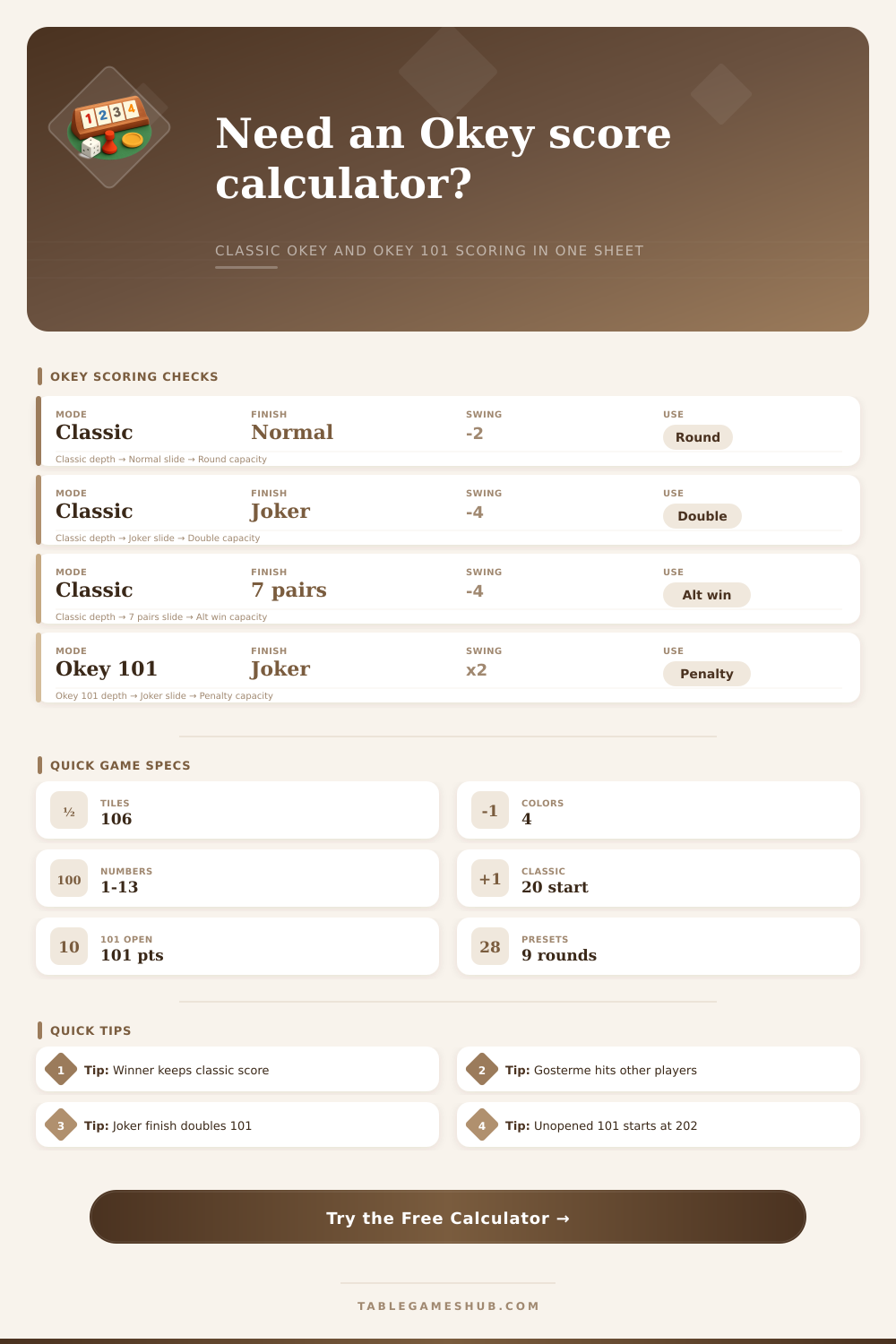
Ordinary wins subtract 2 from each non-winner. Joker finishes and seven-pair finishes subtract 4 before any house multiplier is applied.
Gosterme Adjustment
other players lose 1
If a player shows the matching indicator tile before that holder first draws, every other active player loses one additional classic point.
Okey 101 Penalty
round = hand value x factor + 101 penalties
Opened sets usually count raw hand value. Pairs, joker finishes, and pair finishes increase the multiplier; unopened hands use fixed penalties.
Ranking Rule
classic high wins, 101 low wins
Classic Okey stops when a score reaches zero or below. Okey 101 adds all deals and the lowest total is best.
5Component and Spec Grid
6Reference Tables
| Round Result | Winner Change | Other Active Players | Calculator Use |
|---|---|---|---|
| Ordinary winning hand | 0 | -2 each | Default classic Okey result. |
| Win by discarding joker | 0 | -4 each | Double-value classic finish. |
| Seven pairs winning hand | 0 | -4 each | Alternative win condition with double loss. |
| Gosterme shown before draw | 0 if holder | -1 to every other active player | Can combine with the round result. |
| No exposed winning hand | 0 | 0 | Use when the stock is exhausted without a win. |
| Finish Type | Winner Score | Opened Sets/Runs | Pairs or Unopened |
|---|---|---|---|
| Sets and runs, normal discard | -101 | Remaining tile value | Pairs x2, unopened 202 |
| Sets and runs, joker discard | -202 | Remaining value x2 | Pairs x4, unopened 404 |
| Pairs finish, normal discard | -202 | Remaining value x2 | Pairs x4, unopened 404 |
| Pairs finish, joker discard | -404 | Remaining value x4 | Pairs x8, unopened 404 |
| All tiles in one turn | -202 or -404 | Other players 404 or 808 | Joker discard uses 808 |
| Component | Count | Scoring Role | Input Connection |
|---|---|---|---|
| Colored numbered tiles | 104 | Face value in Okey 101 remaining hands | Enter remaining tile values by player. |
| False jokers | 2 | Represent the actual joker tile only | Shown in the joker tile result card. |
| Actual jokers | 2 | Wild in melds; can double finish scoring | Choose joker finish when discarded last. |
| Indicator tile | 1 face up | Same color, next number sets the actual joker | Use indicator value and color inputs. |
| Setup | Players | Starting Score | Practical Note |
|---|---|---|---|
| Classic casual | 4 | 20 each | Stop when one player reaches zero or below. |
| Classic partners | 4 | 20 per side | Use two player slots as team columns. |
| Okey 101 short set | 4 | 0 each | Lowest total after agreed deals wins. |
| Okey 101 long set | 4 | 0 each | Track penalties, unopened hands, and winner negatives separately. |
7Table Tips
Classic scoring: Keep gosterme as its own line so the show point is not confused with the winner's 2-point or 4-point finish.
Okey 101 scoring: Enter ordinary tile leftovers before multipliers. Add 101 penalties separately for take-backs, illegal discards, or jokers left in hand.
Sometimes there’s uncertainty at the end of an okey game, where no one recalls order of discards and everyone wonders how final scores could be so lopsided? Was it a joker finish, or did someone forget to record their initial count? That’s where the calculator app comes into play. It’s not necessarily cards that are the problem. It’s the accounting after the fact.
The tool up top do the math for simple twenty-point scoring scheme. It also handles slightly more complicated one-zero-one penalty scoring used in okey. People accept wrong math as truth before they even has a chance to complain.
How the Okey Calculator Helps You Score
Twenty points in classic okey. Lose as few as you can get away with. If you lose more than anyone else, you lose twice as much. You also suffer additional loss if you win with a seven pair or finish with a joker. All sounds very simple, except when somebody says “gosterme.” This means they are showing the indicating tile that matches tiles in your hand before you draw first tile. Any other player still playing will lose one point more.
The thing people mess up on is they’re focusing on the dramatics (the big swings) and they miss out on little leaks (like that single point deduction). In the heat of the moment during a double house finish, it’s all too easy to miss that one point loss that gets buried beneath excitement. With the calculator doing all those tricky calculations for you, there’s no need to be doing any mental maths at the same time as your mates who are already reaching for their snacks.
The other system: Okey one-zero-one. Where instead of starting from 20 and working downward, you accumulate penalties until end of the game. Lowest number wins! This means being consistent beats pure luck as a bad round (with lots of tiles left in your hand) will penalize you for nine more rounds. When somebody goes out, you must know what’s in everyone else’s hand. It’s raw value if they opened their set; otherwise it’s multiplied by the penalty factor. Hesitation is punished here: there’s a clear strategy on waiting to open up early vs taking the chance of having too many cards in your hand too late in the game. The reference table on page spells it out well, just how each set of unopened hands gets you a fixed penalty that raises your total more quickly then you realize.
“Unfortunately, on top of all this, there are also house rules, some of which feature a double house rule in which every player gets more if the winner plays with just one color (and vice versa),” he adds. “Others let people adjust at the table to account for past deals, stuff like that can be toggled too without having to restart whole game from zero.”
The way it works: You plug in color and number on the indicator tile, and it tells you what the true joker is, and thus how much any false jokers will be worth. It is a little thing, sure, but it is important when two player have exactly the same hand and one has a wildcard that may or may not count as a wildcard. You’ll want to enter scores directly after each round so you don’t wait till end. By then, it won’t matter who opened pairs versus sets. However, that can make big difference when calculating the penalty, which could change the winner or loser.
You should also keep an eye on your at risk seat indicator. In okey one-zero-one, whoever has highest accumulated score loses. However, in classic play, whoever is closest to zero loses. Knowing who’s in danger changes what you do with your discards and whether you try to help someone meld or sabotage their chances.
In the end, okey is not just a strategic game, but a game of memory too. You remember who has what, what may be left and what you yourself have thrown away. That way your ledger stays clean and actual gameplay gets the attention it deserves. Let tool take care of mathematics and read the table: no need to argue over the score. Enjoy the tension of last discard knowing the tool will handle math. You could of worried less about who owes whom points the next time you play. It’s one little change in routine with a huge difference in peace of mind at the table.