Snowdonia Score Calculator
Total a Snowdonia final score across contract cards, station and track ownership, rubble, trains, work-rate planning, surveyor position, stock-yard resources, and end-game adjustments.
Choose a likely board state, then edit the score sheet, route markers, contract slots, stock, and work-rate fields before calculating.
Track Ownership
Station Ownership
Rubble And Resources
Surveyor And Train
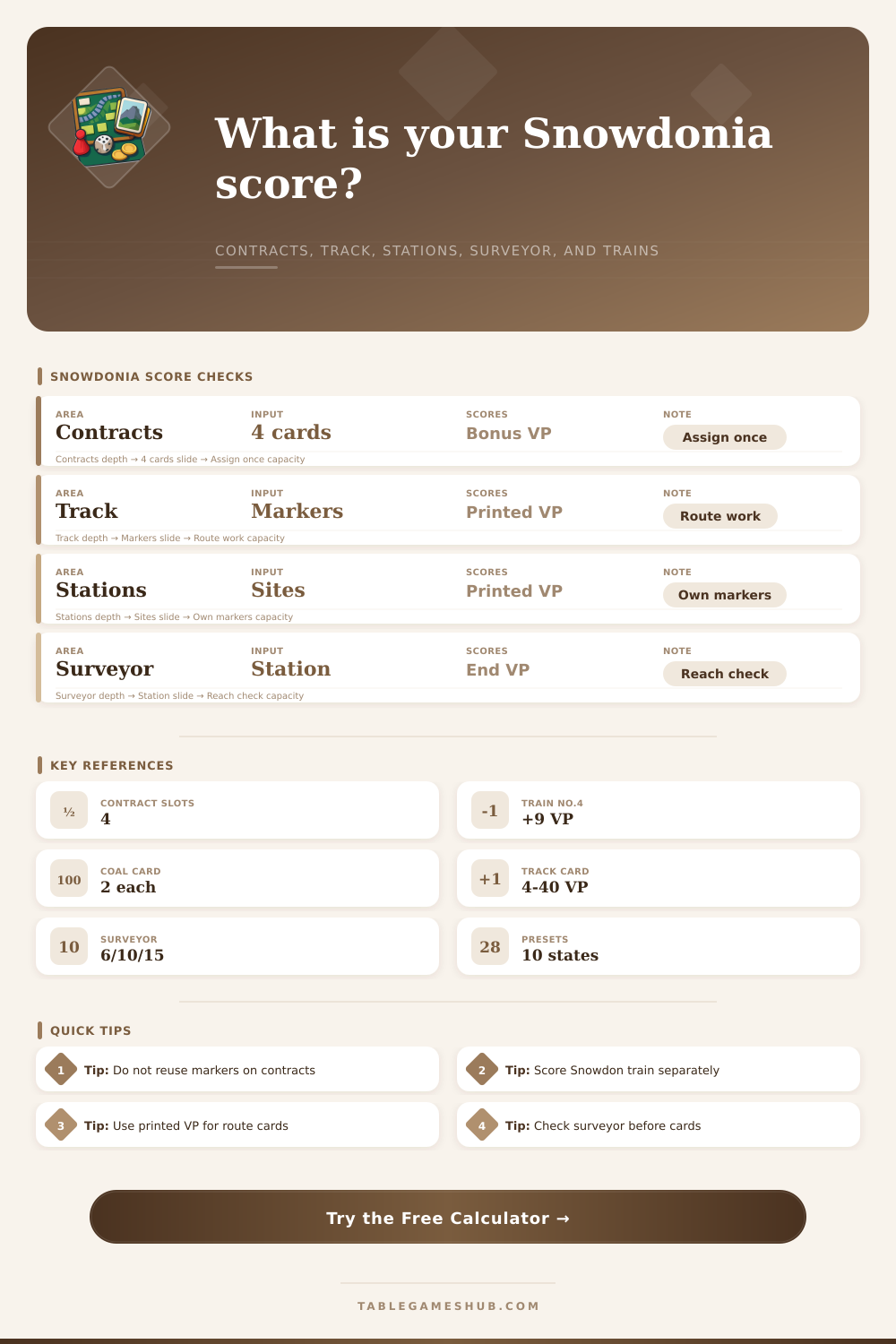
Pick up to four contract cards. The calculator searches every subset and scores the best legal set without reusing rubble, track markers, station markers, or surveyor thresholds.
| Contract family | Typical condition | Score handling | Calculator field |
|---|---|---|---|
| Rubble contracts | 7, 8, or 12 rubble | Score printed reward if enough unused rubble is available. | Rubble req. and reward VP |
| Track contracts | 1 to 5 track markers | Score printed reward if enough unused track markers are available. | Track req. and reward VP |
| Station contracts | Station markers plus surveyor reach | Score only when both ownership and surveyor requirements are met. | Station req. and surveyor req. |
| Coal and surveyor cards | Coal stock or station 5, 6, 7 | Coal card scales by coal; surveyor band updates from position. | Coal card or surveyor band |
| Board area | What to count | Scoring moment | Common miss |
|---|---|---|---|
| Laid track | Your ownership markers and printed card VP | When entered on sheet or at final audit | Double-counting track already included on the score track |
| Station sites | Excavation and build spaces where you placed markers | Printed site VP | Forgetting low-value station excavation markers |
| Surveyor | Station reached on the route | End-game scoring and contract checks | Leaving surveyor VP at zero after reaching a station |
| Train No.4 | Owned Snowdon train | End-game bonus | Missing the separate 9 VP train line |
| Item | Input | Calculator use | End-game note |
|---|---|---|---|
| Excavation work rate | Weather-adjusted marker plus bonuses | Projects rubble clearance capacity | Fog can block affected excavation spaces |
| Lay track work rate | Weather-adjusted marker plus bonuses | Compares against steel and unlaid track | You usually lay as much as possible |
| Stock yard cubes | Useful iron, stone, or coal still visible | Readiness percentage and bottleneck note | Coal limit matters unless a card changes it |
| Steel bars | Bars in personal stock | Caps likely track-laying output | Steel shortage can stop a final track push |
Contract audit: Contract requirements are not just checkboxes. Set aside rubble, track markers, and station markers for each scored card so the same item is not counted twice.
Station audit: Total printed station VP separately from station-marker contract requirements. A station marker can score its printed site value and still be assigned to one eligible contract only if your group treats the contract condition as using that marker for the card.
Work-rate audit: For a pre-final projection, enter the current excavation and lay-track rates after weather, then add train and contract bonuses in the bonus fields.
Stock audit: Leftover coal matters when the coal contract appears, while iron, stone, and steel usually matter through the last actions that create route or station points.
It’s not enough to guess strategicaly at what needs doing in the final few minutes of a Snowdonia session; those last few minutes deserve careful record-keeping. You’ve set up your surveyor, cleared out the route, picked up some contract cards you think will score well. Add them all together and you realise that you don’t have as many points than you thought. Usually this is because you’re counting track markers twice or you’ve forgotten that the rubble cubes are consumed rather than merely checked.
That’s where players lose ground: between perceiving what they have on the board and toting up net results. Snowdonia’s resources aren’t the same for every scoring category. For example: a marker on your route card earn you points for owning it. The same marker might satisfy a condition on your contract card. But it won’t earn you bonus points for both purposes at the same time. Players frequently assume that if they have the marker, they’ll get points for anything associated with it. Nope! The rules is tighter than that. Each resource has a primary job, and it only goes so far towards fulfilling other jobs. Knowing where each resource’s priorities lie allow you to score correctly.
Why Correct Counting Matters in Snowdonia
That’s where the contract cards get complicated, they’re fighting over the same resources. You could have four cards in hand but can only attach each pile of rubble or marker on tracks to one contract. Use those eight rubble cubes for two different contracts? The math don’t work out instantly. Having a dedicated calculator that forces you to state exactly how many resources you have available and which cards can utilizes them is a help; you don’t want to assume that since you satisfy the requirements independently for two contracts that you’ll be paid for both. Check the number against what you actualy own, to make sure.
Scoring potential change based off where the Surveyor is. End game points and higher level contract thresholds are unlocked by moving the surveyor down a given route during play. Depending on which station they occupy, some high payoff card may never be attainable regardless of your number of track markers. That adds a time component to the game missing in pure resource counting. At some point, you must have advanced far enough to be in correct location for points when the last round concludes. The link between where you are physicaly on the board and your ability to earn points there is key, though not obvious.
Some trains give bonus points (like the Snowdon) when the game ends, and these go on top of all other points. So for example, if you have Train No.4 Snowdon, you get 9 points added to whatever else you’ve accumulated when the game ends. It’s not part of the normal economic loop of laying down track and digging up stuff, so it can easily be forgoten in early calculations. It’s also easy to overlook when doing the tally at the end of the game.
Likewise, contracts for coal accumulate as you build them up, which means hoarding resources directly translate into numerical benefits that aren’t realized until the end of the game. And the different inputs have been categorized well in the reference tables. Some things like station building and track ownership are simple additive values. Others, such as fulfilling contracts, is subtractive against your available resources. To handle that, the calculator lets you put in what you currently own and it checks which set of contracts will generate most while staying within your means. So no overly optimistic math here. It is just a realistic picture of where you stand.
Precision matters just as much as planning in Snowdonia. Have the best plan? That doesn’t matter if you don’t add up all of your points correctly at the end. Spending time checking each piece individually guarantees that no card, cube or other marker get counted twice. It transforms an otherwise frantic last round into a clear statement of victory. Often it’s only those stray points lying quietly on the table that would of made the difference between victory and defeat.