Endless Winter Score Calculator
Total your score track, Eclipse gains, tribe and culture card points, Offering track, Honor buried-card chart, animal sets, megalith scoring, villages, and end-game adjustments.
⛄Score Presets
🏔Score Track, Eclipse, Megaliths, Villages
Used for Honor chart wording and table-state notes.
Enter your score marker before adding the audit fields below.
Each covered own-color megalith scores 2 VP for you when you place above it.
Each covered other/neutral megalith scores 1 VP for you.
Villages do not directly score final VP, but they drive Eclipse map control.
Audit field only; include the resulting VP in the round 4 Eclipse box.
🗿Idols, Offering, Honor, Buried Cards
Use only for extra Idols spent after reaching the top Offering space.
In a 2-player game, use highest for first and second for the other player.
Honor chart caps at 7 in this calculator; excess are still counted for printed card VP.
🧩Tribe, Culture, and Other Printed Points
Count hand, deck, discard pile, and buried tribe cards.
Culture cards in every zone still count their printed end VP.
Use for tile/module points not already included in Eclipse VP.
Use for table-state corrections, promos, or edition differences.
🐾Animal Sets
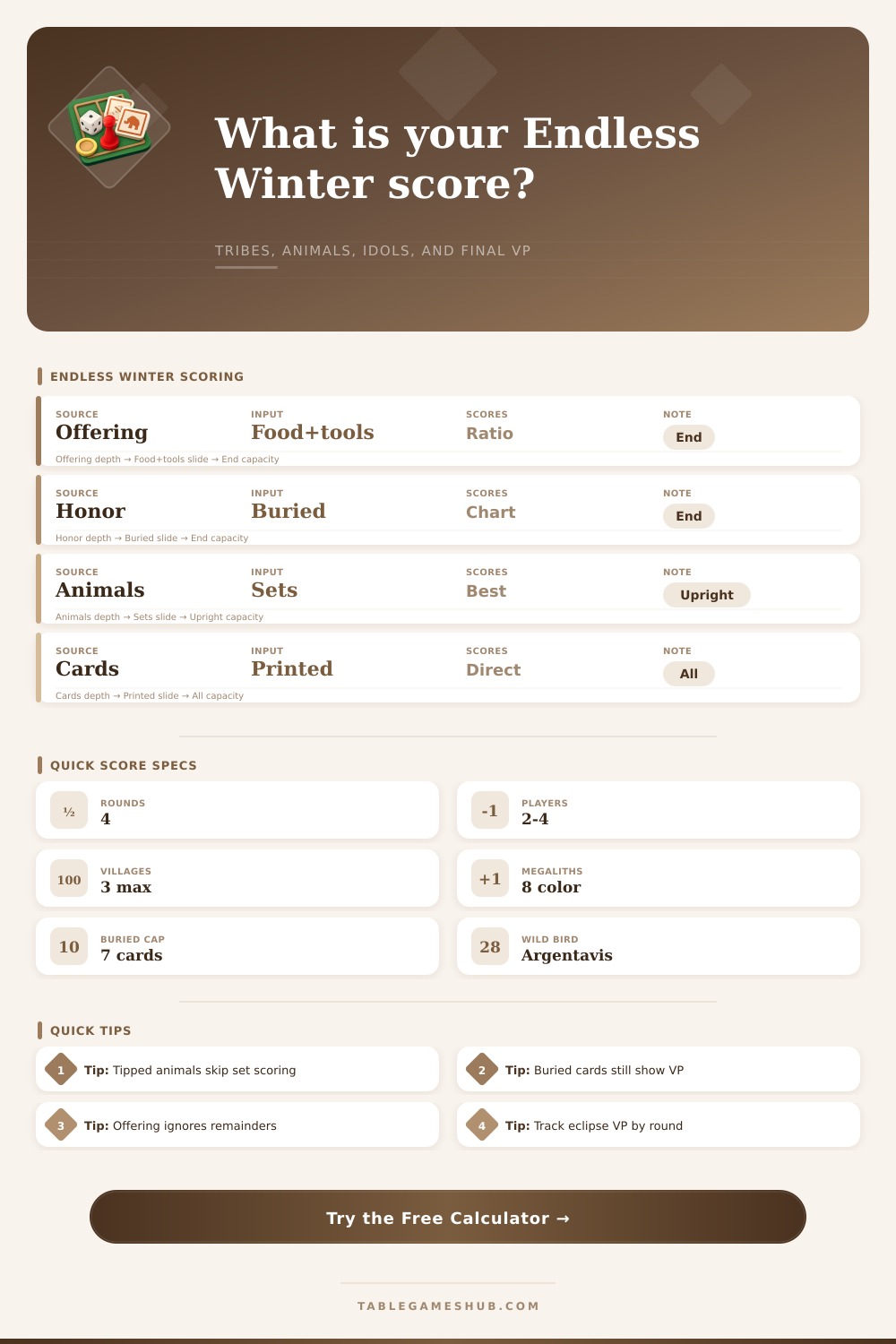
Enter upright animals only for set scoring. Tipped animals are tracked separately because they do not score animal sets, though some tiles or modules may care about them.
📊Component Scoring Grid
Your upper stones score 2 VP over your color and 1 VP over other or neutral stones.
Add leftover food and tools, divide by the reached ratio, and ignore the remainder.
The buried-card chart is capped here at seven cards; printed VP is entered separately.
Wild cards are allocated to the best non-Argentavis animal set automatically.
📜Reference Tables
Final Score Buckets
| Bucket | What to Count | Calculator Field | Timing |
|---|---|---|---|
| Score track | Immediate points plus entered Eclipse rounds | Base score, Eclipse VP, megalith cover VP | During game |
| Offering track | Food plus tools divided by reached ratio | Offering, food, tools | End scoring |
| Honor track | Buried cards by relative idol position | Honor rank and buried count | End scoring |
| Tribe and culture cards | Printed VP from all zones, including buried cards | Tribe VP and culture VP | End scoring |
| Animals | Upright animal sets with Argentavis as wild | Animal set fields | End scoring |
Animal Set Defaults
| Animal Type | Max Set Size | Default VP Curve | Calculator Logic |
|---|---|---|---|
| Woolly Mammoth | 2 cards | 0 / 2 / 5 | Caps at two upright mammoths |
| Woolly Rhino | 4 cards | 0 / 1 / 3 / 6 / 10 | Can receive Argentavis wilds |
| Giant or Ground Sloth | 4 cards | 0 / 1 / 3 / 6 / 10 | Can receive Argentavis wilds |
| Other four-card set | 4 cards | 0 / 1 / 3 / 6 / 10 | Use for another printed animal set |
Eclipse and Board Audit
| System | How It Scores | Common Mistake | Input Tip |
|---|---|---|---|
| Villages | Provide influence and player-board Eclipse benefits | Adding direct final VP for villages | Put resulting VP in Eclipse rounds |
| Terrain control | Resolved during each Eclipse phase | Forgetting tied highest influence still gains benefits | Log each round separately |
| Sacred stones | May score during Eclipse or from module/table effects | Double-counting tile VP | Use manual field only if not already scored |
| Buried cards | Score Honor chart and still count printed VP | Removing their printed card points | Include buried printed VP in card totals |
🧭Scoring Tips
There is a specific kind of panic that sets in during Endless Winter‘s final phase, the Eclipse, as it has a lot of math to get right to earn points. There are four rounds where you’ll be managing resources, burying cards, and placing megaliths. Then, trying to figure out who won just feels like auditing yourself. That’s where the calculator come in. It does all that math for you, bringing all different pieces together into one value. You no longer have to debate if one more food token made a difference in your Offering, or wonder how your Honor rank compares to your opponent burial placement.
Scoring is broken down into two parts of game: what you get right now, and what gets added to that at the end. Most people spend far too much time optimizing immediate score and not enough time thinking about end-game math. To account for that, the tool separates out your starting score and then adjusts it at the end. For example, you would record where you are on the score track as well as any Eclipse VP gained in rounds 1-4. That can come from having the benefit of a village, or points from controlling hexes on the map. Those will change each turn so an early lead may evaporate if you don’t pay attention to map control later.
How to Use the Calculator Tool
Finally, there is the static scoring (only at the end). This includes the Offering and Honor tracks. The Offering track takes the rest of your tools/food and turns them into points based on a ratio determined by how far your marker advanced. So if you had your marker on “E” and went all the way to top, you get higher point values for conversions. However, this means you probably used up some valuable resources in doing so. For every 1 leftover, the calculator will divides it by this factor and round down any fractions. That’s fair and follows the rules. It doesn’t allow people to take advantage of fractional leftover points they don’t actualy have.
The Honor track, on the other hand, just gives you points back for taking risks. You immediately lose some value by burying these cards but it pays off later with glory. Depending on where you rank compared to other players, it give you more or fewer points as you move up the chart. If you are leading, then even a moderate amount of buried cards is going to pay off big time. If you’re in last place, then these same cards may well net you nothing at all.
Another tricky spot is animal scoring. Any animals standing up are counted towards the set. If it’s an Argentavis set then it also scores as a wild card on every other set but itself. The rest of the animals (rhino, mammoth, sloth etc) go in. Then the system assign birds randomly to make sure you get the maximum possible points from them. It takes into account the best case scenario for you, which I suppose is reasonable because that’s what you’d want at a real life game table. Animals tipped over are kept track of, since normally they won’t be scored for the bonus of a set except where the set module specifies otherwise. This matters because players tend to forget to stand up their animal before the count ends.
The Card VP is simple enough to do by hand, but it’s pretty boring. It simply totals the number of points on every single card (tribe/culture) whether they’re out on the board or not. If they’re in your hand, discard, under a snowdrift somewhere … just add ’em up. Then enter that as answer instead of having to list all those cards separately. That cuts way down on time. And it accounts for any megalith covering. Anytime you cover one stone on top of another, you get points right then, more for covering your own color. Those are permanent points. They should of gone into your starting point count, or you can add them to your base with the audit fields if you forgot about them when playing.
The presets they do give are useful in that regard as well, providing instant situations against which you can experiment with various tactics. I can see what kind of game results from a culture-card engine run or a megalith heavy game. This shows me how many points is gained (or lost) toward the endgame. That lets you understand the tradeoff between short-term gains versus end-game potential. Do I really regret giving up control of the Eclipse to have a better spot in Honor? The interface is laid out in such a way that you can tweak each variable separately and see how it affects the overall situation.
Endless Winter is a game about ambition versus scarcity. Don’t horde everything. Decide what to leave behind, what to spend, what to bury. Those decisions gets their moment in the sun during the scoring phase. That’s where we remove the friction of doing any math by hand. This lets you concentrate on dissecting why you did well or didn’t do so well instead. The numbers have a story to tell about your decisions. Half the battle is reading that story correctly. Get the math correct, and you’ll be able to hear what it says.