Wingspan Asia Score Calculator
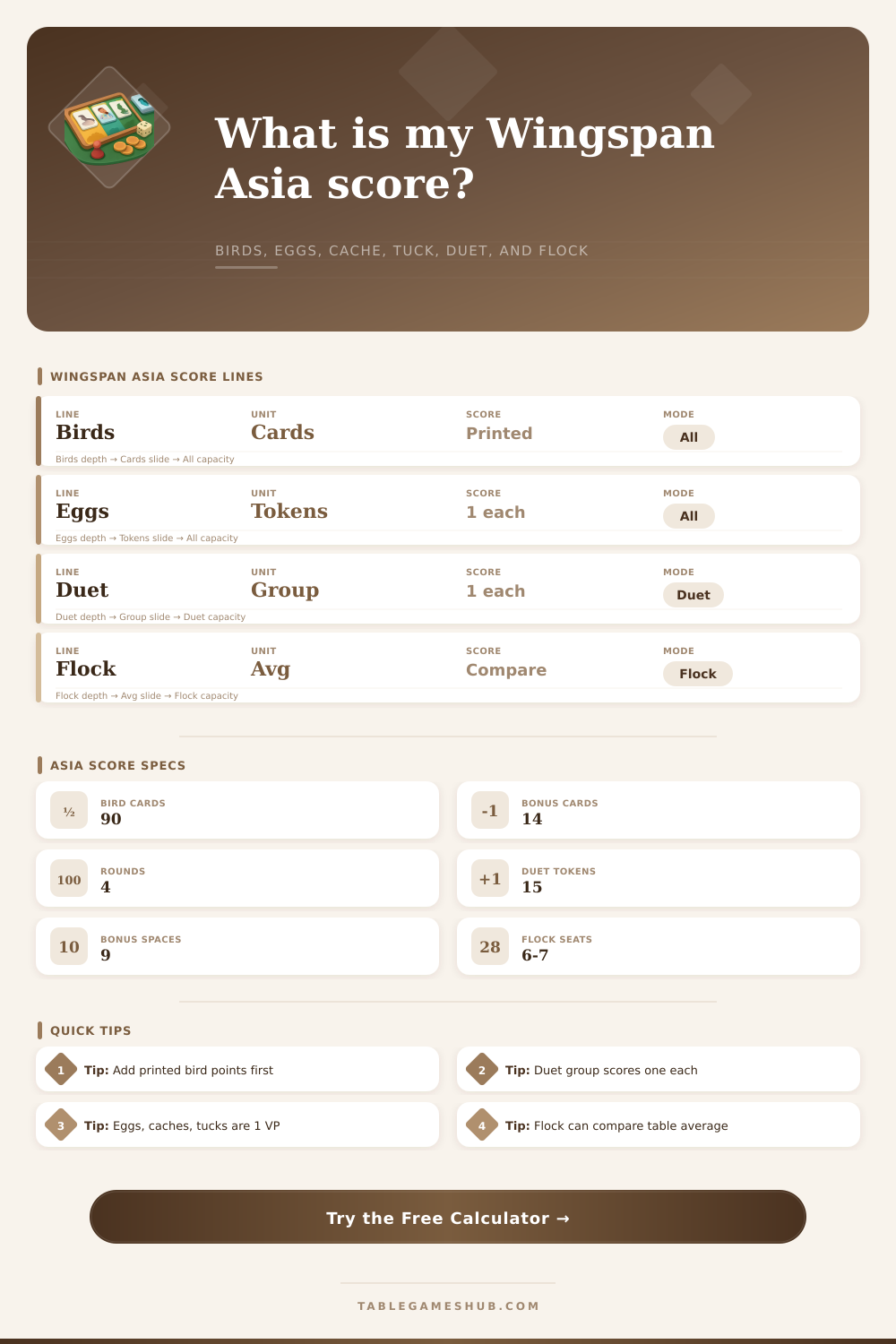
Total your preserve across bird cards, bonus cards, end-round goals, eggs, cached food, tucked cards, Duet map scoring, and Flock mode comparison.
Final Score Summary
| Score Line | What to Count | VP Math | Calculator Field |
|---|---|---|---|
| Bird cards | Face-up birds on your player mat | Printed values on the cards | Bird card printed VP |
| Bonus cards | All completed bonus card text | Printed bonus card scoring | Bonus card points |
| End-round goals | Four goal rounds from the goal board | Points shown on the board or tile | End-round goal points |
| Eggs, cached food, tucked cards | Physical tokens and cards on bird cards | 1 VP per egg, cache, or tuck | Eggs, Cached food, Tucked cards |
| Duet map group | Largest connected group of your Duet tokens | 1 VP per connected token | Largest connected Duet group |
| Duet Map Element | How It Is Used | Score Impact | Calculator Check |
|---|---|---|---|
| Habitat regions | Token region follows the habitat where the bird was played | Feeds goals and connected group shape | Mode note in breakdown |
| Nest spaces | Bird must match the nest symbol; star nests are flexible | Goal progress and map placement | Bonus-space efficiency |
| Food spaces | Token can match food spent to play the bird | Goal progress and map placement | Duet token count |
| Wingspan spaces | Map spaces split around 50 cm or about 20 in | Goal coverage, not automatic VP | Large wingspan tokens |
| Reset space | Tokens placed there can later reset tray or feeder | No connected group point while off-map | Reset-space tokens |
| Flock Mode Situation | Player Count | What Changes | Calculator Output |
|---|---|---|---|
| Six-player Flock | 3 and 3 groups | Fixed groups use simultaneous action structure | Table average across six scores |
| Seven-player Flock | 3 and 4 groups | One group has four players on the shared flow | Table average across seven scores |
| Solo team comparison | 1 player plus Automa target | Compare score or group average to Automarazzi | Ahead or behind target result |
| Standard multiplayer | 2 to 5 players | Score each player separately | Personal final VP only |
| Asia Focus | Useful Score Line | What to Watch | Best Input Pair |
|---|---|---|---|
| Brown Shrike | Cached food | Cache totals can quietly swing close games | Bird VP + Cached food |
| Large-billed Crow | Cache and tuck | Combined engine points are easy to undercount | Cached food + Tucked cards |
| Sarus Crane | Eggs | Egg limit still matters when laying late eggs | Eggs + End-round goals |
| Black Drongo | Tucked cards | Tuck engines score one per card tucked | Tucked cards + Bonus cards |
| Red-crowned Crane | Printed bird VP | High printed values reduce engine pressure | Bird VP + Bonus cards |
When you finally score your game of Wingspan, it’s often quiet. It is not out of satisfaction but anxiety. Because everybody knows that this is there last chance to repeat everything. The beauty of these birds take a back seat to the drudgery of adding up victory points. You have eggs on cards, food in caches, and bonuses stashed away that you may not even recall having. If you want to remember what happened when you won or lost, you’re going to need a serious scoring system.
There are only a couple simple pillars to the base game. Most of your points comes from your bird cards themselves which have printed point values. Additional bonus cards presents additional goals for players to complete that give points based off certain actions (collecting food, laying eggs). Once you add it all up, the score is calculated by the previous calculator. It does the math for you, avoiding the conversion and coefficient calculations that befuddle many manual counters.
How to Count Points in Wingspan
But Wingspan Asia adds some wrinkles, forcing you to rethink that last tally. The introduction of Duet Mode mechanics are the biggest change in the Asian expansion. Even in regular scenarios where you’re keeping track of map efficiency, those mechanics shows up. It’s about telling a story through geography and your points will be calculated based on what the birds say on the board. To reflect this, the calculator lets you input how many of your tokens is in the largest connected cluster. Victory points comes from connectivity, not isolation. Therefore, the map becomes a dynamic scoring system rather than just a static tracker. Early in the game, you have to consider adjacency. Then at the end, you don’t have to frantically count out your token.
Finally there’s the whole engines built around certain Asian birds thing. Birds like the Brown Shrike promote very aggressive caching behavior. It’s fun to follow along with during play but it’s hard to count accurately at score time. It is also an easy point to drop if you miss a food token or two. With this tool you can enter each engine’s own counts separately so that your overall score reflect the proper amount of total effect those little actions have had. It’s really powerful stuff as far as engine building goes. One doesn’t get merely one point for one point but rather uses cards tucked away, eggs in nest, and all those other caches.
And then there’s flock mode. Playing with six or seven people make things even more complex. Suddenly, it’s no longer about optimizing for yourself but about strategy as a group. How do you stack up against the table? How far above average are you? That’s valuable knowledge in a game that’s half competition and half cooperation. Is your score dragging down the average or bringing them up? That determines what you should of being drafting. It drives you toward being efficient instead of just doing whatever is best for yourself.
Tucked cards don’t immediately help you because they’re hidden under your birds. However, they adds to your total score. Every point is a point in a close game. Here’s what tucked cards look like compared to other scoring lines (see the table on this page). This is little and yet (it matters). Putting all of these parts together visually lets you know whether or not you’ve narrowed your strategy too much. Or that there are easy-to-get points youre leaving on the table elsewhere.
But using a structured approach to scoring remove the emotion from the final count. No one can argue that they counted their eggs right while looking at the exact same data. That’s why clarity matters. Players can spend less time arguing and more time planning their next move. The calculator doesn’t play the game for you, but it guarantees that your efforts are being measured fairly. It is not about doing better math; you want to win because you played better then.
In the end, though, what Wingspan is is the fun of creating a thriving habitat. Those numbers are merely how you track that achievement. Understanding how to get those numbers right lets you appreciate the strategy behind them. Knowing your actual score helps you hone in on your strategy next time, whether that’s improving the connectivity between maps or maximizing your bird engine. It clarifies an otherwise confusing endgame. You can look at those birds, count those tokens, and fully understand why the game unfolded as it did. And that understanding makes each subsequent round all the more thrilling than the previous one.