Dale of Merchants Calculator
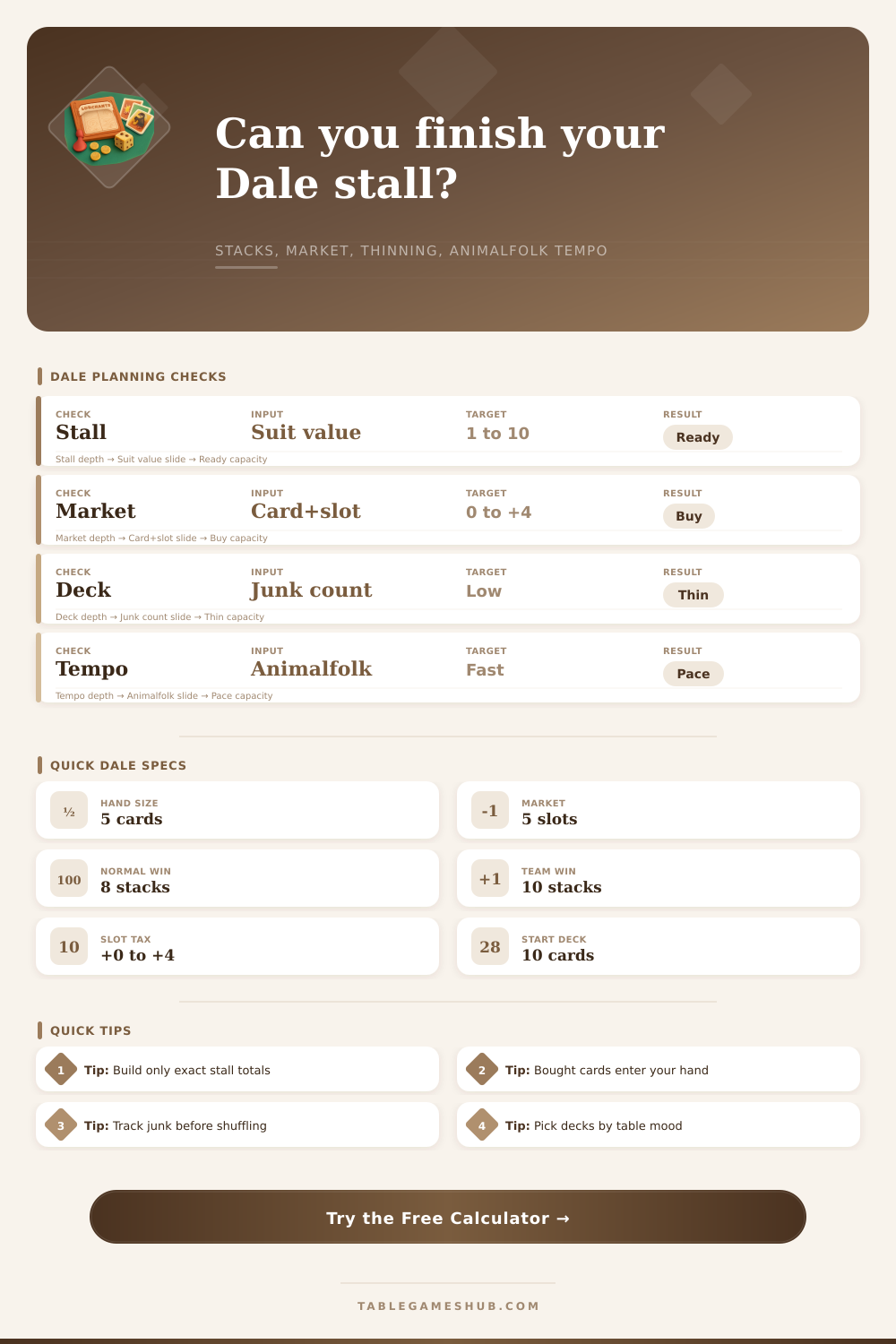
Plan your next stall stack, market purchase, deck-thinning pressure, and animalfolk tempo in one tidy merchant ledger.
| Next Stack | Exact Total Needed | Typical Card Mix | Planning Note |
|---|---|---|---|
| 1 to 2 | 1, then 2 | Single low cards | Early stacks thin weak cards but remove flexible suit icons. |
| 3 to 4 | 3, then 4 | Single 3 or 4, or small pairs | Balance building now against keeping a market payment card. |
| 5 to 6 | 5, then 6 | One 5, or 2+3, 1+4 | Midgame stall choices often decide deck speed. |
| 7 to 8 | 7, then 8 | 2+5, 3+4, or full support | Late stacks need exact math and matching animalfolk access. |
| 9 to 10 | Team only | Shared contribution | Active player contributes at least one card in team play. |
| Market Position | Added Cost | Purchase Check | Deck Effect |
|---|---|---|---|
| Rightmost | +0 | Printed value only | Best for keeping enough value to build soon. |
| Second | +1 | Small overpay risk | Good when the bought card completes a stall suit. |
| Middle | +2 | Needs strong hand | Worth it for high tempo animalfolk effects. |
| Fourth | +3 | Usually a full-hand buy | Can delay stall building by one cleanup. |
| Leftmost | +4 | Premium buy | Only efficient when it replaces several weak cards. |
| Animalfolk Deck | Core Calculator Bias | Market Lean | Stall Lean |
|---|---|---|---|
| Snappy Scarlet Macaws | Hand control and turn smoothing | Medium | High when exact values line up |
| Dealing Giant Pandas | Market access and card flow | High | Medium |
| Hoarding Flying Squirrels | Holding key cards between turns | Medium | High for planned future stacks |
| Lucky Ocelots | Random swing potential | Variable | Variable, with higher risk buffer |
| Thieving Northern Raccoons | Opponent disruption pressure | Medium | Medium, table-dependent |
| Archiving Desert Monitors | Discard and deck searching | Medium | High after shuffle planning |
| Wealthy Tuataras | Gold-supported buying power | High | Medium, after market conversion |
| Connected Emperor Penguins | Shared or linked tempo | Medium | High in coordinated turns |
| Swindling Black-Headed Gulls | Junk handling and deck cleanup | Medium | High after junk is reduced |
| Plan Type | Best When | Watch For | Calculator Signal |
|---|---|---|---|
| Build now | Stack readiness reaches 100% | Losing a key effect card | Ready plus low future gap |
| Buy now | Market margin is nonnegative | Using cards needed for exact stall value | Margin 0 or better |
| Thin now | Junk pressure is high | Running out before cleanup | Deck quality below 60 |
| Hold cards | Future stack is nearly assembled | Attack or trap disruption | High stall percent, sharp table |
Dale of Merchants calculator assist you when the animalfolk deck becomes small and the market slot contain expensive cards. When the animalfolk deck becomes small and the market slots contain expensive cards, the decisions that a player must make in the game of Dale of Merchants can become difficulty for that player. Beyond making decisions about whether to buy cards during a game, player must also make decisions about how much junk to allow to remain in there deck.
The calculator allow players to compare their current hand to the remaining race in their deck. The calculator features several inputs that correspond to the decisions that a player makes during their turn. For instance, a player can compare the value and support value to determine if the player can complete the next stack of cards for themself, or if the player can determine how many of those cards the player can produce during their current turn.
Dale of Merchants Deck and Market Calculator
The player can compare the value of the players remaining cards and the value of the market slot to determine whether the player can afford to purchase a card during their turn. Additionally, the junk count and deck size can be compared to understand the quality of the remaining cards in the players deck. Finally, the animalfolk selector allow for adjustments to these values according to the type of each players deck.
More specific adjustments can be made according to the risk that the player and others is taking during the game. The risk setting can be adjusted according to the other players in the game. For instance, if other players are taking risk with their hands, it is likely that the risk setting will need to be adjusted to reflect the reduction of the tempo that the current player will have during the game.
However, if the other players in the game are racing with large decks of cards, the player can increase the tempo for the player in the risk setting according to this scenario. Within the game of Dale of Merchants, there is several outputs that provide information to the players. For example, the value of the deck quality can help players understand the quality of the remaining cards in their deck.
High scores for deck quality indicate to the player that the remaining cards in that deck are likely to produce the values that are required of each player prior to the next shuffle of the deck. Additionally, if the score for deck quality decrease for a player, the player should of take action to thin their deck prior to the next shuffle. Another output for players to review is the stall readiness of a player.
For instance, stall readiness does not simply add the values of the players cards, but compares the total value of the players cards to the target value. Additionally, stall readiness account for whether or not the players animalfolk cards are legal to play. For example, if the stall readiness percentage is in the seventies, the player will likely need only one market purchase to reach there target value.
However, if the percentage is below fifty, the player should instead draw or purchase cards rather than attempting to complete the required math with their current hand. The same logic apply to the market margin for a player. For instance, if a market margin is positive, a player will be able to purchase a market slot without sacrificing their ability to build a stack of cards during their next turn.
However, if the market margin value is negative, the player will be short of there required number of cards to build a stack. These small comparisons between the parameters of Dale of Merchants can help a player to understand their options during the game, and to make more fewer hesitations about their moves and purchases. Though the calculator cannot see the hidden information for players, or accurately predict the moves of other players in the game, the calculator does remove the mathematics for players that must think about such a calculation during their turns.
As a result, when the calculations are complete in a players mind, their decisions will be simpler and the math will no longer get in the way of their decisions.