Hardback Score Calculator
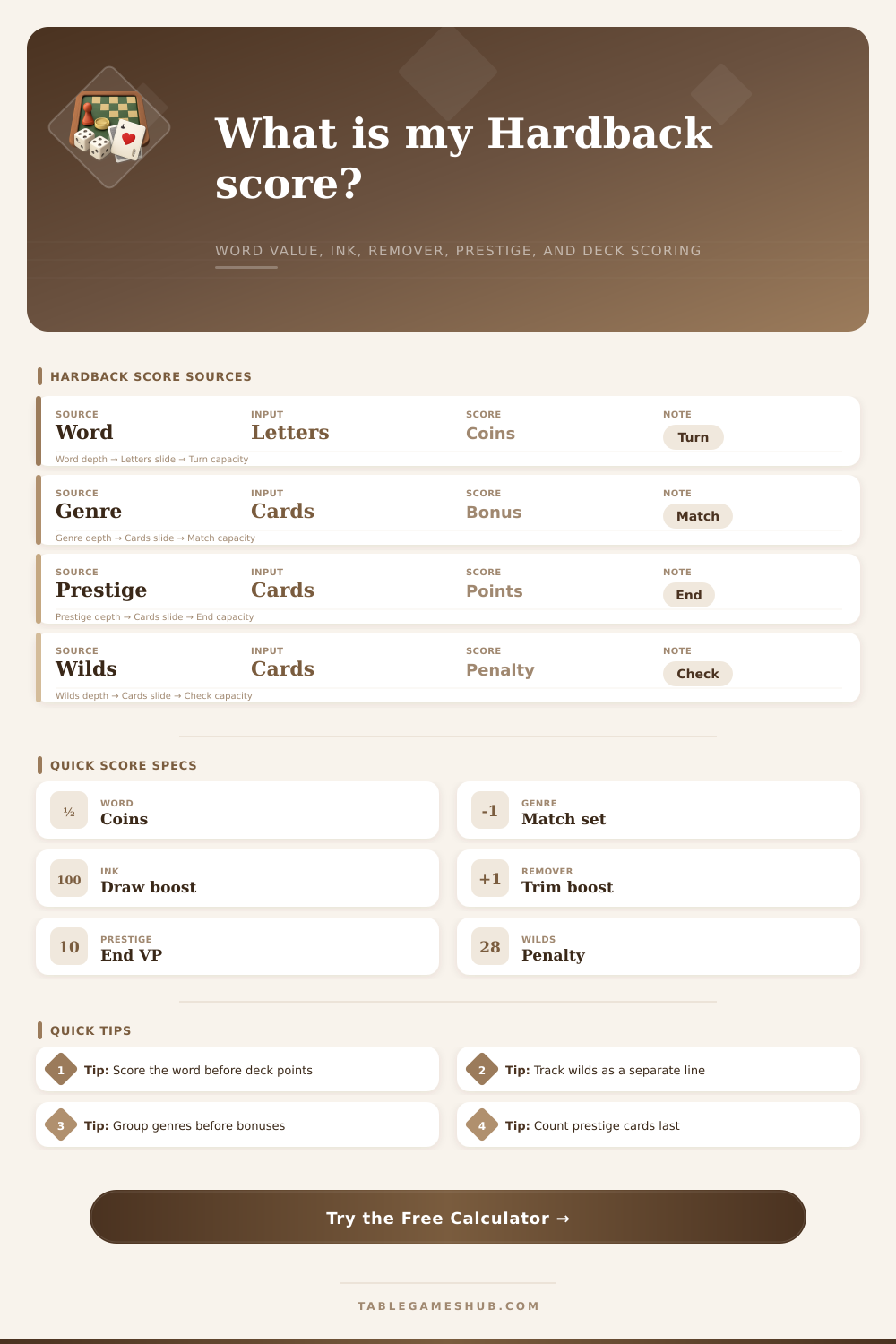
Score a Hardback word turn, genre engine, ink and remover tempo, prestige cards, wild pressure, deck points, and combo value in one pass.
| Hardback Source | Calculator Input | Formula Treatment | Best Use |
|---|---|---|---|
| Current word value | Word letter value and word length | Base value plus length bonus | Turn score before resource and genre lines |
| Genre cards | Genre cards and matching genre cards | Matching cards use focus rate; deck sets add cluster value | Compare focused deck plans with broad genre decks |
| Ink | Ink available or spent this turn | Resource tempo added at profile-specific rate | Estimate the value of improved card access |
| Remover | Remover available or spent this turn | Trim pressure added at profile-specific rate | Value deck cleanup and hand quality |
| Wild cards | Wild cards used and pressure setting | Subtracts light or strict pressure from word and deck lines | Keep flexible letters visible in the score |
| Prestige cards | Prestige cards owned | Profile rate times prestige count | Endgame book-stack and high-value card scoring |
| Focus | Word Bonus Rate | Resource Lean | Deck Scoring Signal |
|---|---|---|---|
| Balanced genre mix | 2 per matching genre card | Even ink and remover | Broad sets, low wild pressure |
| Adventure pressure | 3 per matching genre card | Word length and combo cards | Rewards long words with set clusters |
| Horror ink engine | 2 per matching genre card | Ink tempo | High access, steady card cycling |
| Mystery remover trim | 2 per matching genre card | Remover tempo | Compact deck with fewer weak draws |
| Romance combo chain | 3 per matching genre card | Triggered combo cards | Strong burst turns from linked text |
| Prestige book stack | 1 per matching genre card | Endgame points | Printed points and prestige cards matter most |
| Table State | Ink Line | Remover Line | Wild Reading |
|---|---|---|---|
| Early starter deck | 0 to 1 ink is a small boost | 0 to 1 remover improves cleanup | One wild is usually light pressure |
| Focused genre deck | 2 to 3 ink finds matching cards | 1 to 2 remover trims weak letters | Two wilds should be tracked separately |
| Combo turn | Ink improves trigger density | Remover protects next shuffle | Wilds can inflate the word line |
| Endgame scoring | Ink matters if it reaches scoring cards | Remover matters if it improves final deck | Strict pressure exposes fragile words |
| Deck Shape | Typical Inputs | Calculator Watchpoint | Strong Result |
|---|---|---|---|
| Word-first deck | High word value, long word length | Do not double-count manual bonuses | Turn value beats printed point total |
| Genre set deck | Many genre cards, several matches | Synergy percent should rise above 55% | Genre bonus and deck clusters both score |
| Resource deck | Ink and remover above table average | Tempo value should support a real word | Resources lift score without hiding a weak base |
| Prestige deck | High prestige and printed points | Endgame line matters more than turn value | Deck score stays strong with modest word score |
| Wild-flex deck | Multiple wild cards in word | Pressure setting changes final reading | Wild score stays low or moderate |
Hardback scoring involve many differents variables. The more complex the game is, the more involved the hardback scoring will be. There are many different variables to consider when scoring back.
Such variables includes word value, genre matches, ink and remover tempo, prestige cards, and pressure level. A person must decide which variables is important and which variables can be ignored until the final round of the game. Many people will begin with the printed value of the cards that were played.
How Hardback Scoring Works
While the printed value of the cards accurately represent the value of the words that were played, the value of the cards doesnt include the length bonus for playing longer words or the genre bonus for playing within the specific focus of the genre. A player can use a calculator to enter the value of the played word, the length of the word that was played, and the number of genre that matched to calculate the score for the player. The calculator cannot account for the use of wild card during the play of the word, however.
Ink and remover will change the number of cards that a player will see and the number of cards that remains in a players hand. These variables will have an impact on the player’s hand for the future rounds of the game. For instance, players who play horror deck and use ink will use ink tokens for future words, but players who play mystery decks and use remover will use remover tokens to defend there deck against bad draws of cards.
The ink and remover calculator can be used to appropriately note the ink and remover that each player had to score for their final round. Using wild cards allows a player to play words that may not otherwise be complete using the letters that a player drafted. However, using wild cards will increase the pressure of a player’s deck.
The pressure levels that the calculator can show will indicate the cost of using wild cards during each round of a players turn. This allows a player to understand if the flexibility that comes with using wild cards is worth the more additional pressure that is placed on the player’s deck. Prestige cards and printed deck points are only important at the end of the game.
A small word may provide a small value for a player’s turn, but if that small word protects a large number of prestige cards, those prestige cards will provide a heavy score for the player at the end of the game. A large word using many wild cards can take away from the players ability to play those prestige cards. The calculator will show both the value of each turn that a player had and the projected total score that the player will get from there remaining deck.
The genre that is focused upon can change the mathematical value of each turn that the player scores. Adventure decks require long word. Romance decks use chained combo trigger.
A balanced deck will include elements of each genre. A focused deck will focus upon only one genre and not spread their efforts too thin. The focus selector will calculate the appropriate rate of point value according to the genre that is chosen for focus.
Each element within the word and turn calculator represent a different value. The word value represents the points that are earned for that round of play. The genre matching value represents the potential points that may be earned in the future.
The ink and remover elements represent the number of resources that can be devoted to future plays. The wild cards element represent the flexibility that a player has but comes with a price tag. The prestige and deck point values represent the total score that will be obtained during the game.
Once each of these values are understood, the number values will describe the state of a player’s deck.