Great Western Trail Score Calculator
Total every final scoring source from a Great Western Trail player board, including cattle, stations, buildings, hazards, teepees, objectives, coins, train position, and workers.
| Final score category | What to count | Calculator field | Formula used |
|---|---|---|---|
| Cattle deck | Printed VP on all owned cattle cards | Total cattle card VP in deck | Direct sum |
| Delivery cities | Highest city plus other marker spaces | Highest delivery city VP and additional delivery marker VP | City VP + marker VP |
| Objective cards | Completed objectives minus failed objective penalties | Completed objective card VP and unmet objective penalty VP | Objective VP - penalty |
| Final coins | Money after all income and payments are finished | Final money and game coins | Floor(coins / 5) |
| Board source | Typical VP range | When it scores | Common check |
|---|---|---|---|
| Station disks | 0 to 25+ | Only placed disks and station-master rewards | Do not count unplaced disks |
| Private buildings | 0 to 20+ | Printed VP on your built tiles | Include upgraded buildings |
| Hazards | 0 to 18+ | Collected hazard tiles in player area | Separate from cleared spaces |
| Teepees | 0 to 16+ | Collected teepee or encounter tiles | Use printed tile value |
| Worker path | Main score pressure | Score input affected | Calculator interpretation |
|---|---|---|---|
| Cowboys | Buy higher-value cattle | Total cattle card VP | Higher deck VP share |
| Craftsmen | Build stronger private buildings | Private building tile VP | Higher development VP share |
| Engineers | Advance train and take stations | Station disk VP and final train position | Higher rail VP share |
| Mixed hiring | Stabilize delivery and end scoring | All route and bonus fields | Balanced category profile |
| Version | Extra category to watch | Safe field | Scoring note |
|---|---|---|---|
| Classic / Second Edition | City deliveries and hazards | Delivery marker VP, hazard VP | Use printed board and tile VP |
| Rails to the North | Branchline and station rewards | Station disk VP, other printed VP | Add branch rewards exactly once |
| Argentina | Branchline and exchange rewards | Certificate or exchange bonus VP | Keep exchange VP separate from cattle VP |
| New Zealand | Sheep deck and port rewards | Cattle card VP, additional delivery marker VP | Use the same printed-card sum method |
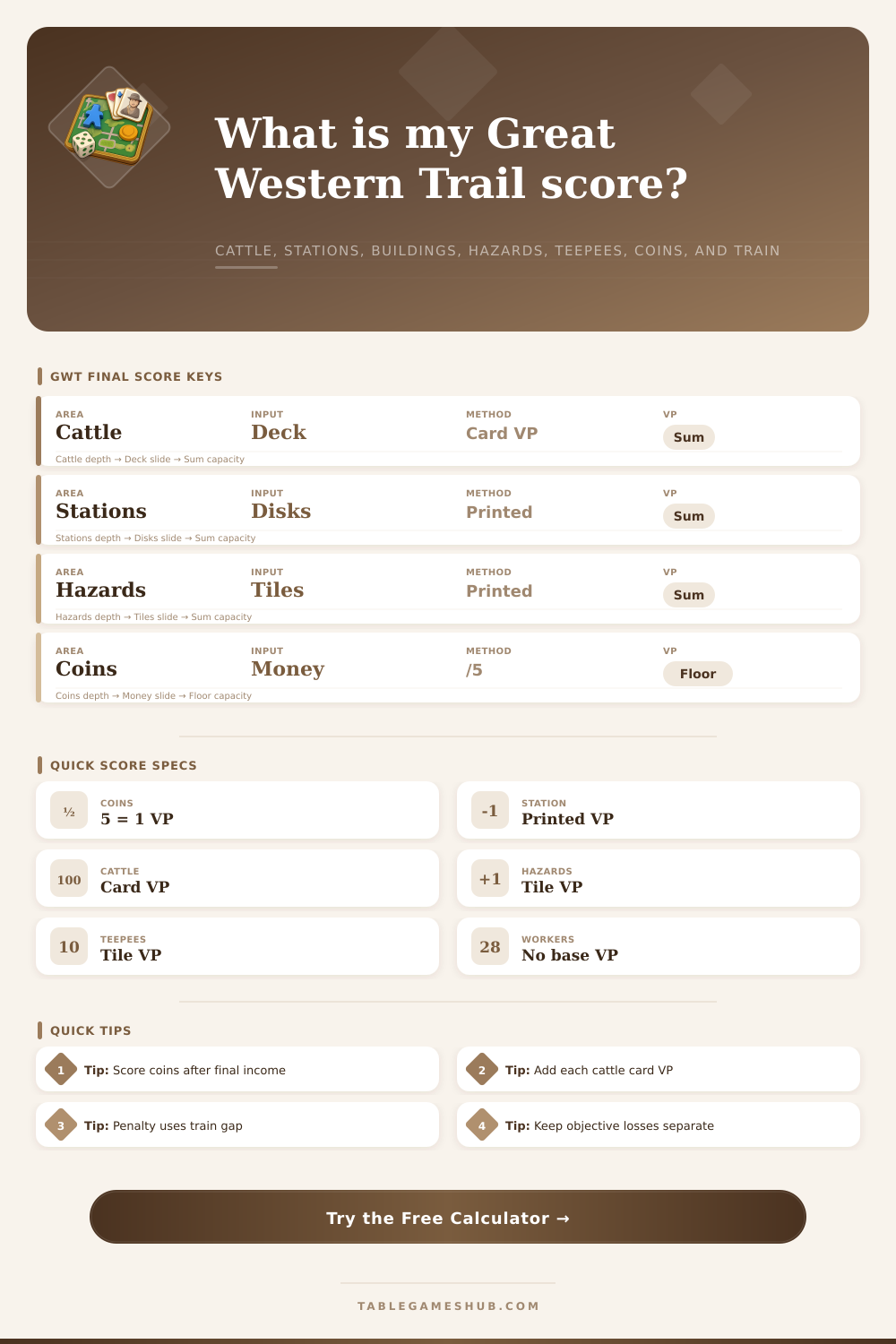
To calculate the final score in Great Western Trail, you must combine several different types of points into a single number. Adding the points from cattle cards, city markers, delivery disks, stations, private buildings, hazards, teepee tokens, objectives, coins, and the position of the train calculates the final score. To calculate this score, it is first important to identify each of these point value to ensure that the final score is calculated accuratly.
Cattle cards contributes to the final score of a player through the numbers that are printed on each of the cattle cards. The player adds the numbers from each of their cattle cards together to determine the total number of points from the cattle. Players earn city markers and delivery disks based on the number of deliveries that is completed during the game.
How to Calculate Your Final Score in Great Western Trail
These points are added to the score along with the points from the cattle because both cattle points and delivery points are a vital part of the game. The points earned from stations and private buildings are earned based on the type of building that the players construct. If a player builds an upgraded building, they will earn more points than if they build a standard building.
The same is true for stations; an upgraded station will earn the player more points than a standard station. Each disk that a player places represent a value that contributes to the total score of the player. Hazards and teepee tokens also contribute to the score of the player based on the values that are printed on these game components.
However, unlike other points that contribute to the score, the hazard and teepee tokens are earned through specific actions during the game that may cost a player some of they opportunities during that game. Objectives contribute to the final score of a player, but the points can either be added or subtract from the total score. If the player completes an objective, the value of the objective is added to the player’s score.
However, if the player does not earn their objective, the value is subtracted from their total score. Objectives are calculated after the final income for the game is calculated, but before the game is over. Coins also contribute to the final score, but at a specific rate.
The player divides the total number of coins they has by five to determine the total number of victory points that a player earns with their coins during that game. The position of the train can impact the final score that is earned by a player. If the train is short of the safe zone, the player will lose points from their total score.
However, if the train reaches a bonus marker during the game, the player will earn points for the game. Workers do not contribute to the player’s score directly. However, they are vital to earning the other points that is required to have a more competitive score during the game.
Besides each type of worker, other examples include cowboys, craftsmen, and engineers as these players earn the cattle, buildings, and move the train to earn the points for the game. The point system for players can change with the expansions that are added to the game. The Rails to the North expansion will provide branchline rewards for the players.
The Argentina expansion will provide exchange bonuses for the players. These points must be added to the total score of the player as separate categories from the score that is earned from the cattle. The New Zealand expansion will change the type of animals that is used for the game, but it will not change the number of points earned during the game.
Due to the complexity of the scoring system for players, it is common for many to make some mistakes when calculating their total score. For example, a player may calculate their coins before determining their final income for the game, or they may calculate their objectives before completing them. Using a calculator to calculate the player’s score can avoid these mistake.
A calculator will force the player to enter each of their score into a specific field. By using a calculator, the player cannot type in the same score more than once, and the player could of forgot to subtract the score of objectives that the player did not earn.