🏛 Through the Ages Score Calculator
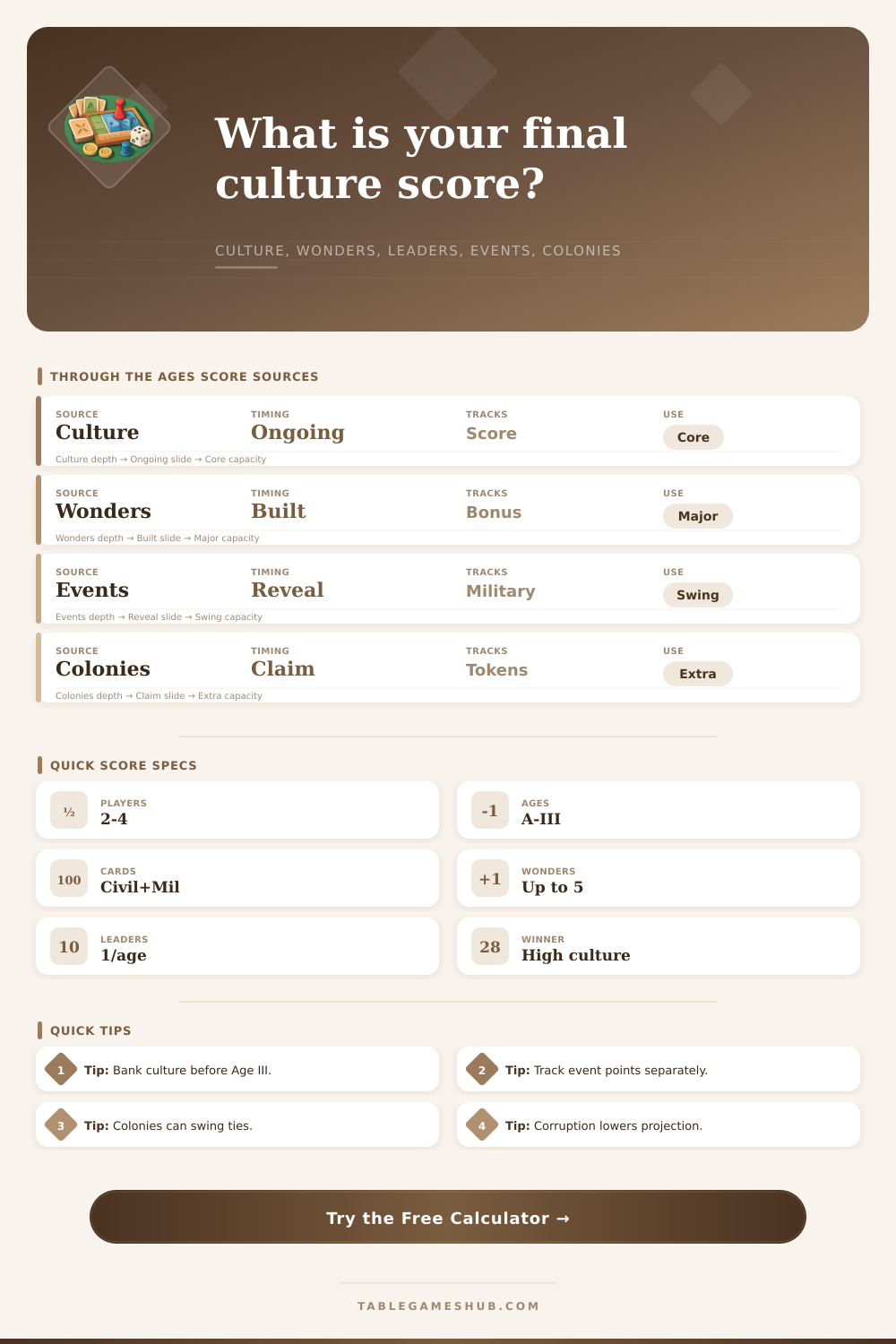
Project final culture from production, wonders, leaders, colonies, military events, endgame cards, corruption, production leftovers, and science tempo.
| Category | Formula | Result | Read |
|---|
| Scoring Source | When It Scores | Calculator Field | Important Note |
|---|---|---|---|
| Culture production | End of each turn | Culture production per turn | Projection multiplies by remaining turns. |
| Completed wonders | When completed or at game end | Completed wonder culture bonus | Use printed points plus final-card effects. |
| Leaders and civil cards | Immediate or endgame | Leader and civil card bonus | Useful for Michelangelo, Shakespeare, and similar engines. |
| Military events | When revealed | Known military and event culture | Can be negative when rival events punish weak strength. |
| Colonies and territories | On colonization or final scoring | Colonies and territory culture | Add culture from colonies and territory bonuses. |
| Endgame cards | Final scoring | Endgame card effect model | Formula uses base count times card-family multiplier. |
| Final Card Model | Multiplier Used | Best Input Base | Score Meaning |
|---|---|---|---|
| Culture buildings score | 3 culture each | Theaters, temples, libraries, labs, arenas | Rewards a broad urban culture engine. |
| Technology and science score | 2 culture each | Useful technologies and science reserve tier | Rewards developed tech rows and late research. |
| Strength and armies score | 2.5 culture each | Armies, tactics value, and military edge | Rewards military investment without counting wars twice. |
| Happy faces and population score | 2 culture each | Happy faces plus available workers | Rewards clean yellow-bank and happiness management. |
| Wonders and urban buildings score | 4 culture each | Completed wonders plus premium buildings | Rewards completed construction, not abandoned builds. |
| Government Pace | Action Factor | Endgame Profile | Calculator Effect |
|---|---|---|---|
| Despotism | 0.80 | Few civil actions, tight card row access | Reduces engine index for late pivot plans. |
| Monarchy or theocracy | 0.92 | Stable middle-age government | Moderate action support for scoring builds. |
| Republic or constitutional monarchy | 1.08 | Strong civil action rhythm | Raises engine index for final-card conversion. |
| Democracy | 1.18 | High actions, high culture potential | Best civic conversion when corruption is controlled. |
| Communism | 1.02 | Production-heavy finish | Helps wonder and army conversion more than raw culture. |
| Endgame Warning | Trigger | Score Impact | Adjustment |
|---|---|---|---|
| Corruption pressure | Blue bank cannot hold production | Subtracts from projection | Raise the corruption input for lost production. |
| Yellow-bank squeeze | Few workers and happiness shortage | Limits final scoring base | Use a lower population or happiness base. |
| Weak strength | Strength below table average | Events and wars may lower score | Enter negative event culture if punishment is likely. |
| Unfinished wonder | Wonder has remaining stages | No completed wonder points yet | Count only finishable wonder culture. |
Separate locked culture from projected culture.
Current culture is already safe. Future culture depends on turn count, attacks, corruption, and whether the final civil deck pace changes.
Count endgame cards by the card family.
Use the model selector for culture buildings, science, strength, population, or wonder scoring so the projection stays tied to visible board assets.
To succeed in the game Through the Ages, there are many different variable that you must keep in mind and track because these variables will determine your total score of culture that you recieve. You must track the culture that you already have banked on the culture track, the production that you earn each turn, the number of wonders that you have complete, as well as the military event that could impact your score. Additionally, since the game end after a few turns after Age III begins, you must correctly weight your final inputs of resources in order to win the game.
The culture that you earn does not always follow the same path. For instance, although you may have built a number of temple row during the game, if you must move some of your workers into the defense aspect of your player board due to an aggression from another player, you will lose some of the culture that those temple rows could of provide. Similarly, if you have acquired a colony card that provide ten points of culture, you will not receive those points if you dont have the military strength to control that player’s colony.
How to Track Your Culture Points
Thus, each of these variables should be treated as an estimate of the number of culture point that you will receive from each of these element of the game. It helps to separate the culture that you already own from the culture that you will need to earn during the game. The culture that you earned during the game on the culture track is certain and cannot be taken from you.
However, the number of culture points that you may earn through the production of resources, the acquisition of endgame card, and the completion of your wonders are all certain to be an estimate. Furthermore, each of the element of your board can be categorized as either certain to earn you that culture point or if it is dependent upon other element of the game (such as civil action or military events). By categorizing each of your wonders as either certain to earn you that many points or dependent upon other elements to earn that many points, you can more easy decide whether to complete a wonder or to instead acquire a colony.
Science tempo is important because it will help to determine how many culture points your final card can provide. If you have a high bank of science point and high rate of production throughout the game, you will be able to reach your final technology and earn the most culture points possible. However, if your science bank is not high, your final card will not be able to earn you as much culture as a player with a high science bank.
The calculator can help you to determine this value yourself rather than having to guess at how many science points you may be able to earn based on your current tempo. Military strength is another critical component of the game that is utilized beyond determining who wins the war. Each turn with military strength will impact how many culture points you earn from the event that you may play.
If you have low military strength, you will earn negative event each turn, but if you have high military strength, you will earn positive event each turn. Thus, your military strength each turn can have a considerable impact on your final score. Many of the component of wonder and leader points are conditional upon the completion of either your wonders or leaders.
For instance, the value of your wonders will not be earned until you have fully completed them and paid for the last stage of each wonder. Additionally, many leaders will only provide you with points if you play certain civil card during the game. Thus, you should only count the number of wonders and leaders that you can fully complete in the remainder of the game, as well as the number of colony that you can support with your military strength.
Factors such as corruption and unused production will drag upon your total score for the game. If you have a high rate of obtaining blue bank but cannot find time to spend it on the games action, that unused production is lost. Similarly, if your happiness on the yellow bank is low, you will not be able to effectively utilize your worker to produce the amount of culture that you desire during the final age.
Thus, each of these factor must be tracked early in the game in order to avoid finding out too late that you were unable to account for this portion of your score. There are a variety of different endgame card that can be earned that will provide a different value of culture to each of the players. For instance, an endgame card that provides points for culture building will reward players who have constructed temples, theaters, and arenas.
An endgame card that awards technology will reward the player who has achieved the highest rate of science throughout the game. Thus, despite the fact that no player can control the type of endgame card that is earned, it is to each player’s advantage to have kept their option open in various categories. This flexibility within the game will allow players to adjust their projections for the remainder of the game according to the type of endgame card that is drawn.
Many of the players of this game tend to commit the same type of errors throughout the game. For instance, players tend to value unfinished wonders just as if they were completed, they tend to ignore their military strength relative to other player, and they do not consider the different type of civil action that may take place during the final age. Additionally, many of these error can inflate the player’s projection of their potential score.
Thus, when players recognize these mistake that others can commit, they can avoid making these same mistake themselves. It is helpful to be able to check your projection of your score for the remainder of the game each time that one of the variable of the game changes. For instance, if one of your opponent draws an aggression, or if you earn a colony, each of these action will change the variable of your game.
Thus, by running the number again, you ensure that your projection of your score is in alignment with the actual state of the game. By taking a few minute each time that the state of the game changes, you can ensure that your score is correctly calculated at the end of the game. The total culture score for the game is not a single number that can be discovered at the end of the game.
Instead, it is the total result of your production, your completed build, your military action, and your final endgame card. Overall, each of the player who can keep tabs on these variable and those who correctly adjust their total production estimate will usually arrive at the correct number of total culture point that they will score throughout the game.