Carcassonne Score Calculator
Score cities, roads, cloisters, farms, shields, meeples, and expansion modifiers for a fast final tally.
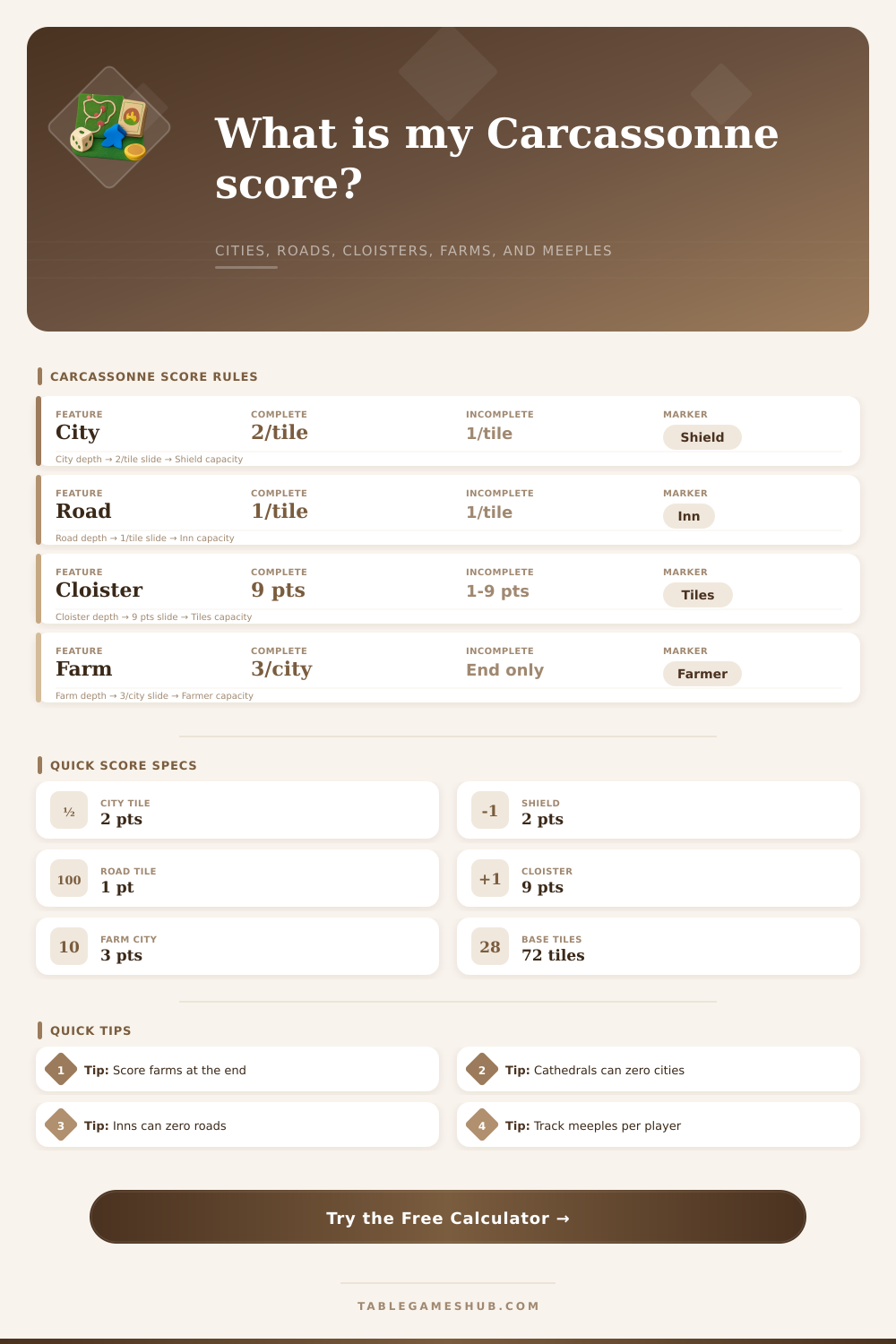
| Feature | During Play | Endgame If Incomplete | Common Marker |
|---|---|---|---|
| City | 2 points per tile plus 2 per shield | 1 point per tile plus 1 per shield | City tile and shield count |
| Road | 1 point per road tile | 1 point per road tile | Continuous road length |
| Cloister or monastery | 9 points when fully surrounded | 1 point for cloister plus each adjacent tile | Covered tile count |
| Farm | Not normally scored during play | 3 points per completed city under current rules | Farmer majority and city contact |
| Modifier | Calculator Effect | Best Input Pair | Risk Note |
|---|---|---|---|
| Base game only | Uses standard city, road, cloister, and farm scoring | Tiles and shields | Stable for any player count |
| Inn road | Completed road tiles score 2 points each | Completed road tiles | Incomplete inn roads score zero |
| Cathedral city | Completed city tiles and shields score 3 each | City tiles and shields | Incomplete cathedral cities score zero |
| Abbot or garden | Adds bonus points to the cloister-style section | Cloister tiles and bonus points | Record agreed pickup score |
| Audit Step | What to Count | Formula Used Here | Output Section |
|---|---|---|---|
| Completed features | Closed cities, closed roads, complete cloisters | Feature rules plus expansion modifier | Feature points card |
| Incomplete features | Open city tiles, road tiles, cloister coverage | Endgame values with inn or cathedral zero checks | Feature points card |
| Farm majority | Completed cities touched by winning farmers | City count times farm rule times majority share | Farm points card |
| Meeple efficiency | Committed meeples plus points they returned | Added points divided by committed meeples | Meeple yield card |
| Scoring Profile | Typical Strength | Meeple Pressure | Calculator Focus |
|---|---|---|---|
| City builder | High burst scoring from tiles and shields | Medium to high | Completed city tiles, shields, cathedral status |
| Road collector | Steady scoring with low shield dependence | Low to medium | Road tile count and inn status |
| Cloister specialist | Compact points with clear endgame count | Medium | Completed cloisters and surrounding tiles |
| Farm closer | Endgame swing from city contact | High | Farm cities, majority share, rule set |
In order to score points for the board game Carcassonne, players must count the points obtained from cities, roads, cloisters, and farms. In order to calculate these scores, the players must understand the different rules for scoring for both completed and incomplete features within the game. For instance, if the player complete a city, they receive points for each of the tiles within that city and for each of the shields within that city.
If, however, the city is not completed when the game ends, then the player receives only one point for each of the tile within that city, and only half of the points for each of the shields within that city. Thus, the player must be able to distinguish between completed and incomplete cities in order to calculate the score for that particuler city. Roads has a different system of scoring than cities, as well as have different scoring rules based off whether or not they contain an inn.
How to Count Points in Carcassonne
Roads score points for each of their segment, and the roads score even if they are not completed. However, if a road contains an inn, then the player must complete it in order to score for that road. Any road with an inn that is not completed will score zero points for that player.
Thus, players must be careful to ensure that any road with an inn is completed when the game ends. Cloisters score points for the number of tiles that surround that cloister. Thus, players will earn points for each of the tiles that touch the cloister, but must be careful to ensure that they correctly count the number of those tiles.
Finally, farms are scored only after all of the cities that touch those farms are completed. Farms score points for the number of completed cities that touch that farm. Furthermore, the player that has the most farmers on any specific field will score the points for any completed cities that touch the field that has that players farmers.
Therefore, players cant score points for their farms until all of the cities on the game are completed. Other expansion tiles will also impact how many points each player earns. For instance, if a player places a cathedral within a completed city, the player will earn three times as many points for that city for both the tiles and shields within that city.
However, if the city with the cathedral is not completed, the city will score zero points for the player. Similarly, the placement of an inn will impact the scoring of any road that contains that inn; the inn will change the way in which the player scores the roads segments. A player can utilize a calculator to account for these placement of expansion tiles, and the calculator will help each player to calculate their score correctly.
In addition to using the calculator, a player may also want to consider the way in which they manage their meeples. A player can only score points if they have at least one of their meeple on the feature for which they are scoring points. Furthermore, players are limited to the number of meeples that they have.
Thus, if players place all of their meeples too early in the game, they wont have any meeples left to score any cities that may appear later in the game. Thus, managing one’s meeples is one strategy that can help a player to score as many points as possible during the game. Finally, players should of use a calculator to ensure that they have the correct score for each of the players.
For instance, a player may make a mistake in that they have forgotten to halve the points for each of the shields in the incomplete cities; they may have forgotten that any road with an inn will score zero points if it is not completed. Additionally, a player may make a mistake in counting the number of farmers on a field or the number of completed cities touching a farm. Overall, by using the calculator, a player can ensure that the player correctly calculates all of the points, and that no error are made in determining the final score for each player.