⛳ Golf Vegas Game Calculator
Combine two-player golf scores into Vegas numbers, apply net strokes and flip options, then update the team point margin for the hole.
| Step | Team A | Team B | Result |
|---|
| Player scores | Vegas number | Against 56 | Point result |
|---|---|---|---|
| 3 and 4 | 34 | 56 - 34 | 22 point win |
| 4 and 4 | 44 | 56 - 44 | 12 point win |
| 4 and 5 | 45 | 56 - 45 | 11 point win |
| 5 and 5 | 55 | 56 - 55 | 1 point win |
| 5 and 6 | 56 | 56 - 56 | 0 point tie |
| 6 and 7 | 67 | 67 - 56 | 11 point loss |
| Rule option | Trigger | Applied to | Calculator treatment |
|---|---|---|---|
| No score flips | None | Both teams | Compare low-high numbers directly. |
| Birdie flips opponent | Any adjusted birdie on one side | Other team's number | Reverse opponent digits before difference. |
| Eagle or better flips | Adjusted score at least two under par | Other team's number | Flip only on eagle or better. |
| Birdie flip, eagle double | Birdie or eagle | Opponent plus swing | Flip for birdie, double final swing for eagle. |
| Format | Team setup | Score basis | Best use |
|---|---|---|---|
| Classic Vegas | Two fixed pairs | Gross low-high | Simple four-player rounds. |
| Net Vegas | Two balanced pairs | Adjusted by hole strokes | Mixed handicap groups. |
| Flip Vegas | Any two pairs | Gross or net with flips | Groups that want bigger point swings. |
| Capped Vegas | Two fixed pairs | Max digit before number | Protecting pace after high scores. |
| Rotating Vegas | Partners change by hole | Gross or net | League-style pair rotations. |
| Team A score | Team B score | No flip swing | Birdie flip swing |
|---|---|---|---|
| 34 | 45 | +11 Team A | +20 Team A if B flips to 54 |
| 45 | 56 | +11 Team A | +20 Team A if B flips to 65 |
| 46 | 55 | +9 Team A | +9 Team A if 55 stays same |
| 57 | 68 | +11 Team A | +29 Team A if B flips to 86 |
| 67 | 58 | -9 Team A | -18 Team A if A flips to 76 |
Vegas score order
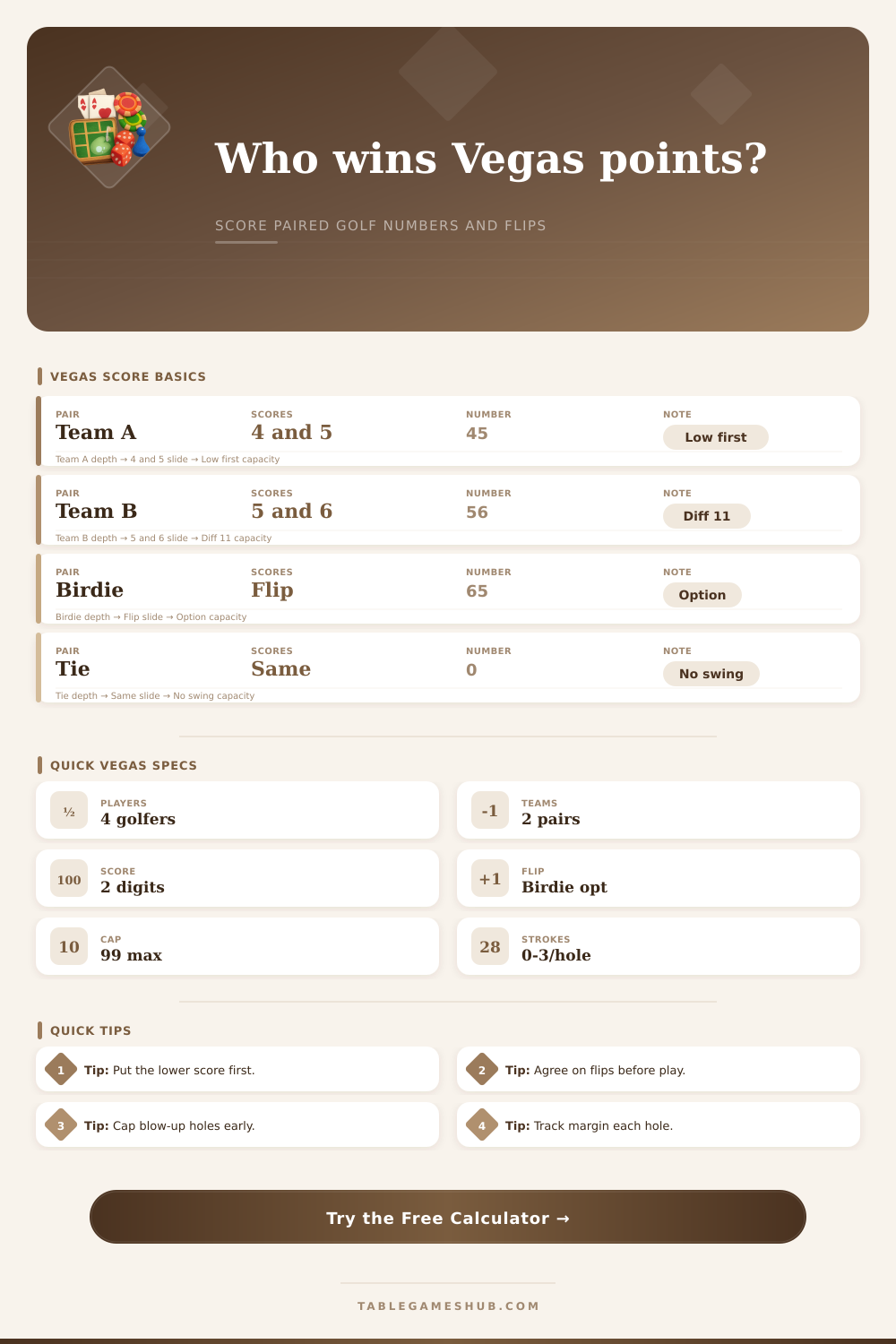
Build each team number from the lower adjusted score first. A 4 and 7 is 47; only a selected flip rule changes digit order.
Rule clarity
Decide cap, net strokes, and flip triggers before the first tee shot so every hole uses the same score logic.
Vegas scoring are a method of scoring in which the focus is upon a two-digit number rather than the numbers of strokes each player took to complete the hole. In a game that employ Vegas scoring, a group of players competes to create the smallest two-digit number, rather than to compete to determine who has the lowest individual score. The two-digit number is created by taking the adjusted scores of each of the two partners and placing the lower score into the tens place and the higher score into the ones place within the two-digit number.
For example, if one partner scores a 4 and the other score a 5, the number created by the partnership is 45. If one partner scores a 5 and the other scores a 6, the number created by the partnership is 56. The partnership with the smallest two-digit number wins the hole, and the difference between the two-digit numbers represent the point swing for that hole.
How Vegas Scoring Works
Because the number that is created always utilizes the lower score as the number of tens, a player who has a poor score for a given round can still contribute positive to there team if one of the other players scores well for that round. In addition to requiring the players to determine their two-digit score for the round, Vegas scoring often incorporates rules related to net strokes and score caps to ensure fairness within the round. Net strokes is used for players of different skill levels; the players subtract the net strokes that each player takes from there scores prior to the creation of the two-digit number.
Score caps are used to ensure that one poor round of golf by a player does not create a very large point swing for the round. Score caps limit the possible score for a player to a certain number, rewarding players who have even scores for each round of golf. The decision of whether to use net strokes or score caps represents the decision of the players of how much one bad round of golf should impact the players score for the round as a whole.
In addition to the use of the calculator, some groups also incorporate a rule known as the flip rule. Under the flip rule, if a player or partnership scores a birdie or better on a hole, the score for that partnership is allowed to be flipped; the two-digit score is reversed. For instance, if a partnership scores 56 for their two-digit number, a flip would change that number to 65.
Some groups make the flip rule automatic; others make it optional. In addition to the use of the calculator, some groups also incorporate the concept of carryovers. A carryover is implemented when the scores of each team are tied for a round.
If each team has the same number of points for a round, the points for that tied round are carried over to the next round. Thus, a carryover can lead to a small point advantage between two teams to develop into a large point advantage by the later rounds of the round of golf. Many groups find it useful to keep a running margin of the points scored by each team.
The margin helps each player to understand the impact of the carryover on the round of golf. In addition to the calculator, some groups also use the point system that is associated with Vegas scoring to determine their scores. The calculator for Vegas scoring requires each player to enter the scores of each player, the number of strokes each player took for the round of golf, and the rules established by the players for that round of golf.
The calculator will display the two-digit number for each player or team, will apply any flips established in the rules for that round, will add any carryover points for any rounds that ended in a tie, and will display the updated margin between the two teams. By utilizing such a calculator, the players can easily and efficienty determine the scores for each round; the visible steps that the calculator performs allow the players to understand how the scores were obtained. Vegas scoring rewards different skill than those required for stroke play.
For stroke play, each player focuses upon their individual score for the round. For Vegas scoring, each player focuses upon their score for the round in conjunction with their partner’s score. Thus, players who avoid high scores for each round are considered valuable players in Vegas scoring.
The players must also communicate with each other to determine whether they should take chances to score high on the course (to potentially earn a flip) or play safe with their partner to avoid high scores for the round. Many players make mistakes in their use of Vegas scoring. For instance, many players do not take into account their current score margin or carryover when they decide with which strategy they will play on a given hole.
Players with a large score margin may choose to play defensively to protect their score margin. Players with a small score margin may desire to take risks to earn a large point swing for the round of golf. The calculator can help players to see the effect of these decisions on their score for the round.
Because the calculator displays the margin after each hole, however, players can use that displayed score to help establish the intention with which they will play the final hole of the round. Thus, Vegas scoring can work for the players due to the fact that it forces the players to focus upon their partnership with each other and the score that they create rather than their individual scores. It could of been easier if the rules was clearer.
Youll find that most groups dont use a modern calculator, they just use a piece of paper. Actualy, the game is more fun when you use a more luxurios pen.