🎳 Bowling Baker Format Calculator
Score a five-player Baker rotation by frame, audit strike and spare carryover, compare lineup balance, and project the team total.
| Measure | Value | Formula | Read |
|---|
| Baker frame | Assigned player | Workload | Lineup note |
|---|---|---|---|
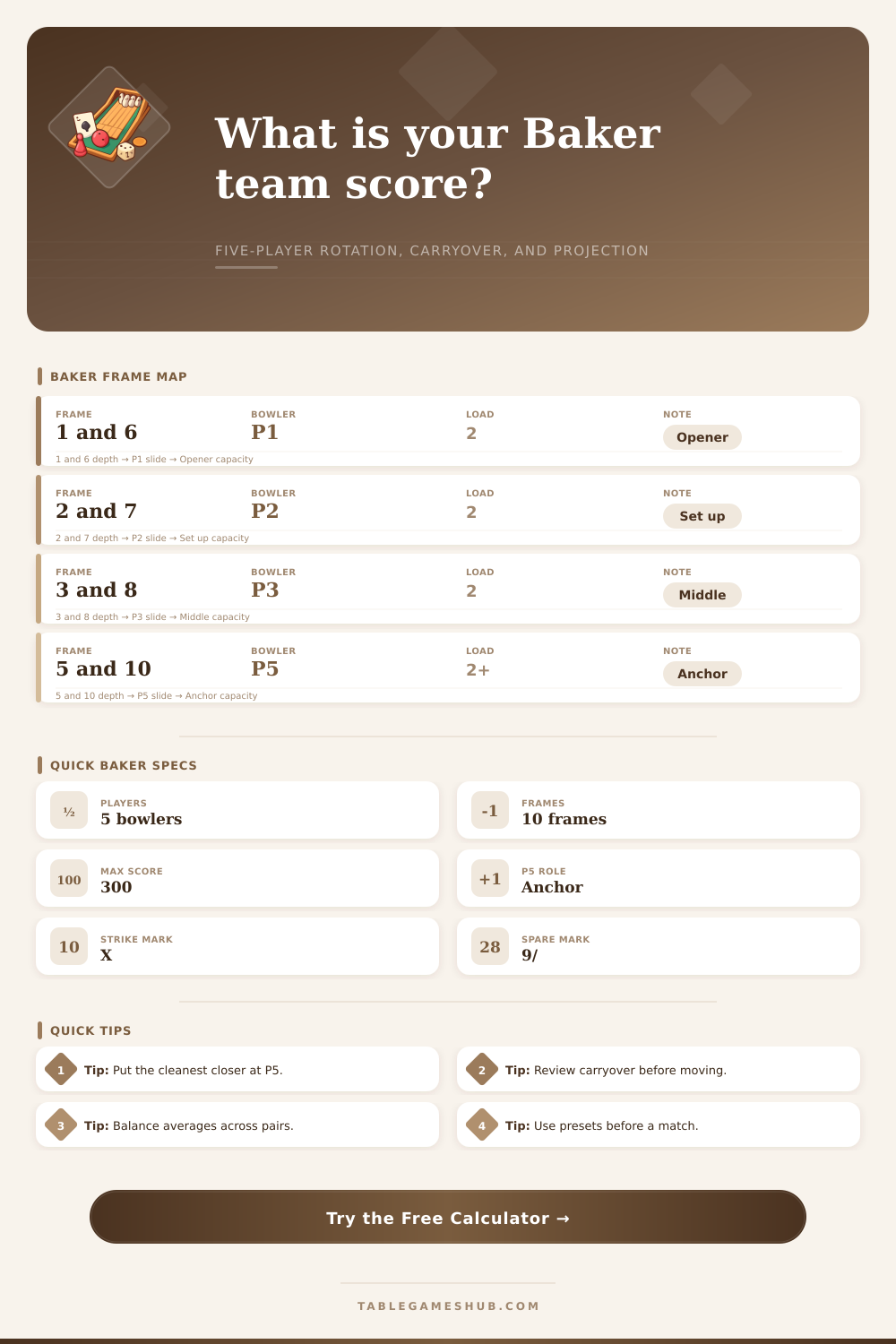
| Frames 1 and 6 | Player 1 | Two regulation frames | Often a steady opener who handles first-shot pressure. |
| Frames 2 and 7 | Player 2 | Two regulation frames | Pairs well with a spare shooter who can recover splits in the middle. |
| Frames 3 and 8 | Player 3 | Two regulation frames | Bridge position; protects both halves of the score sheet. |
| Frames 4 and 9 | Player 4 | Two regulation frames | Sets up the anchor and can multiply strike carryover. |
| Frames 5 and 10 | Player 5 | Two frames plus possible fill balls | Anchor role; tenth-frame marks can add one or two extra balls. |
| Mark | Roll value | Carryover | Calculator handling |
|---|---|---|---|
| X | 10 on the first ball | Next two rolls | Frame score posts when two later rolls are available. |
| 9/ | Spare to 10 | Next one roll | Frame score posts when the next roll is available. |
| 81 | Open frame, 9 total | No carryover | Both rolls score immediately for the assigned player. |
| XX9 | Tenth frame strike line | No later frame needed | The tenth frame uses its own fill balls. |
| Projection mode | Strike effect | Spare effect | Use case |
|---|---|---|---|
| Balanced | Uses entered strike rate | Uses entered spare rate | Normal match estimate from player profiles. |
| Aggressive | Adds strike ceiling | Slight spare trim | When the team is chasing a larger target. |
| Clean spare | Moderate strike value | Adds spare control | When opens are the main risk to protect against. |
| Conservative | Lower strike ceiling | Lower frame value | When lanes are tricky or pressure is high. |
| Lineup read | Typical signal | Balance impact | Practical adjustment |
|---|---|---|---|
| Anchor strong | Player 5 average above team mean | Improves tenth-frame confidence | Keep the best closer in frame 10 if pressure is expected. |
| Wide spread | Highest and lowest averages far apart | Lowers balance score | Place lower volatility near support positions. |
| Middle clean | Players 2 and 3 have spare control | Stabilizes projected finish | Useful when the match is likely to be decided by opens. |
| Late strike push | Players 4 and 5 have higher strike rates | Raises ceiling | Best for comeback Baker games and carryover chains. |
Check carryover before judging a frame
A strike or spare may look incomplete until the next assigned player throws. Use the pending-bonus count before calling the team score finished.
Balance roles, not just averages
The highest average often belongs at anchor, but a cleaner spare shooter can be more valuable in frames 2, 3, 7, and 8.
The Baker format is a way of bowling that change the scoring for a team. The Baker format can change the rhythm of a team night. In a standard game of bowling, there are five separate scoresheets that runs at once.
In the Baker format, there is one single game that belongs to the whole team. Each player own two frames within the game. Each player also owns the extra roll for the tenth frame if the player who bowls first in the game needs extra rolls to complete his game.
How the Baker Format Works for Team Bowling
There is a different pressure for the players in the Baker format. Each player understands that the next player to bowl is waiting for them to bowl a strike so that the next player can earn their bonus. Each player is also aware that if they bowl a spare, it is the only one that will keep the following frame alive.
The order in which the players bowl is crucial to the game. All of the players shares the same total score for the game. The player who bowls first in frames one and six sets the tone for the team for the carryover in the next frame.
However, the most important frames in which the players will bowl are frames four, five, nine and ten. If a player bowls strikes in frames four and five and nine and ten, they will be able to rescue the open frame that they bowl for and ultimately prevent the team’s total score from dropping as a result of that open frame. The calculator can help handle the math for the game once you enter each player’s marks and profiles.
The calculator will save the player from having to do mental math during the game while making a decision about which player to move. The lineups for the players are often based off each player’s bowling average. However, there is more importance placed on how well the players bowl in frames two, three, seven and eight.
These frames occur in the middle of the game between each player’s carryover frames. If a player bowls a spare in these frames they will earn more points than if they bowl a strike in the later frames of the game that will not score for the player. This tool allows the players and coaches to swap the percentage of strikes and spares that each player bowls and to see the impact that each player will have on the total score for the game.
The factor that makes the lanes change is known as the lane transition. The lane transition affects how the balls travel on the bowling boards. If the oil on the lanes evaporates and the boards dry out, the lanes that a player enjoyed when they bowled in the first game could feel entirely different in the third game of the night.
The lane factor that is entered into the calculator only impacts the remaining frames of the player’s game. This factor ensures that the projection score that is calculated for each player is realistic and does not try to make it look as if the projection is a pure score for the player. The player who lines up the balls down the lane for the player who bowls first is the anchor.
The player who bowls first in the game receives a lot of attention due to the possibility of extra balls in the tenth frame. However, the player who lines up the balls for frame nine essentially sets whether or not the anchor will receive that extra game. If the player who bowls in frame nine bowls a strike they will give the anchor two shots to bowl their game instead of just one.
While many teams may ignore frame nine, it is important to note that the carryovers mean that frame nine is essentially worth double what it would be otherwise. It can be difficult to judge the balance of each player by looking at them. However, the tool will provide that information for the coach.
If the player with the lowest average bowls next to the player with the highest average in the middle of the rotation, they will be able to absorb an open frame from one player without the total score for their game dropping too dramatic. However, such an arrangement may cause the player who bowls the most frames to carry the weight of the entire game if the lanes begin to tighten throughout the game. The balance for the game weighs the average score of each player and their strength as the anchor to the game and how well they bowl in the middle of the game.
This provides the coach with a single number as a representation of the teams balance instead of having to guess at what each player will score and how it will impact the game. Carryover can be difficult for some players to understand while they are bowling on the lane. However, if a player bowls a strike in frame four, the rolls for frames five and six must be completed before the player scores on that strike.
The live score for the player will therefore be several frames behind on the scoresheet. The pending bonus count will tell the player how many rolls must be completed before the frames score for that player. This prevents the players from celebrating a score that has yet to be posted.
In a real bowling game, there will be many variables that enter into the player’s score that the calculator cannot account for. For instance, it is possible that a player will miss a spare while bowling if they are feeling nervous about the game. Similarly, a team may choose to bowl for a score instead of protect their score.
However, the different modes that are available to the coach for the players will allow them to test the minds of the players and see how they will bowl with different mindsets: balanced, aggressive, clean or conservative. The gap between the projected score and the target score will prompt the coach to make a decision about whether or not the current rotation of players is correct or if changing the player who bowls in frame nine will be more beneficial to the team. The reference tables will list each frame and which player bowls in which frame as well as the rules regarding the marks that are required to score in each frame.
These tables will be helpful when explaining the game to a teammate who does not know how to play or when settling an argument about the score for the tenth frame. Once the coach understands each frame and what each player must achieve to earn a strike or spare, they can use the calculator to test the changes that will occur to each player’s game. If each player treats the game with the same importance as five separate bowling games, they will score lower on average.
The Baker format rewards the group of players who plan for carryover. The Baker format rewards the group of players who protect the middle of the game. The Baker format rewards the group of players who place the right player in the anchor spot to bowl first for each game.
By running the numbers in the calculator before the game starts, the coach establishes a plan for the game. Then, should anything happen during the game, they can refer to their calculated number to defend their decisions.