Swiss Rounds Needed Calculator
Estimate how many Swiss rounds a tabletop tournament needs from players, cut size, points, time per round, undefeated pressure, and unique pairing coverage.
Based on perfect-record pressure and cut size.
Expected perfect records at the planned round count.
Round clock plus pairing and reporting time.
Ideal no-rematch coverage of possible pairings.
Rounds must create enough separation before tiebreakers decide the final seats.
Ceiling of log2(players), the classic estimate for one undefeated player.
Each round uses floor(players divided by two) match pairings plus any bye.
Match win points times planned rounds, before draws or penalties.
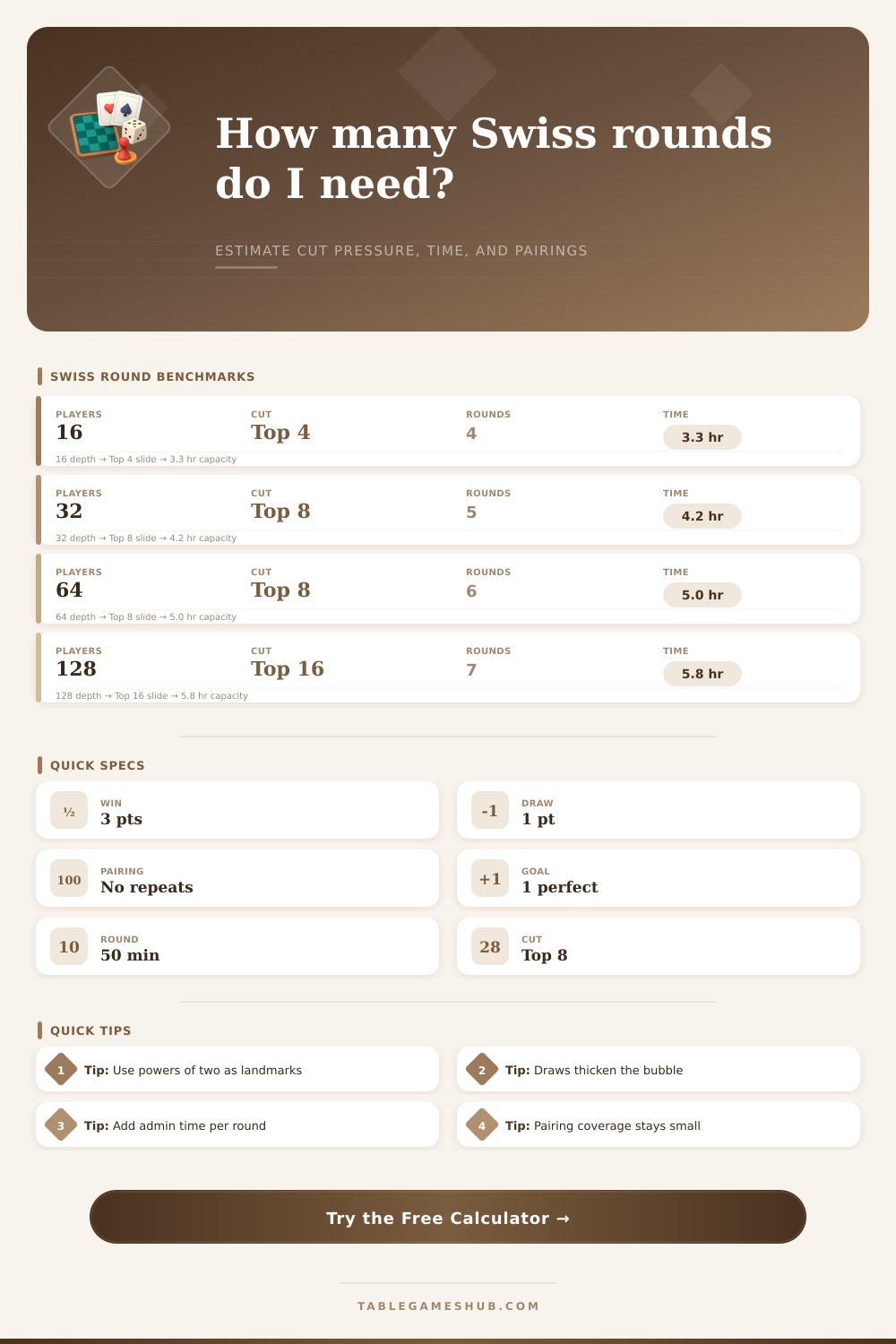
| Preset | Players | Cut | Suggested Swiss | Typical use |
|---|
| Players | Rounds for about 1 perfect | Top 8 pressure | Top 16 pressure | Pairing coverage at that round |
|---|
| Record at planned rounds | Match points | Estimated players at or above | Cut implication | Pairing note |
|---|
| Rounds | Swiss matches | Perfect estimate | Coverage | Clock block |
|---|
Enough rounds for the cut may still leave several players with identical match points, so use one extra round when prizes or ratings make the bubble sensitive.
Swiss is designed to compare nearby records, not to make everyone face everyone. A large event can feel complete with under 10 percent total pairing coverage.
When you plan an Swiss tournament, you must decide how many round the Swiss tournament requires. The number of rounds that a Swiss tournament will require is dependent on several different variable. These variables include, but are not limited to, the field size, the scoring system for the tournament, the number of perfect score that you want at the end of the tournament, and the time that you have to hold the tournament.
Each of these variables will interact with each other, so it is important for tournament organizers to account for each of these variables so as to not run out of time during the tournament. A Swiss tournament will attempt to create separation between the players of the tournament without requiring that each player compete against every other player. The theory behind a Swiss tournament is that each round will half the number of undefeated player.
How Many Rounds Does a Swiss Tournament Need
However, as with any system that include the possibility of draws and byes, the math will be more complexer than half the number of undefeated players. For example, a Swiss tournament that includes sixteen players will end in four round at the most. However, a regional tournament that includes a large field of players may require more than four rounds to produce the same level of separation between the players.
The calculator included in this article will help you determine the number of rounds that your Swiss tournament will require based off the size of your field, your target cut, and the value of each score. The win points and draw points will have an impact upon the number of rounds that your tournament requires. The more draws that there are in your tournament, the more rounds will be required for your cut to become decisive.
This is because the more draws that the players has within your tournament, the more players that will remain close to the leaders in the standings. A bubble buffer will be used in your tournament as a way to avoid the need to use tiebreakers to determine the winners of your Swiss tournament. Using tiebreakers may be preferred by some players, but any addition to the number of rounds for your Swiss tournament will increase the time required to hold the tournament.
Pairing coverage is another factor that many Swiss tournament organizers will ignore until later rounds in your tournament. While it is important to avoid having players compete against the same opponent twice in your Swiss tournament, the number of unique pairings of players increase at a faster rate than the number of rounds that are held in the tournament. For instance, a 128-player Swiss tournament will likely have a lower pairing coverage requirement than a 64-player Swiss tournament.
However, pushing for higher pairing coverage will not improve the quality of the cut for your tournament. There are also a variety of real-world constraints that can impact your Swiss tournament. Factors like curfews at the tournament site, the availability of the tournament judges, and the level of fatigue of the players will have an impact upon your tournament.
For these reasons, organizers will use the number of rounds calculated by the calculator as a starting point for the number of rounds for the Swiss tournament. Another decision that you must make is how you will handle players if you have an odd number of players in your field. One way is to use a bye for the player with an odd number of players in your field.
Using byes for players with an odd number of players in your field is the standard procedure for a Swiss tournament. You can use phantom players or you can use early drops to handle players with an odd number of players in your field. Phantom players will help to even the number of players in your field but may create awkward situation.
Using early drops will reduce the number of players competing in your tournament but requires accurate reporting of drop data prior to setting the pairings for your players. The reference tables included with this calculator may help you to decide whether the number of rounds that you want to hold your Swiss tournament is too many or too few. For instance, a Top 8 cut between sixty-four and one hundred twenty-eight players may require the same number of rounds to even have the potential of having one undefeated competitor in your field.
Calculations of the time that is required for your Swiss tournament will include the length of each round of competition as well as the administrative buffer between rounds. The administrative buffer will grow with the size of your field because there are more result slips and questions will be asked of the players. If you have fewer stations than the number of players competing in your Swiss tournament, some players will be waiting between rounds while others are still competing in their matches.
Fewer stations will result in a longer Swiss tournament. The most common mistake in planning a Swiss tournament is focusing solely on the cut size for the tournament. A cut may look generous to the tournament spectators but may be difficult for the players with the number of rounds that are planned.
An aggressive number of rounds for your Swiss tournament may produce a decisive cut but may leave the staff and the players feeling excessively tired after the tournament is over. Instead, organizers should of ask the question of how many rounds will produce enough separation between the players with similar scores to satisfy the players in your field. While Swiss tournaments are inherently scalable, organizers must use the calculator to understand the various trade-offs involved in setting up the Swiss tournament before beginning to establish the pairings for the players.