Zombie Dice Probability Calculator
Estimate your next-roll bust odds, expected brains, draw color mix, and shotgun distribution from the cup colors and footprints currently in play.
| Shotguns rolled | Probability | Total shotguns | Turn result |
|---|
This table combines the exact cup draw mix with the color-specific die faces for the dice you roll next.
| Brains rolled | Probability | Turn brains if safe | Weighted contribution |
|---|
| Drawn from cup | Probability | Rolled colors after footprints | Average brain faces |
|---|
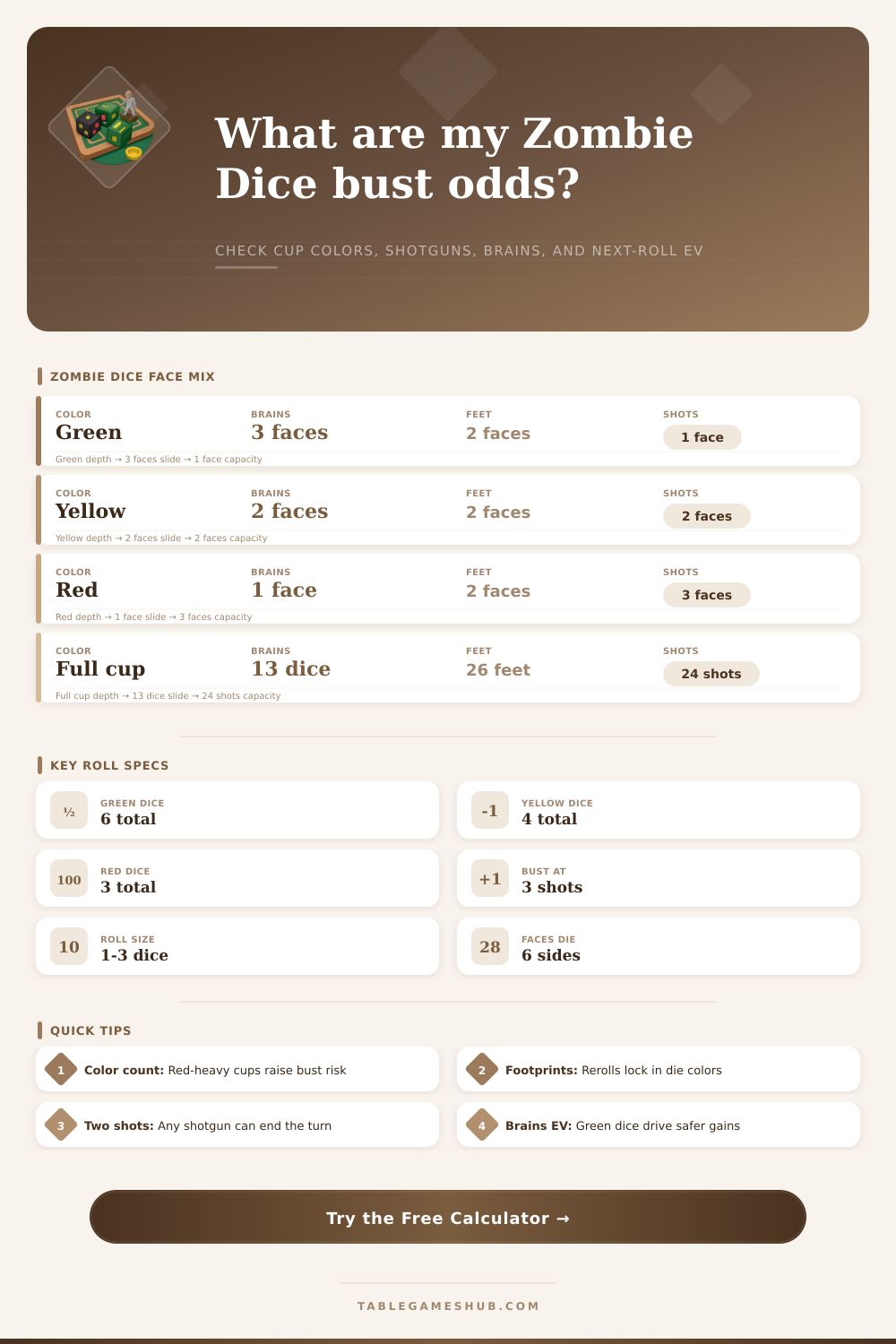
| Die color | Brain faces | Footprint faces | Shotgun faces |
|---|---|---|---|
| Green | 3 of 6, 50.0% | 2 of 6, 33.3% | 1 of 6, 16.7% |
| Yellow | 2 of 6, 33.3% | 2 of 6, 33.3% | 2 of 6, 33.3% |
| Red | 1 of 6, 16.7% | 2 of 6, 33.3% | 3 of 6, 50.0% |
| Full cup | 24 brain faces | 26 footprint faces | 24 shotgun faces |
Zombie Dice is a game in which players rolls dice in order to earn brain while avoiding shotguns. To earn brains, a player rolls the dice, but must avoid rolling three shotgun in a turn. The decision of whether or not to roll again involve the consideration of several different factors.
Such factors includes the number of dice that a player has left, the colors of the remaining dice in the cup, and the footprint that have become locked into the next roll. Additionally, the number of shotguns that a player have collected with their current turn will also impact their decision to roll again. A calculator included with Zombie Dice can help a player to understand the probability of each outcome so that the player dont have to calculating such probabilities in there head.
When to Roll Again in Zombie Dice
The three different colors of dice has different risks for the Zombie Dice player. Green dice are the safest of the three colors, as there are three brain faces and only one shotgun face for each green die. Yellow dice are the middle risk level for players, as there is a balance of brains, footprint, and shotguns on the yellow dies.
Finally, red dice are the most dangerous for players, as each die have three shotgun faces. The composition of the cup of dies changes after a player removes each die from the cup. For instance, if a player has removed many green dies from the cup, the remaining dies in the cup are more likely to be red dies.
Thus, the risk of rolling shotguns increase as the turn progresses, even if the total number of dice in the cup remains the same. Footprints on the dice changes the mathematical odds of the roll. If a footprint is revealed on a die, that color of die must be rolled again.
If the footprint that rolls is green, this adds safety to the player’s rolls. If the footprint that rolls is red, this adds danger to the player’s roll. These footprints are treated separately from the remaining dies in the cup.
Because the footprints prevent players from having to roll additional dice from the cup, the presence of footprints alters the probability of a roll. A player that does not account for the footprints will not account for the reduction of the number of dies that are rolled from the cup. Thus, a player might experience a bad outcome with such ignore footprints.
The number of shotguns that a player has earned as well as the number of brains that have been collected are the primary factors that a player considers before rolling the dice again. If a player has collected zero shotguns with their turn, they can take more risks before rolling again. If, however, a player has two shotguns, their turn is more dangerous if they roll a shotgun, as they will earn their third and end their turn.
Additionally, if a player has collected many brains with their turn, they stand to lose more brains if they roll shotguns. The calculator accounts for each of these factors, which displays to a player the probability of busting with their turn and the number of brains that they will earn with their roll. These two values allow a player to make their decisions with more data than intuition.
Many players make mistakes when rolling Zombie Dice. Such mistakes may include ignoring the changing composition of the cup of dice. For instance, a player may ignore that the composition of the cup changes as dice are removed from the cup and accounted for with each turn.
Additionally, players may ignore how footprints impact the remaining dice in the cup. The calculator accounts for these two factors separately, allowing a player to more careful consider each of these separate factors before making their decisions. The distribution tables in the calculator help to show the probabilities of each outcome of the roll, as these tables are difficult for players to remember in their head.
Each table displays the distribution of shotguns that might be rolled as a result of rolling the dice, as well as the distribution of the number of brains that will be collected as a result. These two views of the probability of each outcome help a player to decide whether or not they wish to roll the dice again. In real rolls of Zombie Dice, there are several complication that exist outside of the scope of the calculator.
Such complications may include other players rolling and the resulting pressure that such players can place upon the player rolling the dice. Additionally, some groups of players use house rules for Zombie Dice. Such house rules might alter the odds that are displayed in the calculator.
However, regardless of any house rules, the decisions that a player must make are essentially the same. Players must balance the amount of brains that they can collect with the number of shotguns that they might roll. The calculator creates a representation of this decision before the player must roll the dice to make their decision.
Thus, the calculator does not make the player’s decision, but it does provide a player with an indication of what the numbers says before they must make their decision.