Probability of Drawing a Pair Calculator
Calculate exact or at least pair odds from ranks, suits, hand size, deck profile, and known dead cards.
| Deck Setup | Hand Size | Pair Target | Probability Note |
|---|---|---|---|
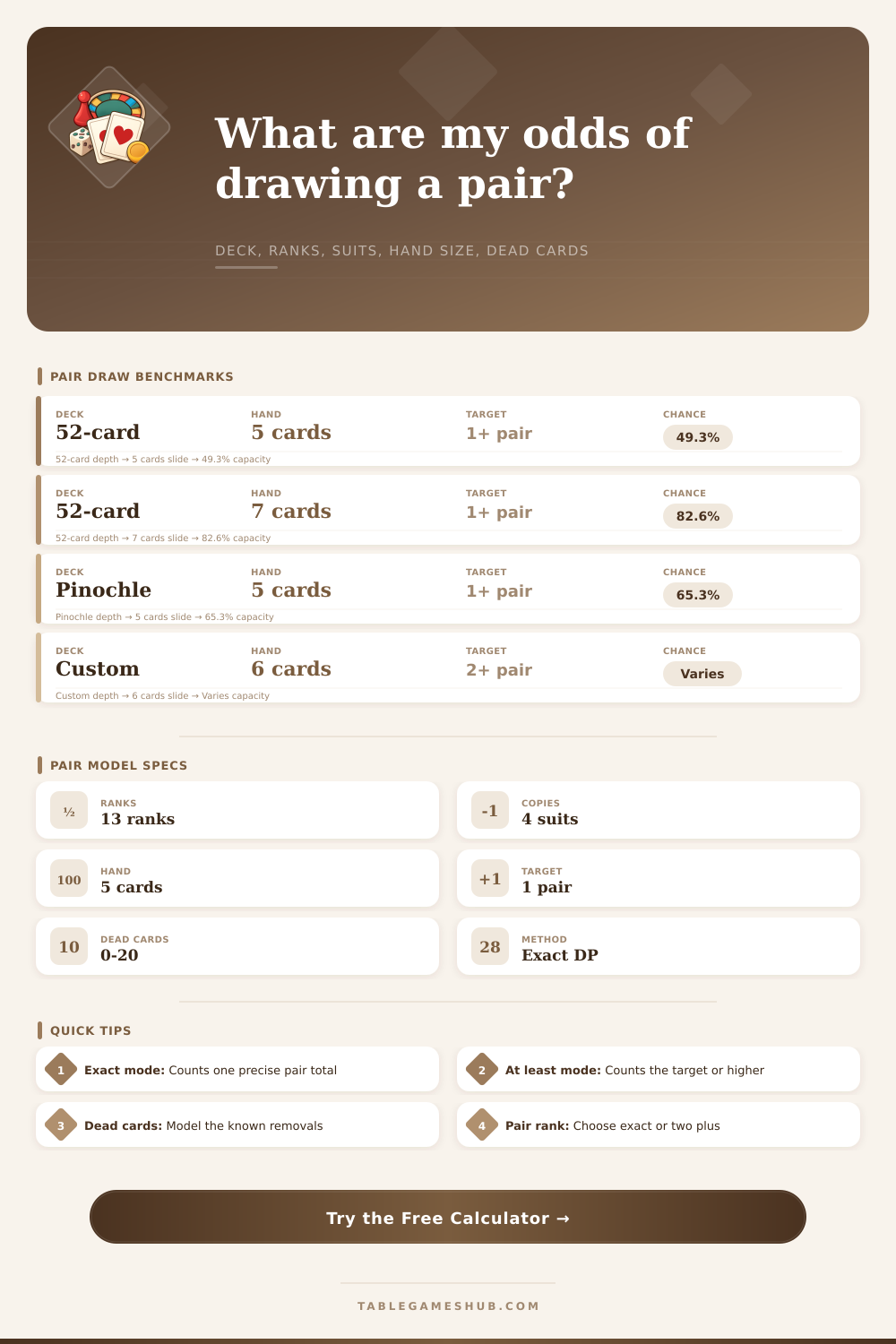
| 52 cards, 13 ranks, 4 suits | 5 cards | At least 1 pair rank | Classic draw-poker pair or better baseline. |
| 52 cards, 13 ranks, 4 suits | 5 cards | Exactly 1 pair rank | Excludes two pair, trips, full house, and quads. |
| 52 cards, 13 ranks, 4 suits | 7 cards | At least 1 pair rank | Seven-card deals make duplicate ranks much more common. |
| 36 cards, 9 ranks, 4 suits | 5 cards | At least 1 pair rank | Fewer ranks increase rank collision pressure. |
| Profile | Ranks | Copies Per Rank | Best Use |
|---|---|---|---|
| Standard 52-card deck | 13 | 4 | Poker, rummy, bridge-style pair checks. |
| Short deck 36 cards | 9 | 4 | Short-deck poker and trimmed-rank games. |
| Euchre 24 cards | 6 | 4 | Small-deck hands where duplicates appear faster. |
| Pinochle 48 cards | 6 | 8 | Double-copy rank groups with high pair density. |
| Double 52-card deck | 13 | 8 | Multi-deck games and large draw piles. |
| Draw Shape | Pair Count | Trips / Quads | Calculator Treatment |
|---|---|---|---|
| A-A-K-8-3 | 1 | None | Counts in both treatment modes. |
| A-A-K-K-3 | 2 | None | Two separate ranks count in both modes. |
| A-A-A-K-3 | 0 or 1 | One trip rank | Counts only when two-plus treatment is selected. |
| A-A-A-K-K | 1 or 2 | One trip rank | Exact-two counts K-K; two-plus counts both ranks. |
| Model | What It Assumes | Pair Effect | Use When |
|---|---|---|---|
| Spread across ranks | Dead cards are distributed as evenly as possible. | Reduces many ranks slightly. | You know only the total seen cards. |
| Block pair ranks first | One card is removed from many ranks before repeats. | Preserves rank variety but lowers copies. | Visible cards show many different ranks. |
| Clump into few ranks | Dead cards fill ranks before moving on. | Deletes some ranks, leaves others rich. | Known discards are rank-heavy. |
| Ignore rank placement | Uses a smaller uniform deck approximation. | Fast estimate, less exact for pairs. | You need a rough live-card check. |
Calculating the probability of drawing a pair require considering several different variable. A person must consider the number of rank in the deck, the number of copies of each rank in the deck, the number of cards in a players hand, and how many cards has been removed from the deck. If a person does not consider these variable, they are essentially guessing the probability of drawing a pair.
The probability of drawing a pair is a mathematical result of these different variable. The number of ranks in a standard deck is 13; however, if a person use a deck that contains fewer rank, such as a 32- or 48-card deck, then there are fewer rank in the deck. A reduction in the number of ranks in a deck will increase the probability of drawing a pair.
How to Find the Chance of Getting a Pair
An increase in the number of copies of each rank in a deck will increase the chance that a player will draw a pair; additional suit or decks increase the number of cards in the deck, which also can affect the probability of drawing a pair. A calculator can adjust the number of ranks and the number of copies to determine the impact on the probability of drawing a pair. The number of cards in a player’s hand will impact the probability of drawing a pair.
For instance, a two-card hand has only one opportunity to draw a pair; however, five- and seven-card hands provide more opportunity for a pair to be drawn. However, a five-card hand also create the possibility of three-of-a-kind and two pairs, and a seven-card hand creates the same possibility of three-of-a-kind and two pairs. Furthermore, the probability of drawing exactly one pair differs from the probability of drawing at least one pair.
The probability of drawing exactly one pair will only count the number of combinations that contains one pair and no higher combination. The probability of drawing at least one pair will count the number of combinations that have one pair, two pairs, three-of-a-kind, or any other combination that includes at least one pair. Dead cards are cards that have been removed from the deck.
By removing cards from the deck, the distribution of the ranks in the cards that can still be drawn are altered. If there are ten dead card in a deck, for instance, there are fewer card that can be drawn that distribute ranks in the same way as the original deck. The dead cards may impact the distribution of the ranks in the remaining deck in a variety of ways; removing specific rank reduces the chance of drawing a pair of those ranks, but removing many of the cards of various ranks will change the probability in a different way.
A person must take into consideration the distribution of the dead cards. Another distinction between the probability of a pair and the probability of at least one pair is that the context of the game may indicate which is more important. For instance, in five-card draw, getting at least one pair is a winning combination; in games like rummy, though, players may want to calculate the probability of getting an exact pair.
Thus, calculators can include options for each of these probabilities so that a player can determine which probability is more important in the context of which game they are playing. In most real games, a number of cards are removed from the deck. These cards may be burned, shown to other players, or simply discarded.
Each of these removed cards contributes to the probability of a pair. Thus, a player must account for the number of dead cards in the deck; with a calculator, a player can enter the number of dead cards that exist in the deck, as well as the placement model for those cards to calculate the impact of the removed cards on the probability of a pair. A player may want to calculate the probability of a pair or the probability of a specific rank of cards.
If a player is playing a game in which getting any pair is sufficient for some benefit, then the probability of any pair can be calculated. However, if the game provides some benefit only for getting a specific rank of cards, then calculating the probability of that specific rank is the goal. Thus, a calculator for determining the probability of a pair could also include the calculation of the probability for a specific rank of cards.
The principles discussed in this article can be applied to a variety of different games, including Bridge, Pinochle, and short-deck poker. Bridge players use the concept of probability of a pair to determine the likelihood that their opponent will be unable to ruff their trick. Pinochle players use the probability of drawing a pair to determine the value of the melds that they can draw.
Short-deck poker players has an increased chance of drawing a pair since there are fewer ranks of cards. In each of these games, the variables that impact the probability of a pair are the same. Due to the complexity of the calculation of the probability of a pair, many people may make mistakes when calculating the probability of a pair.
For instance, many people may remember the probability of a five-card hand containing a pair, but not remember that the probability change when there are more cards in a player’s hand. People may also fail to account for the difference between the probability of an exact pair of cards and the probability of at least one pair when the number of cards drawn is high; with seven-card hands, it is very likely that there will be more than one pair in the player’s hand. Thus, by including different calculation mode in a calculator, people can avoid these mistake.
Although a calculator will not be able to predict the outcome of a players next hand of cards, a calculator will provide a range of possible outcome. Knowing this range of possible outcomes allows a person to make a decision about whether to continue playing or to fold on the hand. The difference between a 45% chance of success and a 62% chance of success is a measurable difference in a players hand; by entering the number of ranks, number of copies of each rank, the size of the hand, and the number of dead cards, a player can use this calculator to change their strategy in the game based on the outcome of these calculation.