Beanbag Toss Distance Calculator
Set cornhole board spacing, foul line distance, target-hole travel, and a practical throw arc for adults, juniors, youth, and shorter backyard layouts.
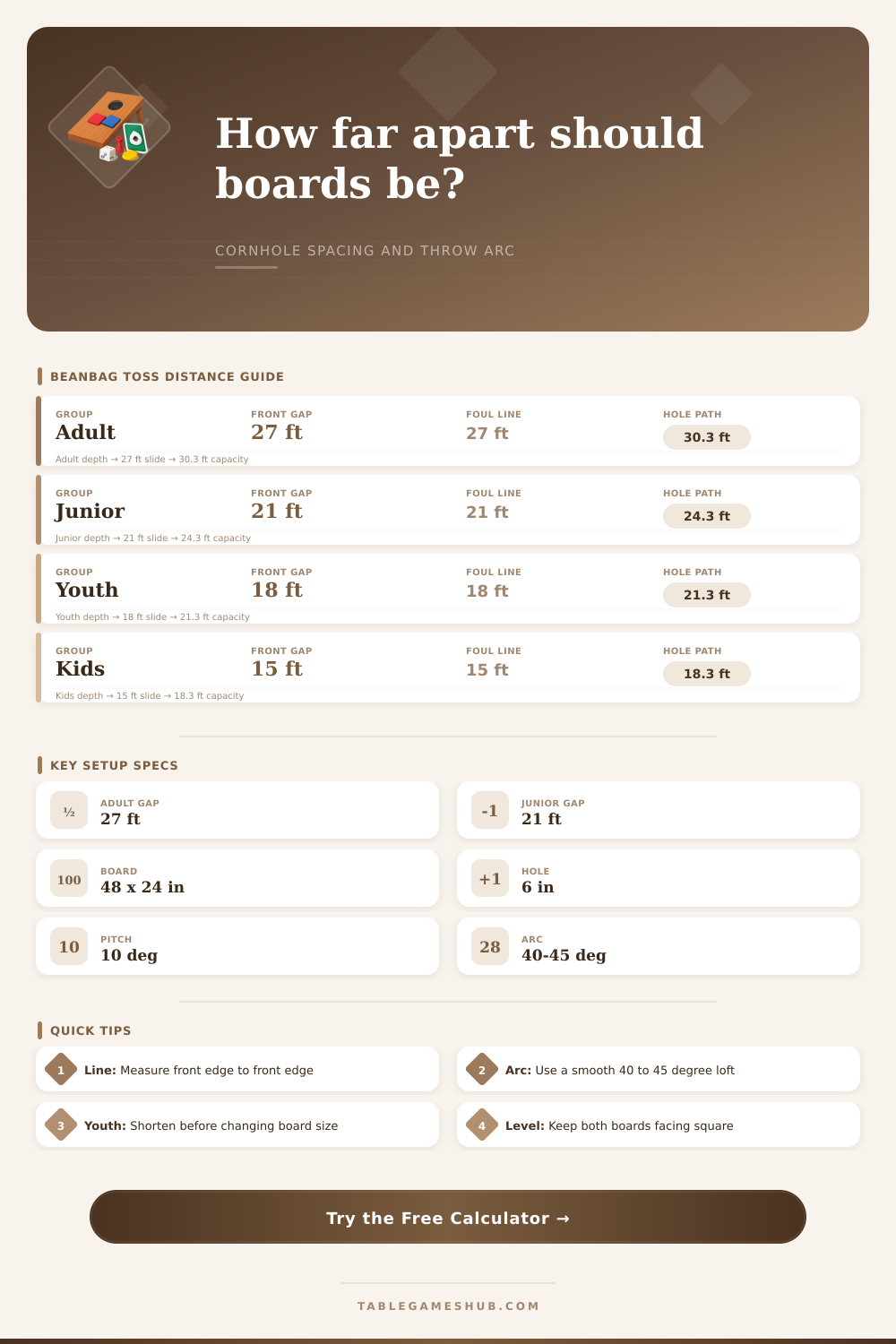
| Group | Board Front Gap | Foul Line | Best Use |
|---|---|---|---|
| Adult regulation | 27 ft | Front board edge | Standard adult play and most league layouts |
| League or tournament | 27 ft | Front board edge | ACL, ACO, and regulation-style events |
| Junior players | 21 ft | Front board edge or marked line | Common junior and family competition distance |
| Youth practice | 18 ft | Marked line | Developing form before full regulation spacing |
| Kids or beginner | 12 to 15 ft | Marked line | Short backyard play with full or mini bags |
| Board Type | Board Size | Hole Location | Hole Path at 27 ft |
|---|---|---|---|
| Regulation cornhole | 48 x 24 in | 9 in from top, centered | About 30.2 ft from foul line |
| Compact full-width board | 36 x 24 in | 7 to 9 in from top | About 29.3 ft at adult spacing |
| Tailgate board | 36 x 24 in | Centered near upper third | About 26.3 ft at 24 ft spacing |
| Mini board | 24 x 16 in | 5 to 6 in from top | About 13.5 ft at 12 ft spacing |
| Arc Style | Launch Angle | Peak Feel | Distance Fit |
|---|---|---|---|
| Low slide | 30 to 35 degrees | Fast, flatter bag path | Short setups or slick boards |
| Balanced loft | 38 to 45 degrees | Smooth arc with controlled landing | Most 21 to 27 ft layouts |
| Soft blocker | 46 to 52 degrees | Higher landing angle | When the bag needs to stop sooner |
| Beginner toss | 40 to 50 degrees | Easy height, less speed pressure | Youth, kids, and shorter practice lines |
| Preset | Front Gap | Board Size | Clear Lane Needed |
|---|---|---|---|
| Adult regulation | 27 ft | 48 x 24 in | About 41 ft with buffers |
| Junior line | 21 ft | 48 x 24 in | About 35 ft with buffers |
| Tailgate setup | 24 ft | 48 x 24 in | About 38 ft with buffers |
| Indoor setup | 20 ft | 36 x 24 in | About 32 ft with buffers |
| Mini board setup | 12 ft | 24 x 16 in | About 22 ft with buffers |
Beanbag toss require a specific distance between the boards. If the distance between the boards is too large, the bags will often land either past the boards or short of the boards. If the distance between the boards is too small, the game rely on luck rather than the skill that players can exhibit when playing the game.
It is important to understand the impact that the distance between the boards will have on the game as a whole. Many people will opt for the adult regulation distance between the boards. People choose this distance for a variety of reason.
How Far Apart Should Beanbag Toss Boards Be
For starters, this distance force the players to use a consistent arc with their toss of the bag. Additionally, this distance allow the player to give the bag time to settle onto the board. However, this distance may not be appropriately for younger players or for individuals who play on a shorter lawn in their yard.
The distance between the boards should be based off the distance at which the player releases the bag and the geometry of the bags themselves. A calculator is available that will allow individuals to calculate the proper distance between the boards. All that will be required is for the individual to enter the length of the playing boards, the height from which the bag is to be released, and the arc that the player wants to use when tossing the bag.
Using such a calculator will remove the guesswork from the process of determining the proper distance. In order to utilize such a calculator, individuals must understand three measurement. The first of these is the gap of the playing boards.
The second is the distance of the player from the playing boards, also referred to as a foul line distance. The foul line distance will change if the players that are to participate in the game are juniors. The third of these measurements is the distance from the front edge of the playing boards to the center of the hole on the board, also referred to as hole travel.
Hole travel will change with the angle of the playing boards. The release height from which the bag is to be released will vary between individuals; tall individuals will have a different release height from short individuals. This will indicate that individuals will have different arc angles.
The arc angle that is used will impact the type of toss that is used when playing the game. A flat arc will make the bag travel quick to the boards but will cause the bag to land on the boards. A high arc will allow the bag to travel more slow to the boards and will allow the bag to land softly on the boards.
Such an arc will be beneficial for players if the boards are slick or if the individual want the bag to stop near the hole. Other distances that can be used are those designated for junior players or for youth players. These distances are established such that the capabilities of the players of different ages match the geometry of the game.
For instance, a twenty-one-foot gap between the boards is a helpful distance for developing players. However, an eighteen-foot or fifteen-foot gap between the boards is considered helpful for younger children. These distances are considered training step for young players to learn the same principles regarding the arc of the bag that adult players use.
In addition to the distances mentioned, it is also important to ensure that there is appropriate space behind the playing boards. Many people will disregard the need for space behind the boards. Players need space behind the boards to step back to toss the bag.
An appropriate safety buffer should be established behind the boards so that the players do not bump into fences or trees, or get hit by the bags that other players toss to the boards. The total length of the lane is the length of the gap between the boards to the space behind the boards. Another aspect of Beanbag Toss that should be considered is the placement of the foul line in relation to the players.
The distances established for adult players are based upon an individual that has a specific release height for the bag and a specific amount of arm strength. The lack of these features in other players will make the game rely upon luck. The spacing between the boards or the arc angle of the bags should be adjusted to account for this rather than the bags themselves.
Other mistakes that can occur in the establishment of the proper distance between the playing boards are when the distance is shortened due to the bags that are tossed landing short. In this scenario, individuals should not shorten the distance between the boards. Instead, the angle at which the player releases the bag should be adjusted.
Using adult spacing for every age group is another mistake. Instead, the distance between the boards should be adjusted such that the players can execute the throw. When each of these measurement is properly understood, Beanbag Toss can become a consistent game for everyone that play.
Youll see that its easy to get the distance wrong if you dont take teh time to measure. You should of checked the boards length first. It is alot more fun when the game is played correctly.