Domino Setup Length Calculator
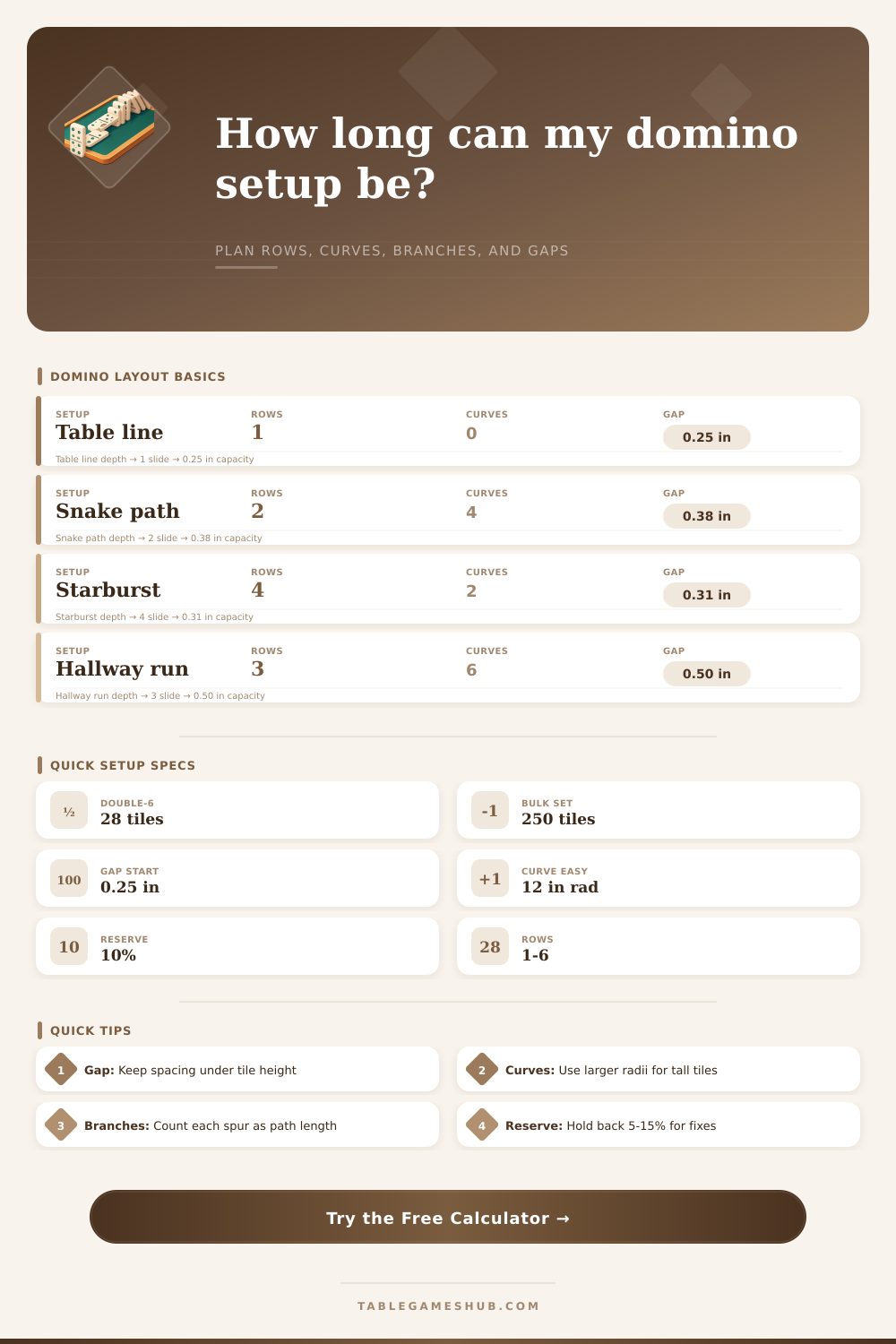
Estimate chain path length, footprint, and domino count from straight rows, curve arcs, branches, gaps, and reserve tiles.
Straight rows
Best for exact table edges. Formula weight comes mostly from rows x row length.
Snake paths
Best for compact rooms. Curve arc length adds distance without needing a longer table.
Branching paths
Best for reveal layouts. Every spur adds branch length and extra intersection tiles.
Hallway runs
Best for long chains. Footprint is narrow, but reserve should be higher for resets.
| Component set | Typical count | Common dimensions | Best layout use |
|---|---|---|---|
| Double-six domino set | 28 tiles | 2 x 1 x 0.3 in | Short tabletop rows and demonstrations |
| Double-nine domino set | 55 tiles | 2 x 1 x 0.32 in | Small snake path with one or two turns |
| Double-twelve domino set | 91 tiles | 2 x 1 x 0.35 in | Long table run or compact floor maze |
| Bulk toppling pack | 100 to 500 tiles | 1.8 x 0.7 x 0.3 in | School events, clubs, and record practice |
| Formula part | Calculator expression | Uses inputs | Why it matters |
|---|---|---|---|
| Straight path | rows x row length | Rows, row length | Counts every straight segment in the toppling route |
| Curve arcs | curves x 2 x pi x radius x angle / 360 | Curves, radius, angle | Turns add length without extending the straight footprint |
| Branches | branches x branch length | Branches, branch length | Side spurs need their own dominoes and reset reserve |
| Spacing pitch | tile thickness + gap | Thickness, gap | Sets how many dominoes fit along each path unit |
| Gap target | Imperial range | Metric range | Use when |
|---|---|---|---|
| Tight topple | 0.15 to 0.25 in | 4 to 6 mm | Small dominoes or short indoor test rows |
| Standard setup | 0.25 to 0.50 in | 6 to 13 mm | Most table and floor domino layouts |
| Large tile setup | 0.50 to 1.00 in | 13 to 25 mm | Jumbo tiles with taller standing height |
| Risky spacing | Over half height | Over half height | Likely to skip unless tile fall is controlled |
| Setup scenario | Rows | Curves | Branch note |
|---|---|---|---|
| Table edge line | 1 to 2 rows | 0 to 2 turns | Usually no branches |
| Compact maze | 3 to 5 rows | 4 to 8 turns | Short decorative spurs |
| Starburst reveal | 1 center row | 1 to 3 arcs | Four or more equal branches |
| Hallway chain | 2 to 6 sections | 2 to 6 turns | Branches only at feature points |
Planning a domino chain requires that you decide exactly how far the toppling path will travel before the last domino fall. The distance of that path determines how many dominoes will be required to create that path, the distance of that path determines how much space will be required on the floor or table for the dominoes to lie in a path, and the distance of that path will determine if any of the spare dominoes that you brought will be used to reset the chain or to replace any that may be missed during the fall of the last domino. The calculator will handle the math for you once you have described the shape of the path that the dominoes will travel, saving you from the guesswork of determining the arc lengths of any curve that may be part of the path.
Many people will envision a series of dominoes arranged in a straight line from one end of the table or floor to the other. This is only suitable for relatively short demonstrations, however. If you would like to include a turn in your path of dominoes, it become more complex than the simple count of the number of dominoes needed for a straight line.
Plan Your Domino Path and Count Dominoes
The length of the path of dominoes that curves can be measured along the centerline of that curve, and the calculator treats any curve as a portion of a circle the radius of which you can enter into the calculator. If the radius of that curve is large relative to the length of the turn that it makes, the turn will be gentler and it will consume more dominoes to complete that turn. Conversely, if the radius is small, the turn will be tight and steep, such as a 90-degree turn, and it will consume fewer dominoes to perform that turn.
If any branch are to be made in the path, the same complex calculations are made. Each branch will be a separate run of dominoes, each branch will increase the total length of the path, and the number of dominoes will increase at the split in the path. Any extra dominoes that is added at the split of the path will sit at the intersection of the branches and they cant be shared between the separate paths of each branch.
The calculator includes a small allowance in the number of dominoes for these extra dominoes at the split, and then it calculates the number based on the percentage of the total number of dominoes that you chose to bring as a reserve. Spacing between each domino is another important factor in the construction of a path of dominoes. If the gap between each domino is too small, the path may not work reliably if the table is warped.
However, if the gap between each domino is too wide, that portion of the path will be wasted in the construction of the path of dominoes. The calculator will calculate the distance between each domino, combining the thickness of each domino with the gap between each domino to form a pitch. The total length of the path will be divided by that pitch to calculate the number of dominoes that will be required.
The pitch will be expressed in the same units as the length of the path that you define, so the calculator will automatically convert inches to millimeters and vice versa as you toggle between units. The footprint that the domino arrangement will occupy is calculated in the same way as the length of the path of dominoes, but in two dimensions. One dimension will be the length of the longest row of dominoes, and the other dimension will be the width of the arrangement of the dominoes, which is determined by the spacing between rows of domdominoes, the diameter of the curves of the path, and the width of each branch.
This estimate of the footprint is accurate enough to allow you to decide whether the path will fit on a rug or whether you must move one of your coffee tables. If the footprint is too large, you can always reduce the number of rows of dominoes, reduce the radius of any curves in the path, or eliminate one of the branches. The sizes of the dominoes can also impact the number of dominoes and the footprint of the arrangement.
If you use mini dominoes, fewer inches of floor will be consumed by each row of dominoes. If you use jumbo dominoes, larger gaps between each domino will be required and the curves will be larger in diameter, which will impact the number of dominoes required. The calculator will store the dimensions of each type of domino in the program, but you can change the thickness, the height, and the gap of each domino in the calculation for custom sets of dominoes.
As the initial plans for the path of dominoes are constructed, it is likely that the path will need to be changed during the construction phase. For example, you may plan a starburst pattern of four identical branches to a center domino, but one of the branches may need to be shortened to avoid one of your tables. Likewise, a hallway of dominoes may need to include a loop to avoid another doorway.
The calculator will provide a solid calculation of the number of dominoes that will be required, and it will help you make sure that your alterations to the original plan will still be within the budget of dominoes that you brought to complete the project. These calculations help to determine the number of each type of domino that will be required for the project. Each type of calculation can be separated to help determine how many of each type of domino are required.
These separate calculations will help to compare the requirements of two different designs for the path of dominoes. Once you have determined the number of dominoes that will be required based off the different calculations, you should mark the path of the dominoes on the floor. A line can be drawn along the centerline of any curves in the path using chalk or tape, for instance.
Along that centerline, you can place the first domino by measuring out half the width of a domino from the centerline. Each additional row of dominoes can be measured out at the spacing that you defined. The visual estimation of the path of dominoes that is provided by the calculator will provide a general idea of where the dominoes should be placed, but will not be as accurate as physically placing a few of the dominoes to test the path.
When the last domino falls in the direction that you intended for it to fall, and there is still a spare number of dominoes to replace the reserve number of dominoes, you know that your original calculations was sound and that any alterations that you have made to the original path are within the limits that the calculator established.