🎯 Kubb Pitch Dimensions Calculator
Size a kubb field, baselines, centerline, king position, corner pins, baseline kubb spacing, and scaled backyard layouts.
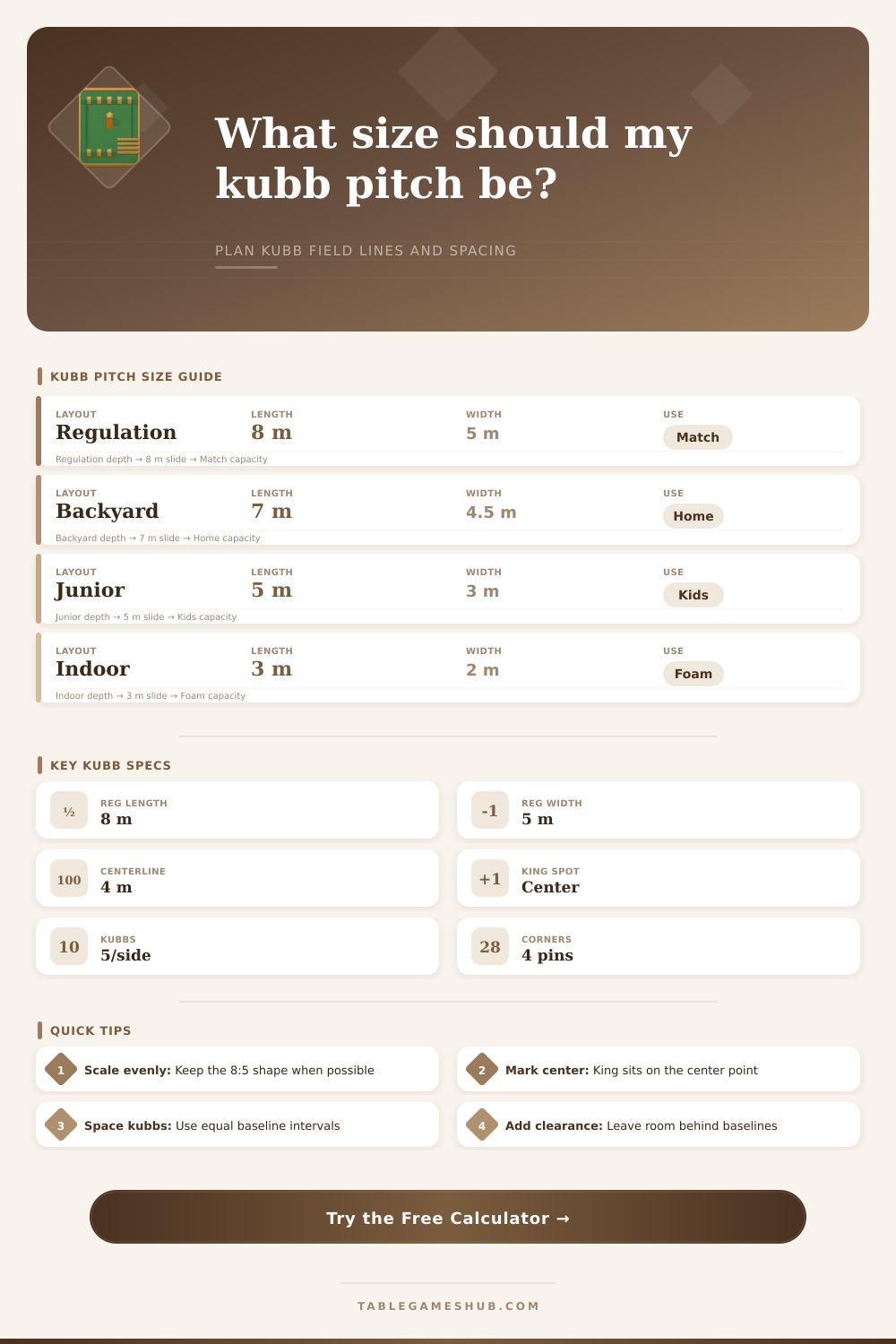
| Layout | Pitch Length | Pitch Width | Best Use |
|---|---|---|---|
| Regulation match | 8 m or 26.25 ft | 5 m or 16.40 ft | Standard adult kubb |
| Backyard scaled | 6 to 7 m | 4 to 4.5 m | Home play with shorter throws |
| Junior family | 4.5 to 5.5 m | 2.8 to 3.5 m | Kids, mixed ages, limited yards |
| Indoor foam | 2.5 to 3.5 m | 1.5 to 2.2 m | Soft sets and practice throws |
| Marker | Regulation Coordinate | Scaled Formula | Calculator Output |
|---|---|---|---|
| Near baseline | y = 0 m | Start of length | Baseline row |
| Far baseline | y = 8 m | Pitch length | Baseline row |
| Centerline | y = 4 m | Length divided by 2 | Card and breakdown |
| King | x = 2.5 m, y = 4 m | Width divided by 2, length divided by 2 | King coordinate row |
| Pitch Width | Baseline Kubbs | Inset Centers | Approx Center Spacing |
|---|---|---|---|
| 5 m regulation | 5 per side | 0.035 m and 4.965 m | 1.23 m |
| 4.5 m backyard | 5 per side | 0.035 m and 4.465 m | 1.11 m |
| 3 m junior | 5 per side | 0.035 m and 2.965 m | 0.73 m |
| 2 m indoor | 5 per side | 0.035 m and 1.965 m | 0.48 m |
| Clearance Area | Regulation Suggestion | Backyard Minimum | Why It Matters |
|---|---|---|---|
| Behind baselines | 1.5 to 2 m | 1 m | Throwing stance and recovery |
| Outside sidelines | 1 m each side | 0.5 m | Safe walking and missed batons |
| Corner pins | On four corners | On four corners | Defines the pitch rectangle |
| King clearance | Center stays open | Center stays open | Keeps the middle target visible |
Tip 1: Scale the rectangle before the pieces
For backyard kubb, reduce length and width together so the pitch still feels close to the 8 m by 5 m regulation shape.
Tip 2: Mark coordinates from one corner
Use one baseline corner as zero, then measure the centerline, king point, and kubb centers from that same reference.
A kubb field is a rectangle, and the dimensions of that rectangle will determine the layout of the game. You must decide on the length of the kubb field and the width of the kubb field prior to setting up the pieces on the field. A regulation kubb field is eight meters in length and five meters in width.
Any changes to the length or the width of the field will change the distance between the players and the pieces that are to be thrown. The calculator will provide you with the mathematical measurement of the kubb field once you have entered the length, the width, and the number of baseline kubbs that will be used in the game. By using the calculator, you will ensure that you dont make a mistake in measuring the field, and you will ensure that you provide enough extra room behind the baseline kubbs.
Kubb Field Size and Layout
The length of the kubb field is one of the most critical measurements for the game. The length of the field will determine how far a baton must travel for a player to score a point. Fields with a longer length will require the baton to travel a further distance, and it will take the defenders more time to react to the baton that is thrown.
An eight-meter length for the field is ideal for experienced kubb players, but fields with shorter lengths are more easy for younger players to master. The width of the field is another of the most critical measurement to establish. The width of the field will determine how many kubbs can be placed on each baseline.
The five-meter width allow five kubbs to be placed on each baseline with even spaces in between each kubbs. If the width of the field is too narrow, however, the kubbs will be too close to the sidelines of the field, and they can be more difficult for the players to hit without also hitting the sideline of the field. The spacing of the baseline kubbs depends upon the width of the kubb field.
The calculator will determine the distance between each of the baseline kubbs so that they are even along each baseline. Having even spacing between the baseline kubbs ensures that there are even gaps between each kubbs. By using the style setting for the layout of the baseline kubbs, the outer kubbs will be placed near each sideline of the field.
By using the custom margin setting, the calculator will move the first and last kubbs inward from the baseline so that they are kept away from the sidelines of the field. By moving the kubbs inward from the baseline to the sidelines, they will be less likely to be knocked out of bounds, and they will be less likely to be hit by a wide throw from an opposing player. The centerline is a line that is situated in the middle of the length of the kubb field.
The centerline divides the field into two equal sides, and it is where the king of kubb stands. The centerline must be placed correctly because after the opening phase of the game is completed, every throw must follow the centerline rules. The calculator will provide the midpoint of the length of the field, and the calculator will also provide the coordinate of the king.
The king always stands at the center of the width of the field, and at the center of the length of the field. It is important for the players to ensure that the king is visible during the game. Within the field, there is a designated area for the players to clear.
The clearance area is one and a half meters in width behind each of the baseline marks. This area allow for the player to move forward to throw the baton over the kubbs. An area behind the baseline markings is also provided for players to retrieve their batons from the area behind the baseline.
An area to the sides of the field is also provided so that players dont knock their throws into the bushes or down slopes of the field. The calculator will add this area to the length and the width of the kubb field. The total footprint of the game will be larger than the playing area of the field.
Therefore, it is critical that the players have enough lawn area for the total footprint of the kubb field. There are several different settings for the kubb field. A tournament layout for kubb will be eight meters in length by five meters in width, and there will be additional clearances for the officials of the tournament.
A backyard layout will be smaller in size for easier throws for players. A junior layout will be even smaller in size to account for the shorter throwing distance of younger players. An indoor layout will have even smaller dimensions since it will be played on floor.
The calculator allows players to switch between each of these settings so that the spacing and footprint of the field is adjusted to accommodate each of these size. One of the most common mistake made by players is to decrease the length of the field but to leave the width of the field as it is. By decreasing the length, the field will become long and narrow.
This can change the angle of the throws that the players make. It is better to maintain the eight-to-five meter length-to-width ratio for the players to maintain the same strategy in the game. Another of the most common mistakes by the players is to forget that the baseline kubbs must have gaps between each kubbs.
If there are more kubbs on the baseline, the gaps between each kubbs will become smaller. The calculator will provide a measurement of the width of the gap between each kubbs so that the players can decide whether or not the width of the field will have to be widened, or whether there will be fewer kubbs on each baseline. Corner pins are placed at the corners of the kubb field.
These pins allow the players to have a visual reference of each sideline of the field. Most people will place the corner pins at the corners of the field, but some rules allow the pins to be placed slightly outside of the corners of the field so as to protect the pins. The width of the king base is also included in the calculator results.
The width of the king base will affect how much clear space is to be provided around the center of the kubb field. These measurements do not change the rules of the game, but they will ensure that the field looks correct once it is marked out with lines. By planning the dimensions of the kubb field, you will ensure that all of the players are playing on the same rectangle.
By ensuring that the distances between the baselines are the same, and that the kubbs are even along each baseline, you will ensure that the game follows the rules of kubb. By using the calculator, you will save yourself the math that you would of otherwise had to perform to calculate each of these dimensions. Thus, once you have set all of the dimensions for the field and you have marked each of the lines for the players, the game can begin between players.