🎯 Petanque Court Calculator
Size a petanque terrain, lane count, throwing circle, jack distance, dead-ball lines, team layout, and scaled backyard footprint.
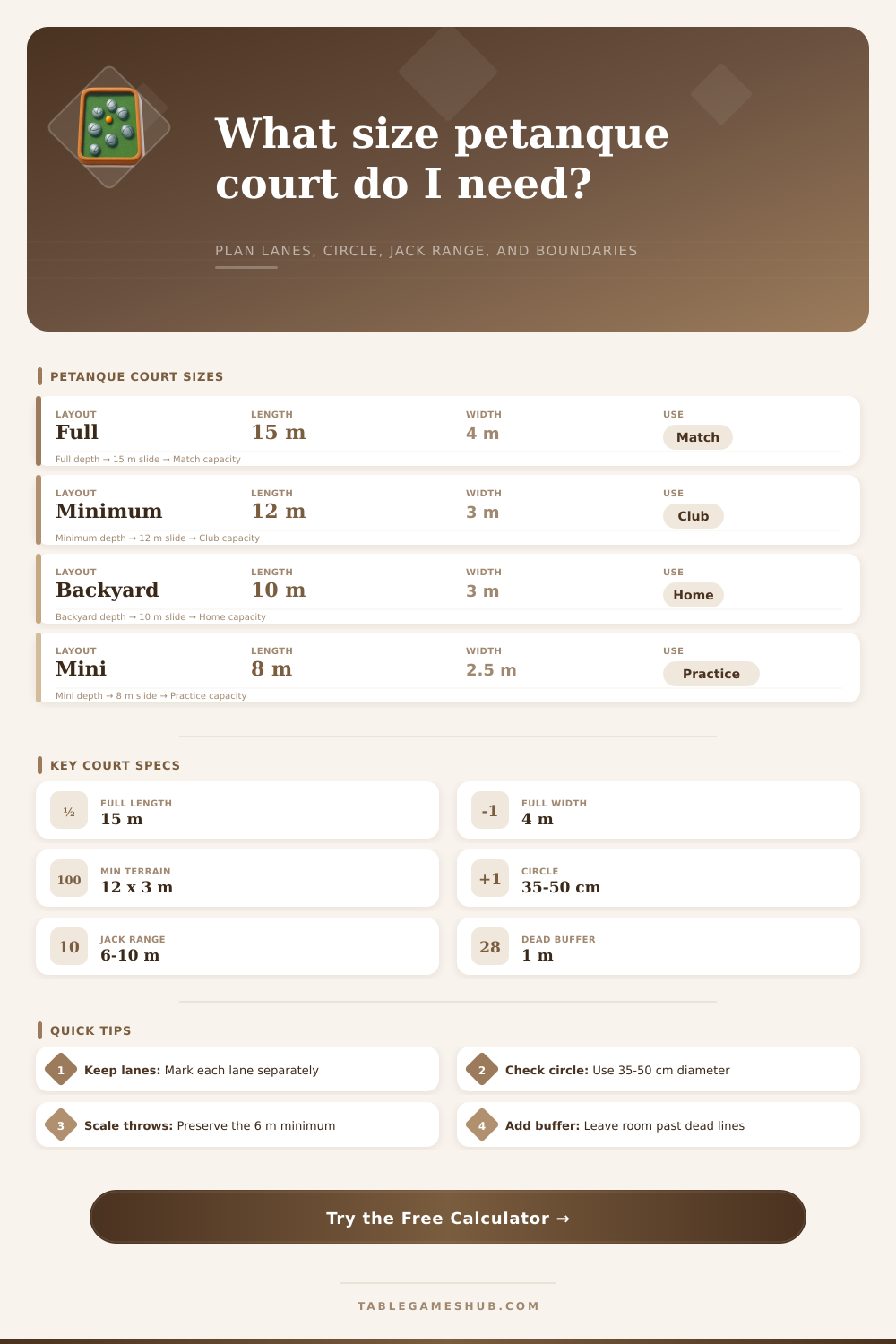
| Terrain | Inside Length | Inside Width | Best Use |
|---|---|---|---|
| Full marked terrain | 15 m / 49.2 ft | 4 m / 13.1 ft | National, international, and full club play |
| Minimum marked terrain | 12 m / 39.4 ft | 3 m / 9.8 ft | Regional, compact club, and serious home play |
| Backyard terrain | 9 to 11 m | 2.5 to 3.5 m | Home courts that still preserve the 6 m jack minimum |
| Practice strip | 7 to 9 m | 2 to 3 m | Short pointing drills and casual scaled games |
| Feature | Standard Range | Calculator Input | Layout Meaning |
|---|---|---|---|
| Throwing circle | 35 to 50 cm diameter | Circle diameter | Standing area for every boule throw |
| Jack distance | 6 to 10 m from circle | Jack min and max | Valid target throw band for adult play |
| Dead-ball line | Jack must stay clear of boundary | Dead-ball line buffer | Protects valid jack placement near edges |
| Circle clearance | About 1 m from boundary or obstacle | Circle boundary clearance | Keeps the throwing stance away from dead lines |
| Lane Count | Grouped Width | Players at Once | Typical Use |
|---|---|---|---|
| 1 lane | 4 m plus access | 2 to 6 players | Private court, one match, or practice |
| 2 lanes | 8.5 to 9 m plus access | 4 to 12 players | Club doubles or two simultaneous games |
| 4 lanes | 17 to 18 m plus access | 8 to 24 players | Park group, league night, or event play |
| 8 lanes | 35 m or more with gaps | 16 to 48 players | Tournament layout with marked lanes |
| Backyard Length | Suggested Width | Jack Range | Scaling Note |
|---|---|---|---|
| 12 m | 3 to 4 m | 6 to 10 m | Minimum marked terrain can keep adult distances |
| 10 m | 3 m | 6 to 9 m | Good backyard size with a shortened top range |
| 9 m | 2.5 to 3 m | 5.5 to 8 m | Compact doubles with reduced long throws |
| 8 m | 2 to 2.5 m | 5 to 7 m | Practice strip; mark as casual scaled play |
Tip 1: Start with the jack band
If the court is short, protect the 6 m minimum first, then reduce the maximum jack distance and mark the layout as a scaled backyard terrain.
Tip 2: Separate lane lines from dead lines
For multi-lane play, mark each lane clearly and keep dead-ball boundaries easy to see so a boule or jack is judged only after crossing fully.
When you are looking to mark out a petanque court, you may find that the available space for such a court isnt in an ideal shape. You might have a strip of land that is ten meters in length and two meters in width that you could use for a single lane of play. Alternatively, the club may have a patch of ground that is only large enough for two lanes of play.
Beyond the size of the rectangle that is available to you, though, you must also take into consideration the fact that the length of the court must allow for the jack to be thrown a distance that allows for players to engage in real play with the jack. Additionally, the throwing circle must be contained within the dead-ball lines, and the entire court must accommodate for the number of players that are to utilize the court at any given time. The petanque court calculator allows you to determine many of these dimension for your desired course.
How to use the petanque court calculator
By entering the length and the width of the area that you wish to mark out for petanque, the number of lanes that you wish to have marked out along the strip of land, and how much clearance you wish to provide at the ends and the sides of the court, the calculator can tell you whether or not the distance for which the jack is to be thrown will fit within the court once the dead-ball lines are accounted for. Additionally, the calculator can show you how wide the court will be after accounting for the width of the lanes and the gaps between those lanes, which may be important if you are attempting to fit multiple terrains within a certain strip of land within the park that already has other feature like trees or benches along its edge. Petanque courts can range in size from fifteen meters in length by four meters in width.
Such dimensions is utilized in national and international competitions, and allow for jacks to be thrown between six and ten meters from the throwing circle. For most clubs and individuals that play the game at home, though, a length of twelve meters by three meters is likely all that is required for players to have an even game of petanque. The calculator can determine whether or not the distances within this smaller area will fit within the court dimension after the buffer for the dead-ball lines is accounted for.
Within the court are the throwing circles, which are easy to overlook when setting out to mark the court. The throwing circle, though, must still be an appropriate size for the players, it is allowed to be anywhere between thirty-five and fifty centimeters in diameter. If the throwing circle is too small (smaller than thirty-five centimeters), players may feel as if they are not having an even game when rotating throwing positions.
If the circle is too large (larger than fifty centimeters), though, it will take up some of the length of the court that is allotted for the jacks to be thrown. The calculator also allows players to input how many meters of space they will leave between the throwing circle and any dead-ball lines. This ensures that the boule that is thrown behind the throwing circle does not become a dead boule, and that players dont have to worry about stepping out of the throwing circle while throwing their boules.
Backyard courts, however, are often smaller than those within parks or clubs. If there is less than ten meters of length available, for instance, the maximum distance for the thrown jacks will be less than the competition standard. Such a course is still usable, though, and players can mark the court to account for this.
Two-and-a-half meters is a fairly narrow width for a throwing lane, but it is still enough space for players to engage in doubles play on such a court. Another consideration with marking out a throwing area is the number of players that may utilize that court for various games. Singles and doubles players use three boules each, meaning that there will be eighteen boules on the court for six players that are playing on a single lane.
Triples players, however, use only two boules each, so there are fewer boules on the court at any time, but more individuals that have to stand near the throwing circle. These variable can be entered into the calculator to determine how many boules and players will be on the court, which can help clubs to determine if one lane is enough for all players to use, or if the opening of a second lane is required. Another of the features of the court is the dead-ball boundaries.
Any time the jack or one of the boules crosses the boundary lines, the jack or boule is out of play. A small buffer in the boundary lines, though, allows for the jack to remain on the court if it is within centimeters of the boundary line. The petanque court calculator allows players to input the size of the dead-ball buffer.
If the dead-ball buffer is too small, there may be an argument over whether the boundary lines were crossed. If too large, though, length of the court that could be used for throwing jacks will be lost. If multiple courts are to be laid out, the gaps between those courts must be considered.
Fifty centimeters of space between courts is enough for a string or divider of some sort, but additional space between courts allows spectators or individuals playing the game who are not throwing to move about the court. These gaps between courts are accounted for in the petanque court calculator. Another feature of the calculator is that it indicates the percentage of the size of the courts that are laid out.
If the backyard courts are only two-thirds the length of the full terrain courts, the distances that jacks are thrown will be of the same scale. This prevents the individual from making an error in setting up a short court for the backyard. By altering any of the variables that are entered into the calculator, the others will change to reflect those alterations.
If the number of lanes is increased, for example, the grouped width will increase. If the length of the court is shortened, the distance of which the jacks are thrown can be shortened. If the amount of clearance provided at the ends of the courts is increased, the total footprint of the area that is used for play will increase.
These alterations allow individuals to gain an understanding of how the variables relate to one another, which is helpful when attempting to explain to others why a certain layout will or will not be successful. Such a calculator can perform the calculations that would of otherwise been performed with a tape measure and notepad. Armed with the calculations from the calculator, the individual can make decision regarding the use of the course, and who will use the course for petanque play.