Call of Cthulhu Credit Rating Calculator
Allocate an investigator's Credit Rating by occupation band, abstract spending level, asset score, party role, period tone, and lifestyle tier without using real-world prices.
| Occupation Band | Suggested Range | Social Signal | Best Party Use | Allocation Note |
|---|---|---|---|---|
| Struggling or marginal work | 0 to 19 | Low formal status | Street access, disguise, risky leads | Keep points for survival skills |
| Working professional | 10 to 40 | Reliable respectability | Introductions and routine access | Good default for balanced builds |
| Established specialist | 20 to 60 | Known in a useful field | Archives, labs, letters, experts | Pairs well with knowledge skills |
| Respected elite field | 30 to 80 | High-status professional | Clubs, officials, institutional doors | Expensive in skill points |
| Inherited wealth or high society | 50 to 99 | Name recognition and patronage | Funding, invitations, society leverage | Needs a strong character reason |
| Period Tone | Modifier | What It Represents | Access Effect | Keeper Prompt |
|---|---|---|---|---|
| Gaslight or genteel society | +0 | Class markers matter openly | Credit Rating is read directly | Ask where the reputation comes from |
| Classic 1920s investigation | -3 | Reputation helps, but scrutiny rises | Small drag on effective standing | Tie access to references and attire |
| Depression or hard-times tone | -6 | Liquidity and trust are strained | Spending requests become harder | Use favors instead of ready resources |
| Modern access-heavy campaign | +2 | Credentials travel faster | Small boost to institutional access | Separate online reputation from wealth |
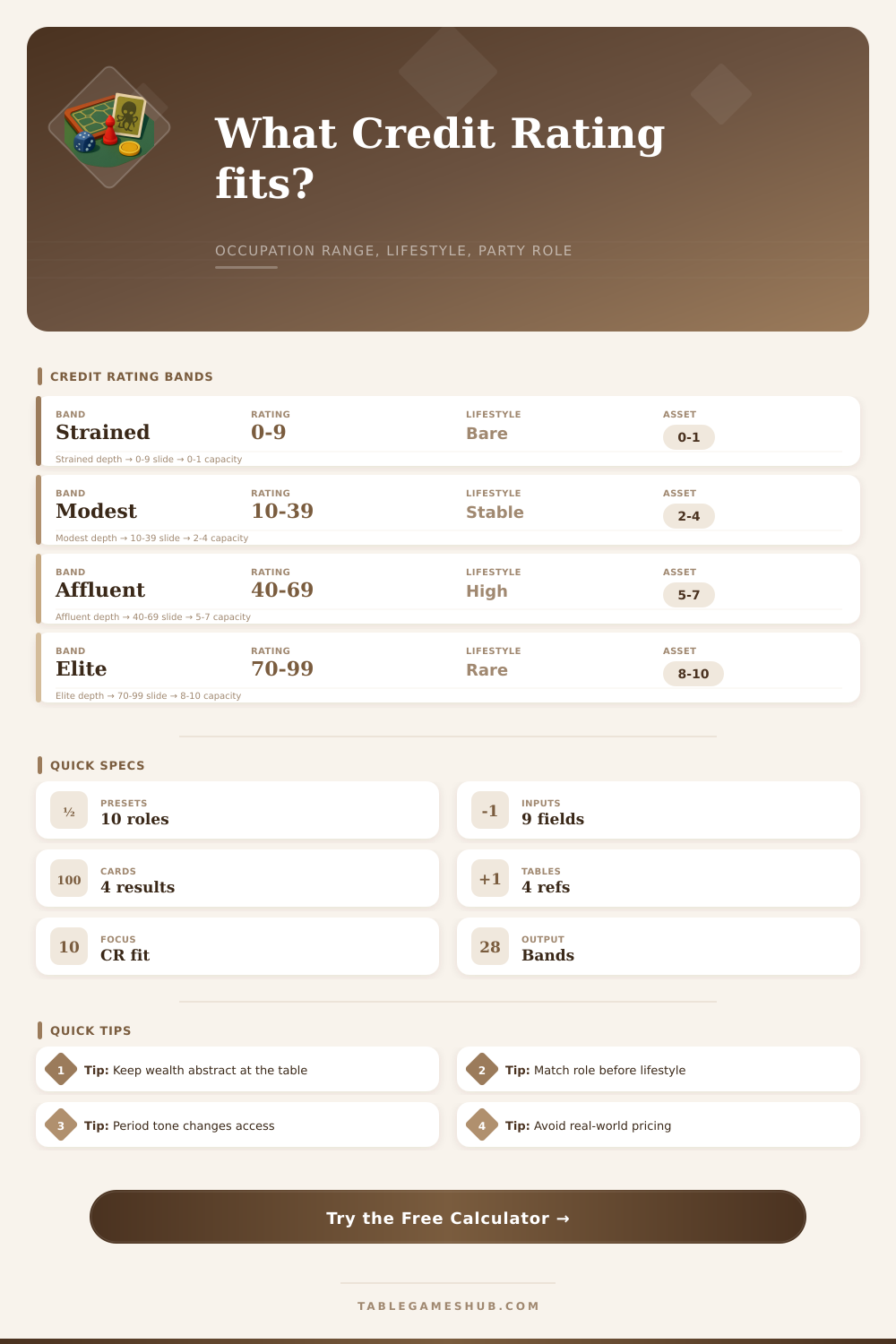
| Lifestyle Tier | Rating Floor | Asset Score | Table Meaning | Failure Signal |
|---|---|---|---|---|
| Bare | 0 | 0 to 1 | Unstable lodging and few cushions | Delayed favors, debt, exposure |
| Modest | 10 | 2 to 4 | Reliable basics and local respect | Choose between comforts and tools |
| Comfortable | 30 | 4 to 6 | Stable address and social footing | Introductions take time |
| Affluent | 50 | 6 to 8 | Servants, clubs, patrons, travel access | Attention from rivals or authorities |
| Elite | 70 | 8 to 10 | Rare circles and major influence | Obligation, scandal, public scrutiny |
| Party Role | Target Bias | Strength | Tradeoff | Good Range |
|---|---|---|---|---|
| Self-funded investigator | Balanced | Can justify routine travel and tools | Less dramatic leverage than a patron | 20 to 50 |
| Social face and introducer | Access | Opens doors and smooths officials | Consumes points from field skills | 35 to 70 |
| Patron or expedition backer | Assets | Explains logistics and retainers | Attracts obligation and scrutiny | 50 to 85 |
| Field specialist with modest means | Skills | Keeps build points for practical work | Needs contacts for elite access | 10 to 35 |
| Outsider or hidden identity | Disguise | Low profile and fewer assumptions | Harder formal introductions | 0 to 30 |
Credit Rating is an statistic that represents the social standing and the financial resources that your character possesses. Credit Rating is not just a representation of money, and Credit Rating is not just a numerical value. Instead, Credit Rating exist as a tool to determine how other characters in the game will interact with your character.
Characters with high ratings has access to areas in the game that characters with a lower Credit Rating are denied access to. Characters with wealth can perform actions that deny characters without wealth access to certain features. Many players makes the mistake of considering Credit Rating as if it were a secondary statistic to the character.
How Credit Rating Affects Your Character
Credit Rating must have a purpose for your character and the game. By treating Credit Rating as a binary switch for your character, you will lose the element of tension that comes from the character struggling with money. A character who lives in a boarding house will exhibit a different relationship with the rest of society than a character who recieve their living from an inheritance.
The rest of high society is likely to ignore a character who lives in a boarding house. The character that has received their living from an inheritance is a known entity in high society, even if their wealth is starting to wane. You must make a decision for your character as to whether their wealth will provide them with connections to others in society, or whether the lack of wealth for your character will create obstacles for them in society.
You should consider the role that your character will play within the group of investigators. In any group of investigators there must be at least one investigator who is able to interact with officials or pay bribe to help them in some way. This investigator will have a high Credit Rating.
Depending on the role that you would like to play within the investigation team, you may have to allocate your points differently. Investigators who play the role of the leader of the group will likely need to allocate more points to their Credit Rating than a field specialist. This is because the leader will be using their high Credit Rating to open doors for the rest of the investigators.
A field specialist, however, may want to allocate their points to their other skills rather than their Credit Rating as they can count on a wealthy investigator to assist them in their investigations. A calculator can assist in ensuring that your character’s Credit Rating aligns with their occupation. By aligning the Credit Rating that your character possess with their occupation in the game, you ensure that your character fits within the world that the Keeper has created for the game.
For instance, if your antiquarian has a high social rating within society but has no wealth, you have created a potential conflict for your character. A calculator can ensure that this does not happen to your character. Furthermore, a calculator will also allow you to determine whether or not your desired lifestyle for your character is compatible with the assets that they possess.
Abstract assets for characters are a helpful means of keeping track of their wealth since it is difficult to track wealth in a tabletop game. You dont need to track how much money your character put into purchasing a hotel room, but you do need to ensure that they have the wealth to perform this action. Asset scores and spending bands for characters help the Keeper to more easily manage the finances of the character.
Instead of having to count how much money each character has and subtract the price of an item that they wish to purchase, the Keeper can simply determine if the character has the resources to perform the action. Furthermore, this method helps to keep the game moving along at a steady pace, and it helps to maintain the element of tension regarding the possible financial ruin of the character. The time period in which the game takes place can play a major role in the function of Credit Rating.
In a high society there are markers for social classes that are difficult to change, but in periods of economic depression it is possible for individuals to lose all of their wealth. High Credit Ratings for characters can make them targets for others in society during these periods of economic depression. Such high Credit Ratings will alter the social life of your character within the time period in which the game is set.
These time period modifiers will alter the function of Credit Rating within the game. A Credit Rating that works within one decade may not have the same function within another decade of the time period. Credit Rating cannot be used as a way to solve every problem that your character may encounter within the cosmic horror setting.
For instance, while a high Credit Rating may allow your character to purchase a fast car, it will not help your character to pass a sanity check. Additionally, having extreme wealth can pose additional problems for the character that a character with no wealth poses. For instance, wealth puts your character in the spotlight and makes for them to be watched by the others in society.
The more people who watch your character the more likely that they will have consequences if they perform some action that the others in society fail to perform. Finally, when you have created your character it is helpful to review the ratio of the Credit Rating to the total occupation pool. If you have allocated most of your points towards Credit Rating for your character it is possible that they will have no skills in relation to the objects that they purchase with their wealth.
You must find a balance in how you allocate your points so that you ensure that your character has enough resources to enable the plot of the game, but you also ensure that they struggle enough to create a sense of victory whenever they succeed in their efforts. Credit Rating is a tool that can help you to create your character and define the world and the character’s ambitions within the game. You should of thought about the luxuruis nature of your choices.
It’s important to remember that your character’s decisions is based off of their background. Tehtricity is important to avoid. Actually, it’s alot of work.
Youll find that moddern characters needs to be balanced. Dont forget to check your characters wealth. Its important to recieve feedback.
You’re character is what matters. Your’re going to have fun. One of the most importent things is the character’s history.
They’re wealth can be dissapears quickly.