Javelin Throw Distance Calculator
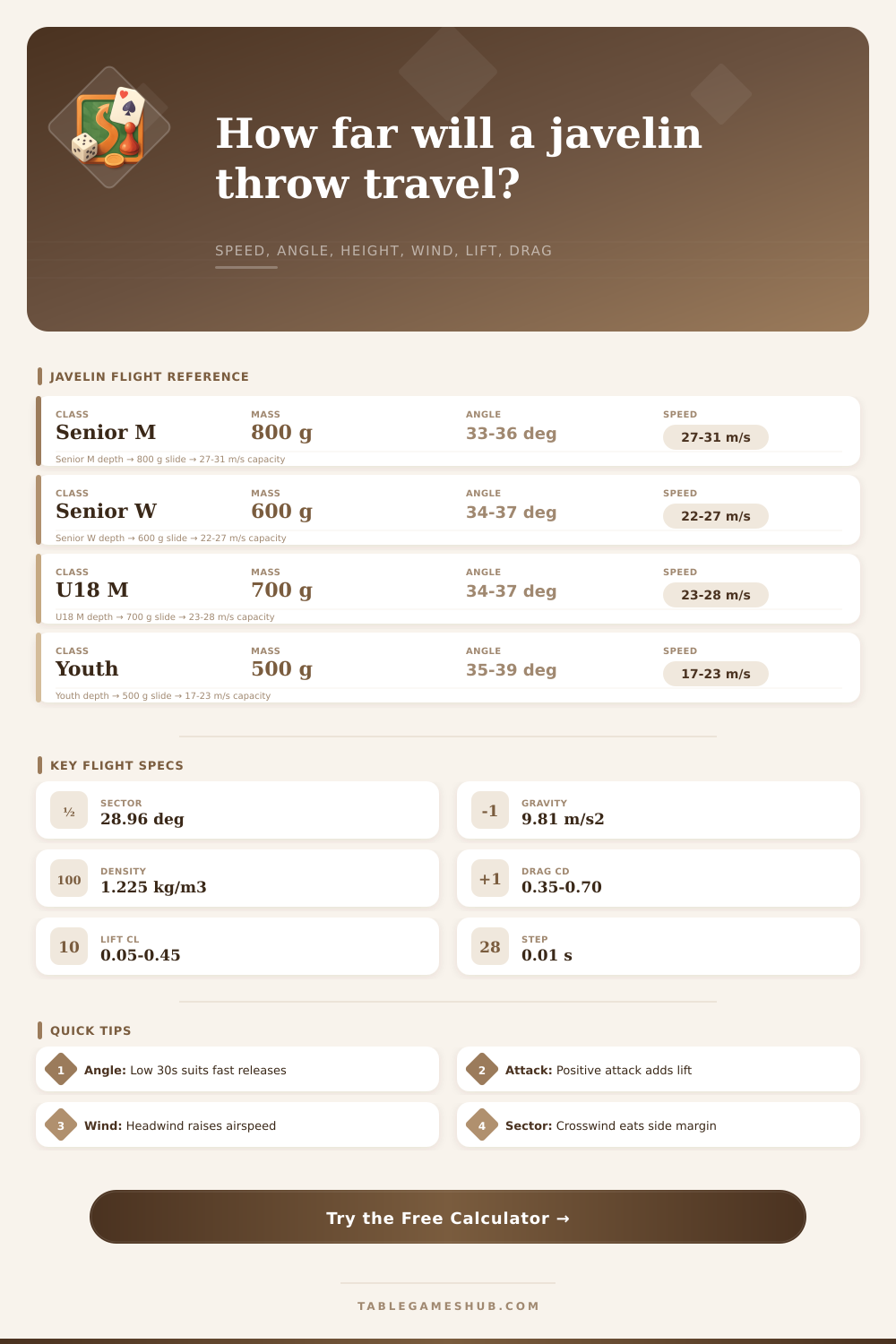
Estimate carry distance from release speed, angle, height, attack angle, javelin class, wind, drag, lift, and landing sector margin.
| Class | Mass | Typical length | Useful calculator range |
|---|---|---|---|
| Senior men / U20 men | 800 g | 2.60-2.70 m | 25-32 m/s release speed |
| U18 men | 700 g | 2.30-2.40 m | 22-29 m/s release speed |
| Senior women / masters | 600 g | 2.20-2.30 m | 20-28 m/s release speed |
| Youth / training | 400-500 g | 1.85-2.20 m | 14-24 m/s release speed |
| Release pattern | Angle band | Flight effect | Calculator watchpoint |
|---|---|---|---|
| Fast, low trajectory | 29-33° | Lower apex, shorter time aloft | Needs high speed to carry |
| Balanced carry | 33-37° | Often best with modest lift | Compare aero to vacuum result |
| High arc | 38-42° | More time aloft, more drag exposure | Headwind can punish wobble |
| Too steep for many throws | 43°+ | Distance falls unless lift is strong | Check apex and stall penalty |
| Profile | Base drag Cd | Lift response | Modeled use |
|---|---|---|---|
| Clean release | 0.38 plus attack effect | Stable low wobble | Best-case comparison |
| Standard release | 0.46 plus attack effect | Balanced lift and drag | Default calculator model |
| Wobble / yaw | 0.58 plus attack effect | Extra drag from poor alignment | Conservative distance estimate |
| Nose-high stall risk | 0.68 plus attack effect | Lift capped at high attack | Large attack angle tests |
| Input | Positive value | Negative value | Distance effect |
|---|---|---|---|
| Headwind / tailwind | Headwind into throw | Tailwind with throw | Headwind raises airspeed and drag |
| Crosswind | Drift to right side | Drift to left side | Reduces sector clearance |
| Sector half-angle | 14.48° | Same both sides | Allowed width grows with range |
| Margin kept | Extra clearance target | Zero means line limit | Turns drift into a pass/fail check |
Javelin throwing is a physical activity that are governed by the laws of physics. Several different variable determines the distance that the javelins travels, such as the attack angle of the javelin, the release angle of the javelin, and the way in which the javelin interact with the air around it. If the javelin is to travel the distance required of a javelin throw, it is essential that the javelin thrower take into account the effect that the javelin will have upon the air around it.
If the javelin does not interact with the air in an appropriate way, the javelin will not travel as far as it is potentially capable of travel. The attack angle of the javelin is the angle of the javelin in relation to the path of the movement of the javelin through the air. The attack angle have a significant effect upon the distance that the javelin can travel.
What Affects How Far a Javelin Flies
If the athlete aligns the attack angle of the javelin with the path that the javelin travels, the javelin will experience minimal air resistance. If the javelin has an upward tilt to its attack angle, the javelin will create lift. This created lift can extend the length of time that the javelin remains in the air.
However, if the attack angle of the javelin is too steeply, the air will not flow smooth over the javelin. As a result, the javelin may stall in flight, and a javelin that stalls will begin to fall towards the ground quick. The release angle of the javelin is the trajectory of the javelin in relation to the ground.
Many people believe that a release angle of forty-five degrees to the ground is the best angle for maximizing the distance that the javelin travel. However, the athlete can adjust the release angle according to the speed at which the javelin is thrown and the strength of the wind. For instance, athletes that possess high speed with which to throw javelins may use angles that are lower than forty-five degrees to the ground.
The javelin will spend less time interacting with the wind at an unfavorable angle if the javelin follow a flatter trajectory. However, javelin throwers with lower speeds may use angles that are higher then forty-five degrees to the ground. These athletes must ensure that there javelins spend sufficient time in the air to reach great distances.
Wind is another of the variables of javelin throwing. A headwind is wind that move in the opposite direction of the javelin’s movement. Headwinds can increase the relative air speed of the javelin, which in turn can increase the lift that the javelin experience.
Thus, headwinds may assist javelins in traveling further distance. Tailwinds, however, are winds that travel in the same direction as the javelin. These type of winds will reduce the relative air speed of the javelin, which can lead to a decrease in the amount of lift that the javelin experiences.
Consequently, javelins may fall short of the distances that the javelin thrower intended for their javelins to travel. The mass of the javelin also has an effect upon its flight. For instance, javelin have different masses.
A javelin with a mass of eight hundred grams will have more inertia than javelins with a mass of five hundred grams. Because the javelin with more inertia will make it more difficult for the javelin to change the direction of the javelin, the javelin will experience a greater resistance to the effect of the wind. However, more inertia also mean more force is required to accelerate the javelin to reach the high speed that are required for javelin thrower to maximize the distance to which the javelin travels.
Additionally, because the javelin is more massive, the wind will more easily move the javelin. Thus, javelin throwers throwing javelins of less mass will require much more precision in the attack angle at which they throw their javelins. Finally, another of the variables to consider is the landing sector.
The landing sector is the area in which the javelin must land in order to count as a valid throw; the area is marked by white line. If the javelin land outside of the landing sector, it is a foul. The force of crosswind can affect the landing sector.
Furthermore, one can mathematically calculate the effect of the javelin in terms of the amount of drift that it will experience due to those crosswinds. By calculating this variable, javelin thrower can ensure that they remain within the limits of the landing sector.