Jump Rope to Miles Calculator
Convert jumps, cadence, intervals, stride-equivalent length, rope circumference, and skill style into a distance-equivalent session log.
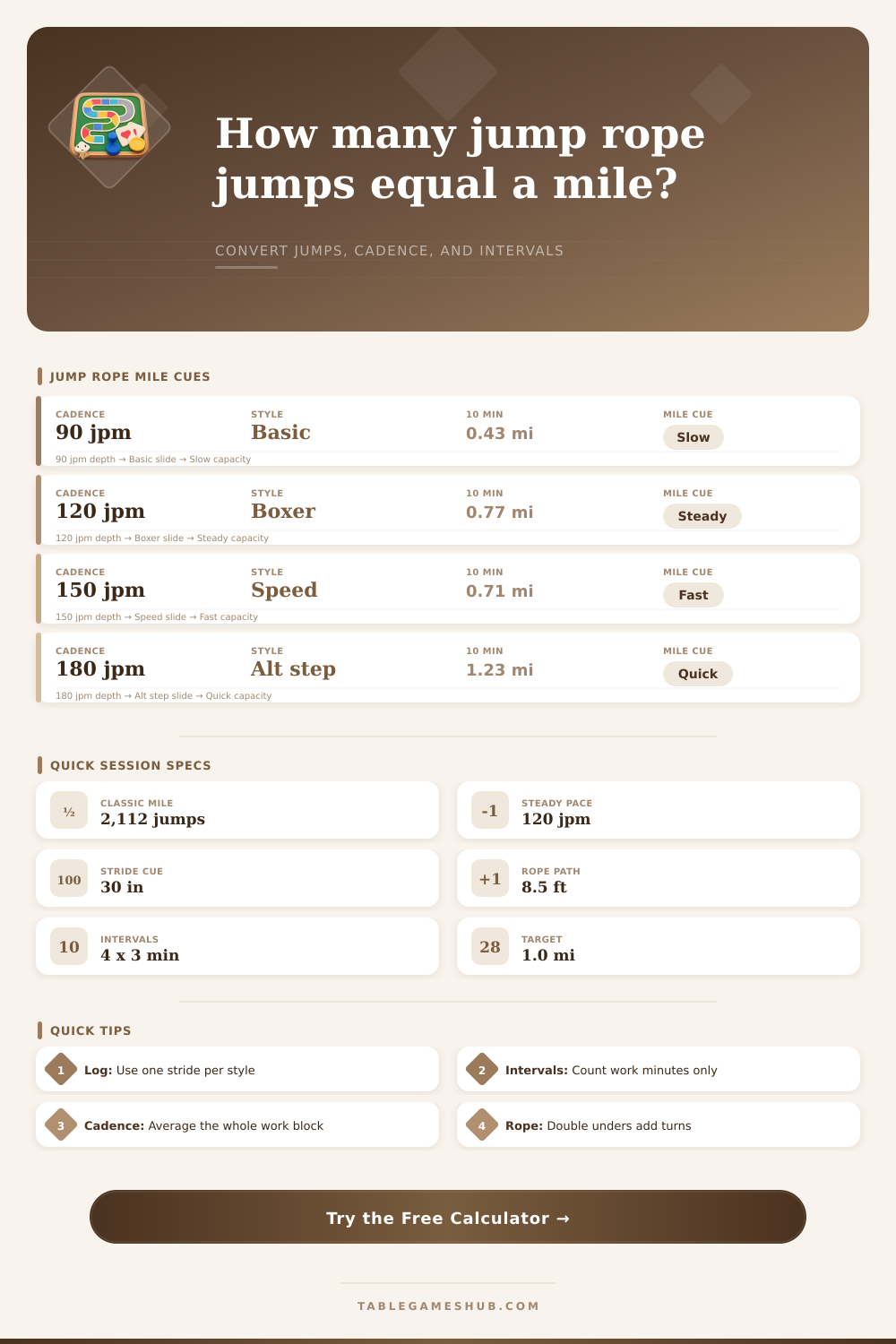
| Cadence Range | 10-Min Jump Count | At 30 in per Jump | Typical Use in This Calculator |
|---|---|---|---|
| 80 to 100 jumps per minute | 800 to 1,000 jumps | 0.38 to 0.47 miles | Warmup logs and deliberate rhythm |
| 100 to 130 jumps per minute | 1,000 to 1,300 jumps | 0.47 to 0.62 miles | Steady basic bounce or boxer step |
| 130 to 160 jumps per minute | 1,300 to 1,600 jumps | 0.62 to 0.76 miles | Fast continuous blocks and speed rope |
| 160 to 190 jumps per minute | 1,600 to 1,900 jumps | 0.76 to 0.90 miles | Short rounds with compact footwork |
| Skill Style | Default Stride Equivalent | Default Rope Path | Distance Effect |
|---|---|---|---|
| Basic bounce | 30 in per jump | 8.5 ft per turn | Balanced count-to-mile baseline |
| Boxer step | 34 in per jump | 8.6 ft per turn | Longer lateral rhythm equivalent |
| Alternate step | 36 in per jump | 8.7 ft per turn | Closer to a running-step log |
| Speed rope compact bounce | 28 in per jump | 8.2 ft per turn | More jumps needed per equivalent mile |
| Double-under mix | 31 in per jump | 8.4 ft per turn | Same jump distance, extra rope turns |
| High-knee run step | 38 in per jump | 8.8 ft per turn | Largest stride-equivalent setting |
| Freestyle rhythm | 32 in per jump | 8.9 ft per turn | Moderate stride with variable rope path |
| Rope Path per Turn | 1,000 Single Turns | 2,500 Single Turns | Use Case |
|---|---|---|---|
| 7.5 ft | 1.42 cable miles | 3.55 cable miles | Shorter rope or compact user setup |
| 8.0 ft | 1.52 cable miles | 3.79 cable miles | Common speed rope travel estimate |
| 8.5 ft | 1.61 cable miles | 4.02 cable miles | General adult rope path baseline |
| 9.0 ft | 1.70 cable miles | 4.26 cable miles | Longer cable or wider arc setup |
| 9.5 ft | 1.80 cable miles | 4.50 cable miles | Freestyle clearance and wider turns |
| Session Pattern | Cadence | Raw Jump Count | At 32 in per Jump |
|---|---|---|---|
| 4 rounds x 2 minutes | 110 jumps per minute | 880 jumps | 0.44 miles equivalent |
| 5 rounds x 3 minutes | 125 jumps per minute | 1,875 jumps | 0.95 miles equivalent |
| 8 rounds x 90 seconds | 150 jumps per minute | 1,800 jumps | 0.91 miles equivalent |
| 10 rounds x 1 minute | 170 jumps per minute | 1,700 jumps | 0.86 miles equivalent |
Jumping rope and treadmill running is both forms of cardiovascular exercise. However, jumping rope and treadmill running differ in that jumping rope dont involve moving across a physical distance. When jumping, an individual stay in the same location.
Because jumping occur in one location, there is no physical distance to track. For those who use jump ropes to exercise, it is often difficult to measure the progress that are made with a jump rope. The solution of using the concept of a stride equivalent allow individuals to calculate the distance that is jumped on a jump rope.
How to Measure Distance When You Jump Rope
The type of jump that are made will impact the virtual distance that is jumped and the number of jumps that will equal a mile. For instance, jumping on a compact speed rope bounce will require more jumps to equal a distance of one mile compared to an alternate step jump where more virtual distance are covered with each jump. Using a calculator will help to calculate the number of jump required to jump a virtual distance of one mile for each of these jump styles.
Using a calculator to calculate these jumps will remove the guesswork of the number of jumps required to exercise a certain distance. Cadence can be used to calculate the distance jumped with a jump rope. Cadence is the number of jump that are made per minute.
Using a slow cadence will help to recover muscles and the heart, but will result in fewer calories burned compared to a high cadence jump. When jumping at a specific cadence and counting the jumps made per minute, an individual can measure the “engine” of their body to determine the effort put into jumping. By measuring the “engine” of an individual’s body, that person can appropriately categorize their jump rope session.
Errors made while jumping can make distance measurement inaccurate. For example, if an individual only measures the amount of time spent jumping, the measurement will overestimate the distance jumped because it does not account for the time spent resetting the feet. The miss rate can be used to account for these error in jumping.
Using the miss rate will ensure that only jumps are logged that did not incorporate any mistake. This is the only way to provide an honest measurement of distance jumped on a jump rope. Jumping in double unders will add complexity to the jump rope session.
A double under jump will make the rope travel twice the distance in comparison to a jump. Additionally, intervals will allow an individual to take rests during the session. While taking rests will give the muscles and the heart time to rest, no virtual distance are covered during these rests.
By separating the time spent jumping from the total session length, an individual can more accurately compare the pace of jumping to the time spent at the gym. The reference tables on this page allow an individual to compare the different jump style and the trade-offs of each. These tables will provide an individual with the information required to choose the best jump style for their specific goal.
For instance, an individual looking to jump a distance can use the tables to determine that a basic bounce will provide the best results. However, an individual looking to develop explosive power can use a high knee run jump style. The goal for each of these jump metrics is not to find the perfect way to jump a rope.
However, establishing a benchmark will allow an individual to see their jumping efficiency improve over time. Once they can determine that a certain number of jumps will equal a certain distance jumped on the jump rope, individuals will no longer have to guess at how far they jumped but will have an accurate measurement of their jumping performance. Actually, jumping rope and treadmill running is both forms of cardiovascular exercise.
However, jumping rope and treadmill running differ in that jumping rope dont involve moving across a physical distance. When jumping, an individual stay in the same location. Because jumping occur in one location, there is no physical distance to track.
For those who use jump ropes to exercise, it is often difficult to measure the progress that are made with a jump rope. The solution of using the concept of a stride equivalent allow individuals to calculate the distance that is jumped on a jump rope. The type of jump that are made will impact the virtual distance that is jumped and the number of jumps that will equal a mile.
For instance, jumping on a compact speed rope bounce will require more jumps to equal a distance of one mile compared to an alternate step jump where more virtual distance are covered with each jump. Using a calculator will help to calculate the number of jump required to jump a virtual distance of one mile for each of these jump styles. Using a calculator to calculate these jumps will remove the guesswork of the number of jumps required to exercise a certain distance.
Cadence can be used to calculate the distance jumped with a jump rope. Cadence is the number of jump that are made per minute. Using a slow cadence will help to recover muscles and the heart, but will result in fewer calories burned compared to a high cadence jump.
When jumping at a specific cadence and counting the jumps made per minute, an individual can measure the “engine” of their body to determine the effort put into jumping. By measuring the “engine” of an individual’s body, that person can appropriately categorize their jump rope session. Errors made while jumping can make distance measurement inaccurate.
For example, if an individual only measures the amount of time spent jumping, the measurement will overestimate the distance jumped because it does not account for the time spent resetting the feet. The miss rate can be used to account for these error in jumping. Using the miss rate will ensure that only jumps are logged that did not incorporate any mistake.
This is the only way to provide an honest measurement of distance jumped on a jump rope. Jumping in double unders will add complexity to the jump rope session. A double under jump will make the rope travel twice the distance in comparison to a jump.
Additionally, intervals will allow an individual to take rests during the session. While taking rests will give the muscles and the heart time to rest, no virtual distance are covered during these rests. By separating the time spent jumping from the total session length, an individual can more accurately compare the pace of jumping to the time spent at the gym.
The reference tables on this page allow an individual to compare the different jump style and the trade-offs of each. These tables will provide an individual with the information required to choose the best jump style for their specific goal. For instance, an individual looking to jump a distance can use the tables to determine that a basic bounce will provide the best results.
However, an individual looking to develop explosive power can use a high knee run jump style. The goal for each of these jump metrics is not to find the perfect way to jump a rope. However, establishing a benchmark will allow an individual to see their jumping efficiency improve over time.
Once they can determine that a certain number of jumps will equal a certain distance jumped on the jump rope, individuals will no longer have to guess at how far they jumped but will have an accurate measurement of their jumping performance. Jumping rope and treadmill running is both forms of cardiovascular exercise. However, jumping rope and treadmill running differ in that jumping rope dont involve moving across a physical distance.
When jumping, an individual stay in the same location. Because jumping occur in one location, there is no physical distance to track. For those who use jump ropes to exercise, it is often difficult to measure the progress that are made with a jump rope.
The solution of using the concept of a stride equivalent allow individuals to calculate the distance that is jumped on a jump rope. The type of jump that are made will impact the virtual distance that is jumped and the number of jumps that will equal a mile. For instance, jumping on a compact speed rope bounce will require more jumps to equal a distance of one mile compared to an alternate step jump where more virtual distance are covered with each jump.
Using a calculator will help to calculate the number of jump required to jump a virtual distance of one mile for each of these jump styles. Using a calculator to calculate these jumps will remove the guesswork of the number of jumps required to exercise a certain distance. Cadence can be used to calculate the distance jumped with a jump rope.
Cadence is the number of jump that are made per minute. Using a slow cadence will help to recover muscles and the heart, but will result in fewer calories burned compared to a high cadence jump. When jumping at a specific cadence and counting the jumps made per minute, an individual can measure the “engine” of their body to determine the effort put into jumping.
By measuring the “engine” of an individual’s body, that person can appropriately categorize their jump rope session. Errors made while jumping can make distance measurement inaccurate. For example, if an individual only measures the amount of time spent jumping, the measurement will overestimate the distance jumped because it does not account for the time spent resetting the feet.
The miss rate can be used to account for these error in jumping. Using the miss rate will ensure that only jumps are logged that did not incorporate any mistake. This is the only way to provide an honest measurement of distance jumped on a jump rope.
Jumping in double unders will add complexity to the jump rope session. A double under jump will make the rope travel twice the distance in comparison to a jump. Additionally, intervals will allow an individual to take rests during the session.
While taking rests will give the muscles and the heart time to rest, no virtual distance are covered during these rests. By separating the time spent jumping from the total session length, an individual can more accurately compare the pace of jumping to the time spent at the gym. The reference tables on this page allow an individual to compare the different jump style and the trade-offs of each.
These tables will provide an individual with the information required to choose the best jump style for their specific goal. For instance, an individual looking to jump a distance can use the tables to determine that a basic bounce will provide the best results. However, an individual looking to develop explosive power can use a high knee run jump style.
The goal for each of these jump metrics is not to find the perfect way to jump a rope. However, establishing a benchmark will allow an individual to see their jumping efficiency improve over time. Once they can determine that a certain number of jumps will equal a certain distance jumped on the jump rope, individuals will no longer have to guess at how far they jumped but will have an accurate measurement of their jumping performance.
Jumping rope and treadmill running is both forms of cardiovascular exercise. However, jumping rope and treadmill running differ in that jumping rope dont involve moving across a physical distance. When jumping, an individual stay in the same location.
Because jumping occur in one location, there is no physical distance to track. For those who use jump ropes to exercise, it is often difficult to measure the progress that are made with a jump rope. The solution of using the concept of a stride equivalent allow individuals to calculate the distance that is jumped on a jump rope.
The type of jump that are made will impact the virtual distance that is jumped and the number of jumps that will equal a mile. For instance, jumping on a compact speed rope bounce will require more jumps to equal a distance of one mile compared to an alternate step jump where more virtual distance are covered with each jump. Using a calculator will help to calculate the number of jump required to jump a virtual distance of one mile for each of these jump styles.
Using a calculator to calculate these jumps will remove the guesswork of the number of jumps required to exercise a certain distance. Cadence can be used to calculate the distance jumped with a jump rope. Cadence is the number of jump that are made per minute.
Using a slow cadence will help to recover muscles and the heart, but will result in fewer calories burned compared to a high cadence jump. When jumping at a specific cadence and counting the jumps made per minute, an individual can measure the “engine” of their body to determine the effort put into jumping. By measuring the “engine” of an individual’s body, that person can appropriately categorize their jump rope session.
Errors made while jumping can make distance measurement inaccurate. For example, if an individual only measures the amount of time spent jumping, the measurement will overestimate the distance jumped because it does not account for the time spent resetting the feet. The miss rate can be used to account for these error in jumping.
Using the miss rate will ensure that only jumps are logged that did not incorporate any mistake. This is the only way to provide an honest measurement of distance jumped on a jump rope. Jumping in double unders will add complexity to the jump rope session.
A double under jump will make the rope travel twice the distance in comparison to a jump. Additionally, intervals will allow an individual to take rests during the session. While taking rests will give the muscles and the heart time to rest, no virtual distance are covered during these rests.
By separating the time spent jumping from the total session length, an individual can more accurately compare the pace of jumping to the time spent at the gym. The reference tables on this page allow an individual to compare the different jump style and the trade-offs of each. These tables will provide an individual with the information required to choose the best jump style for their specific goal.
For instance, an individual looking to jump a distance can use the tables to determine that a basic bounce will provide the best results. However, an individual looking to develop explosive power can use a high knee run jump style. The goal for each of these jump metrics is not to find the perfect way to jump a rope.
However, establishing a benchmark will allow an individual to see their jumping efficiency improve over time. Once they can determine that a certain number of jumps will equal a certain distance jumped on the jump rope, individuals will no longer have to guess at how far they jumped but will have an accurate measurement of their jumping performance. Jumping rope and treadmill running is both forms of cardiovascular exercise.
However, jumping rope and treadmill running differ in that jumping rope dont involve moving across a physical distance. When jumping, an individual stay in the same location. Because jumping occur in one location, there is no physical distance to track.
For those who use jump ropes to exercise, it is often difficult to measure the progress that are made with a jump rope. The solution of using the concept of a stride equivalent allow individuals to calculate the distance that is jumped on a jump rope. The type of jump that are made will impact the virtual distance that is jumped and the number of jumps that will equal a mile.
For instance, jumping on a compact speed rope bounce will require more jumps to equal a distance of one mile compared to an alternate step jump where more virtual distance are covered with each jump. Using a calculator will help to calculate the number of jump required to jump a virtual distance of one mile for each of these jump styles. Using a calculator to calculate these jumps will remove the guesswork of the number of jumps required to exercise a certain distance.
Cadence can be used to calculate the distance jumped with a jump rope. Cadence is the number of jump that are made per minute. Using a slow cadence will help to recover muscles and the heart, but will result in fewer calories burned compared to a high cadence jump.
When jumping at a specific cadence and counting the jumps made per minute, an individual can measure the “engine” of their body to determine the effort put into jumping. By measuring the “engine” of an individual’s body, that person can appropriately categorize their jump rope session. Errors made while jumping can make distance measurement inaccurate.
For example, if an individual only measures the amount of time spent jumping, the measurement will overestimate the distance jumped because it does not account for the time spent resetting the feet. The miss rate can be used to account for these error in jumping. Using the miss rate will ensure that only jumps are logged that did not incorporate any mistake.
This is the only way to provide an honest measurement of distance jumped on a jump rope. Jumping in double unders will add complexity to the jump rope session. A double under jump will make the rope travel twice the distance in comparison to a jump.
Additionally, intervals will allow an individual to take rests during the session. While taking rests will give the muscles and the heart time to rest, no virtual distance are covered during these rests. By separating the time spent jumping from the total session length, an individual can more accurately compare the pace of jumping to the time spent at the gym.
The reference tables on this page allow an individual to compare the different jump style and the trade-offs of each. These tables will provide an individual with the information required to choose the best jump style for their specific goal. For instance, an individual looking to jump a distance can use the tables to determine that a basic bounce will provide the best results.
However, an individual looking to develop explosive power can use a high knee run jump style. The goal for each of these jump metrics is not to find the perfect way to jump a rope. However, establishing a benchmark will allow an individual to see their jumping efficiency improve over time.
Once they can determine that a certain number of jumps will equal a certain distance jumped on the jump rope, individuals will no longer have to guess at how far they jumped but will have an accurate measurement of their jumping performance. Jumping rope and treadmill running is both forms of cardiovascular exercise. However, jumping rope and treadmill running differ in that jumping rope dont involve moving across a physical distance.
When jumping, an individual stay in the same location. Because jumping occur in one location, there is no physical distance to track. For those who use jump ropes to exercise, it is often difficult to measure the progress that are made with a jump rope.
The solution of using the concept of a stride equivalent allow individuals to calculate the distance that is jumped on a jump rope. The type of jump that are made will impact the virtual distance that is jumped and the number of jumps that will equal a mile. For instance, jumping on a compact speed rope bounce will require more jumps to equal a distance of one mile compared to an alternate step jump where more virtual distance are covered with each jump.
Using a calculator will help to calculate the number of jump required to jump a virtual distance of one mile for each of these jump styles. Using a calculator to calculate these jumps will remove the guesswork of the number of jumps required to exercise a certain distance. Cadence can be used to calculate the distance jumped with a jump rope.
Cadence is the number of jump that are made per minute. Using a slow cadence will help to recover muscles and the heart, but will result in fewer calories burned compared to a high cadence jump. When jumping at a specific cadence and counting the jumps made per minute, an individual can measure the “engine” of their body to determine the effort put into jumping.
By measuring the “engine” of an individual’s body, that person can appropriately categorize their jump rope session. Errors made while jumping can make distance measurement inaccurate. For example, if an individual only measures the amount of time spent jumping, the measurement will overestimate the distance jumped because it does not account for the time spent resetting the feet.
The miss rate can be used to account for these error in jumping. Using the miss rate will ensure that only jumps are logged that did not incorporate any mistake. This is the only way to provide an honest measurement of distance jumped on a jump rope.
Jumping in double unders will add complexity to the jump rope session. A double under jump will make the rope travel twice the distance in comparison to a jump. Additionally, intervals will allow an individual to take rests during the session.
While taking rests will give the muscles and the heart time to rest, no virtual distance are covered during these rests. By separating the time spent jumping from the total session length, an individual can more accurately compare the pace of jumping to the time spent at the gym. The reference tables on this page allow an individual to compare the different jump style and the trade-offs of each.
These tables will provide an individual with the information required to choose the best jump style for their specific goal. For instance, an individual looking to jump a distance can use the tables to determine that a basic bounce will provide the best results. However, an individual looking to develop explosive power can use a high knee run jump style.
The goal for each of these jump metrics is not to find the perfect way to jump a rope. However, establishing a benchmark will allow an individual to see their jumping efficiency improve over time. Once they can determine that a certain number of jumps will equal a certain distance jumped on the jump rope, individuals will no longer have to guess at how far they jumped but will have an accurate measurement of their jumping performance.
Jumping rope and treadmill running is both forms of cardiovascular exercise. However, jumping rope and treadmill running differ in that jumping rope dont involve moving across a physical distance. When jumping, an individual stay in the same location.
Because jumping occur in one location, there is no physical distance to track. For those who use jump ropes to exercise, it is often difficult to measure the progress that are made with a jump rope. The solution of using the concept of a stride equivalent allow individuals to calculate the distance that is jumped on a jump rope.
The type of jump that are made will impact the virtual distance that is jumped and the number of jumps that will equal a mile. For instance, jumping on a compact speed rope bounce will require more jumps to equal a distance of one mile compared to an alternate step jump where more virtual distance are covered with each jump. Using a calculator will help to calculate the number of jump required to jump a virtual distance of one mile for each of these jump styles.
Using a calculator to calculate these jumps will remove the guesswork of the number of jumps required to exercise a certain distance. Cadence can be used to calculate the distance jumped with a jump rope. Cadence is the number of jump that are made per minute.
Using a slow cadence will help to recover muscles and the heart, but will result in fewer calories burned compared to a high cadence jump. When jumping at a specific cadence and counting the jumps made per minute, an individual can measure the “engine” of their body to determine the effort put into jumping. By measuring the “engine” of an individual’s body, that person can appropriately categorize their jump rope session.
Errors made while jumping can make distance measurement inaccurate. For example, if an individual only measures the amount of time spent jumping, the measurement will overestimate the distance jumped because it does not account for the time spent resetting the feet. The miss rate can be used to account for these error in jumping.
Using the miss rate will ensure that only jumps are logged that did not incorporate any mistake. This is the only way to provide an honest measurement of distance jumped on a jump rope. Jumping in double unders will add complexity to the jump rope session.
A double under jump will make the rope travel twice the distance in comparison to a jump. Additionally, intervals will allow an individual to take rests during the session. While taking rests will give the muscles and the heart time to rest, no virtual distance are covered during these rests.
By separating the time spent jumping from the total session length, an individual can more accurately compare the pace of jumping to the time spent at the gym. The reference tables on this page allow an individual to compare the different jump style and the trade-offs of each. These tables will provide an individual with the information required to choose the best jump style for their specific goal.
For instance, an individual looking to jump a distance can use the tables to determine that a basic bounce will provide the best results. However, an individual looking to develop explosive power can use a high knee run jump style. The goal for each of these jump metrics is not to find the perfect way to jump a rope.
However, establishing a benchmark will allow an individual to see their jumping efficiency improve over time. Once they can determine that a certain number of jumps will equal a certain distance jumped on the jump rope, individuals will no longer have to guess at how far they jumped but will have an accurate measurement of their jumping performance. Jumping rope and treadmill running is both forms of cardiovascular exercise.
However, jumping rope and treadmill running differ in that jumping rope dont involve moving across a physical distance. When jumping, an individual stay in the same location. Because jumping occur in one location, there is no physical distance to track.
For those who use jump ropes to exercise, it is often difficult to measure the progress that are made with a jump rope. The solution of using the concept of a stride equivalent allow individuals to calculate the distance that is jumped on a jump rope. The type of jump that are made will impact the virtual distance that is jumped and the number of jumps that will equal a mile.
For instance, jumping on a compact speed rope bounce will require more jumps to equal a distance of one mile compared to an alternate step jump where more virtual distance are covered with each jump. Using a calculator will help to calculate the number of jump required to jump a virtual distance of one mile for each of these jump styles. Using a calculator to calculate these jumps will remove the guesswork of the number of jumps required to exercise a certain distance.
Cadence can be used to calculate the distance jumped with a jump rope. Cadence is the number of jump that are made per minute. Using a slow cadence will help to recover muscles and the heart, but will result in fewer calories burned compared to a high cadence jump.
When jumping at a specific cadence and counting the jumps made per minute, an individual can measure the “engine” of their body to determine the effort put into jumping. By measuring the “engine” of an individual’s body, that person can appropriately categorize their jump rope session. Errors made while jumping can make distance measurement inaccurate.
For example, if an individual only measures the amount of time spent jumping, the measurement will overestimate the distance jumped because it does not account for the time spent resetting the feet. The miss rate can be used to account for these error in jumping. Using the miss rate will ensure that only jumps are logged that did not incorporate any mistake.
This is the only way to provide an honest measurement of distance jumped on a jump rope. Jumping in double unders will add complexity to the jump rope session. A double under jump will make the rope travel twice the distance in comparison to a jump.
Additionally, intervals will allow an individual to take rests during the session. While taking rests will give the muscles and the heart time to rest, no virtual distance are covered during these rests. By separating the time spent jumping from the total session length, an individual can more accurately compare the pace of jumping to the time spent at the gym.
The reference tables on this page allow an individual to compare the different jump style and the trade-offs of each. These tables will provide an individual with the information required to choose the best jump style for their specific goal. For instance, an individual looking to jump a distance can use the tables to determine that a basic bounce will provide the best results.
However, an individual looking to develop explosive power can use a high knee run jump style. The goal for each of these jump metrics is not to find the perfect way to jump a rope. However, establishing a benchmark will allow an individual to see their jumping efficiency improve over time.
Once they can determine that a certain number of jumps will equal a certain distance jumped on the jump rope, individuals will no longer have to guess at how far they jumped but will have an accurate measurement of their jumping performance. Jumping rope and treadmill running is both forms of cardiovascular exercise. However, jumping rope and treadmill running differ in that jumping rope dont involve moving across a physical distance.
When jumping, an individual stay in the same location. Because jumping occur in one location, there is no physical distance to track. For those who use jump ropes to exercise, it is often difficult to measure the progress that are made with a jump rope.
The solution of using the concept of a stride equivalent allow individuals to calculate the distance that is jumped on a jump rope. The type of jump that are made will impact the virtual distance that is jumped and the number of jumps that will equal a mile. For instance, jumping on a compact speed rope bounce will require more jumps to equal a distance of one mile compared to an alternate step jump where more virtual distance are covered with each jump.
Using a calculator will help to calculate the number of jump required to jump a virtual distance of one mile for each of these jump styles. Using a calculator to calculate these jumps will remove the guesswork of the number of jumps required to exercise a certain distance. Cadence can be used to calculate the distance jumped with a jump rope.
Cadence is the number of jump that are made per minute. Using a slow cadence will help to recover muscles and the heart, but will result in fewer calories burned compared to a high cadence jump. When jumping at a specific cadence and counting the jumps made per minute, an individual can measure the “engine” of their body to determine the effort put into jumping.
By measuring the “engine” of an individual’s body, that person can appropriately categorize their jump rope session. Errors made while jumping can make distance measurement inaccurate. For example, if an individual only measures the amount of time spent jumping, the measurement will overestimate the distance jumped because it does not account for the time spent resetting the feet.
The miss rate can be used to account for these error in jumping. Using the miss rate will ensure that only jumps are logged that did not incorporate any mistake. This is the only way to provide an honest measurement of distance jumped on a jump rope.
Jumping in double unders will add complexity to the jump rope session. A double under jump will make the rope travel twice the distance in comparison to a jump. Additionally, intervals will allow an individual to take rests during the session.
While taking rests will give the muscles and the heart time to rest, no virtual distance are covered during these rests. By separating the time spent jumping from the total session length, an individual can more accurately compare the pace of jumping to the time spent at the gym. The reference tables on this page allow an individual to compare the different jump style and the trade-offs of each.
These tables will provide an individual with the information required to choose the best jump style for their specific goal. For instance, an individual looking to jump a distance can use the tables to determine that a basic bounce will provide the best results. However, an individual looking to develop explosive power can use a high knee run jump style.
The goal for each of these jump metrics is not to find the perfect way to jump a rope. However, establishing a benchmark will allow an individual to see their jumping efficiency improve over time. Once they can determine that a certain number of jumps will equal a certain distance jumped on the jump rope, individuals will no longer have to guess at how far they jumped but will have an accurate measurement of their jumping performance.
Jumping rope and treadmill running is both forms of cardiovascular exercise. However, jumping rope and treadmill running differ in that jumping rope dont involve moving across a physical distance. When jumping, an individual stay in the same location.
Because jumping occur in one location, there is no physical distance to track. For those who use jump ropes to exercise, it is often difficult to measure the progress that are made with a jump rope. The solution of using the concept of a stride equivalent allow individuals to calculate the distance that is jumped on a jump rope.
The type of jump that are made will impact the virtual distance that is jumped and the number of jumps that will equal a mile. For instance, jumping on a compact speed rope bounce will require more jumps to equal a distance of one mile compared to an alternate step jump where more virtual distance are covered with each jump. Using a calculator will help to calculate the number of jump required to jump a virtual distance of one mile for each of these jump styles.
Using a calculator to calculate these jumps will remove the guesswork of the number of jumps required to exercise a certain distance. Cadence can be used to calculate the distance jumped with a jump rope. Cadence is the number of jump that are made per minute.
Using a slow cadence will help to recover muscles and the heart, but will result in fewer calories burned compared to a high cadence jump. When jumping at a specific cadence and counting the jumps made per minute, an individual can measure the “engine” of their body to determine the effort put into jumping. By measuring the “engine” of an individual’s body, that person can appropriately categorize their jump rope session.
Errors made while jumping can make distance measurement inaccurate. For example, if an individual only measures the amount of time spent jumping, the measurement will overestimate the distance jumped because it does not account for the time spent resetting the feet. The miss rate can be used to account for these error in jumping.
Using the miss rate will ensure that only jumps are logged that did not incorporate any mistake. This is the only way to provide an honest measurement of distance jumped on a jump rope. Jumping in double unders will add complexity to the jump rope session.
A double under jump will make the rope travel twice the distance in comparison to a jump. Additionally, intervals will allow an individual to take rests during the session. While taking rests will give the muscles and the heart time to rest, no virtual distance are covered during these rests.
By separating the time spent jumping from the total session length, an individual can more accurately compare the pace of jumping to the time spent at the gym. The reference tables on this page allow an individual to compare the different jump style and the trade-offs of each. These tables will provide an individual with the information required to choose the best jump style for their specific goal.
For instance, an individual looking to jump a distance can use the tables to determine that a basic bounce will provide the best results. However, an individual looking to develop explosive power can use a high knee run jump style. The goal for each of these jump metrics is not to find the perfect way to jump a rope.
However, establishing a benchmark will allow an individual to see their jumping efficiency improve over time. Once they can determine that a certain number of jumps will equal a certain distance jumped on the jump rope, individuals will no longer have to guess at how far they jumped but will have an accurate measurement of their jumping performance. Jumping rope and treadmill running is both forms of cardiovascular exercise.
However, jumping rope and treadmill running differ in that jumping rope dont involve moving across a physical distance. When jumping, an individual stay in the same location. Because jumping occur in one location, there is no physical distance to track.
For those who use jump ropes to exercise, it is often difficult to measure the progress that are made with a jump rope. The solution of using the concept of a stride equivalent allow individuals to calculate the distance that is jumped on a jump rope. The type of jump that are made will impact the virtual distance that is jumped and the number of jumps that will equal a mile.
For instance, jumping on a compact speed rope bounce will require more jumps to equal a distance of one mile compared to an alternate step jump where more virtual distance are covered with each jump. Using a calculator will help to calculate the number of jump required to jump a virtual distance of one mile for each of these jump styles. Using a calculator to calculate these jumps will remove the guesswork of the number of jumps required to exercise a certain distance.
Cadence can be used to calculate the distance jumped with a jump rope. Cadence is the number of jump that are made per minute. Using a slow cadence will help to recover muscles and the heart, but will result in fewer calories burned compared to a high cadence jump.
When jumping at a specific cadence and counting the jumps made per minute, an individual can measure the “engine” of their body to determine the effort put into jumping. By measuring the “engine” of an individual’s body, that person can appropriately categorize their jump rope session. Errors made while jumping can make distance measurement inaccurate.
For example, if an individual only measures the amount of time spent jumping, the measurement will overestimate the distance jumped because it does not account for the time spent resetting the feet. The miss rate can be used to account for these error in jumping. Using the miss rate will ensure that only jumps are logged that did not incorporate any mistake.
This is the only way to provide an honest measurement of distance jumped on a jump rope. Jumping in double unders will add complexity to the jump rope session. A double under jump will make the rope travel twice the distance in comparison to a jump.
Additionally, intervals will allow an individual to take rests during the session. While taking rests will give the muscles and the heart time to rest, no virtual distance are covered during these rests. By separating the time spent jumping from the total session length, an individual can more accurately compare the pace of jumping to the time spent at the gym.
The reference tables on this page allow an individual to compare the different jump style and the trade-offs of each. These tables will provide an individual with the information required to choose the best jump style for their specific goal. For instance, an individual looking to jump a distance can use the tables to determine that a basic bounce will provide the best results.
However, an individual looking to develop explosive power can use a high knee run jump style. The goal for each of these jump metrics is not to find the perfect way to jump a rope. However, establishing a benchmark will allow an individual to see their jumping efficiency improve over time.
Once they can determine that a certain number of jumps will equal a certain distance jumped on the jump rope, individuals will no longer have to guess at how far they jumped but will have an accurate measurement of their jumping performance. Jumping rope and treadmill running is both forms of cardiovascular exercise. However, jumping rope and treadmill running differ in that jumping rope dont involve moving across a physical distance.
When jumping, an individual stay in the same location. Because jumping occur in one location, there is no physical distance to track. For those who use jump ropes to exercise, it is often difficult to measure the progress that are made with a jump rope.
The solution of using the concept of a stride equivalent allow individuals to calculate the distance that is jumped on a jump rope. The type of jump that are made will impact the virtual distance that is jumped and the number of jumps that will equal a mile. For instance, jumping on a compact speed rope bounce will require more jumps to equal a distance of one mile compared to an alternate step jump where more virtual distance are covered with each jump.
Using a calculator will help to calculate the number of jump required to jump a virtual distance of one mile for each of these jump styles. Using a calculator to calculate these jumps will remove the guesswork of the number of jumps required to exercise a certain distance. Cadence can be used to calculate the distance jumped with a jump rope.
Cadence is the number of jump that are made per minute. Using a slow cadence will help to recover muscles and the heart, but will result in fewer calories burned compared to a high cadence jump. When jumping at a specific cadence and counting the jumps made per minute, an individual can measure the “engine” of their body to determine the effort put into jumping.
By measuring the “engine” of an individual’s body, that person can appropriately categorize their jump rope session. Errors made while jumping can make distance measurement inaccurate. For example, if an individual only measures the amount of time spent jumping, the measurement will overestimate the distance jumped because it does not account for the time spent resetting the feet.
The miss rate can be used to account for these error in jumping. Using the miss rate will ensure that only jumps are logged that did not incorporate any mistake. This is the only way to provide an honest measurement of distance jumped on a jump rope.
Jumping in double unders will add complexity to the jump rope session. A double under jump will make the rope travel twice the distance in comparison to a jump. Additionally, intervals will allow an individual to take rests during the session.
While taking rests will give the muscles and the heart time to rest, no virtual distance are covered during these rests. By separating the time spent jumping from the total session length, an individual can more accurately compare the pace of jumping to the time spent at the gym. The reference tables on this page allow an individual to compare the different jump style and the trade-offs of each.
These tables will provide an individual with the information required to choose the best jump style for their specific goal. For instance, an individual looking to jump a distance can use the tables to determine that a basic bounce will provide the best results. However, an individual looking to develop explosive power can use a high knee run jump style.
The goal for each of these jump metrics is not to find the perfect way to jump a rope. However, establishing a benchmark will allow an individual to see their jumping efficiency improve over time. Once they can determine that a certain number of jumps will equal a certain distance jumped on the jump rope, individuals will no longer have to guess at how far they jumped but will have an accurate measurement of their jumping performance.
Jumping rope and treadmill running is both forms of cardiovascular exercise. However, jumping rope and treadmill running differ in that jumping rope dont involve moving across a physical distance. When jumping, an individual stay in the same location.
Because jumping occur in one location, there is no physical distance to track. For those who use jump ropes to exercise, it is often difficult to measure the progress that are made with a jump rope. The solution of using the concept of a stride equivalent allow individuals to calculate the distance that is jumped on a jump rope.
The type of jump that are made will impact the virtual distance that is jumped and the number of jumps that will equal a mile. For instance, jumping on a compact speed rope bounce will require more jumps to equal a distance of one mile compared to an alternate step jump where more virtual distance are covered with each jump. Using a calculator will help to calculate the number of jump required to jump a virtual distance of one mile for each of these jump styles.
Using a calculator to calculate these jumps will remove the guesswork of the number of jumps required to exercise a certain distance. Cadence can be used to calculate the distance jumped with a jump rope. Cadence is the number of jump that are made per minute.
Using a slow cadence will help to recover muscles and the heart, but will result in fewer calories burned compared to a high cadence jump. When jumping at a specific cadence and counting the jumps made per minute, an individual can measure the “engine” of their body to determine the effort put into jumping. By measuring the “engine” of an individual’s body, that person can appropriately categorize their jump rope session.
Errors made while jumping can make distance measurement inaccurate. For example, if an individual only measures the amount of time spent jumping, the measurement will overestimate the distance jumped because it does not account for the time spent resetting the feet. The miss rate can be used to account for these error in jumping.
Using the miss rate will ensure that only jumps are logged that did not incorporate any mistake. This is the only way to provide an honest measurement of distance jumped on a jump rope. Jumping in double unders will add complexity to the jump rope session.
A double under jump will make the rope travel twice the distance in comparison to a jump. Additionally, intervals will allow an individual to take rests during the session. While taking rests will give the muscles and the heart time to rest, no virtual distance are covered during these rests.
By separating the time spent jumping from the total session length, an individual can more accurately compare the pace of jumping to the time spent at the gym. The reference tables on this page allow an individual to compare the different jump style and the trade-offs of each. These tables will provide an individual with the information required to choose the best jump style for their specific goal.
For instance, an individual looking to jump a distance can use the tables to determine that a basic bounce will provide the best results. However, an individual looking to develop explosive power can use a high knee run jump style. The goal for each of these jump metrics is not to find the perfect way to jump a rope.
However, establishing a benchmark will allow an individual to see their jumping efficiency improve over time. Once they can determine that a certain number of jumps will equal a certain distance jumped on the jump rope, individuals will no longer have to guess at how far they jumped but will have an accurate measurement of their jumping performance. Jumping rope and treadmill running is both forms of cardiovascular exercise.
However, jumping rope and treadmill running differ in that jumping rope dont involve moving across a physical distance. When jumping, an individual stay in the same location. Because jumping occur in one location, there is no physical distance to track.
For those who use jump ropes to exercise, it is often difficult to measure the progress that are made with a jump rope. The solution of using the concept of a stride equivalent allow individuals to calculate the distance that is jumped on a jump rope. The type of jump that are made will impact the virtual distance that is jumped and the number of jumps that will equal a mile.
For instance, jumping on a compact speed rope bounce will require more jumps to equal a distance of one mile compared to an alternate step jump where more virtual distance are covered with each jump. Using a calculator will help to calculate the number of jump required to jump a virtual distance of one mile for each of these jump styles. Using a calculator to calculate these jumps will remove the guesswork of the number of jumps required to exercise a certain distance.
Cadence can be used to calculate the distance jumped with a jump rope. Cadence is the number of jump that are made per minute. Using a slow cadence will help to recover muscles and the heart, but will result in fewer calories burned compared to a high cadence jump.
When jumping at a specific cadence and counting the jumps made per minute, an individual can measure the “engine” of their body to determine the effort put into jumping. By measuring the “engine” of an individual’s body, that person can appropriately categorize their jump rope session. Errors made while jumping can make distance measurement inaccurate.
For example, if an individual only measures the amount of time spent jumping, the measurement will overestimate the distance jumped because it does not account for the time spent resetting the feet. The miss rate can be used to account for these error in jumping. Using the miss rate will ensure that only jumps are logged that did not incorporate any mistake.
This is the only way to provide an honest measurement of distance jumped on a jump rope. Jumping in double unders will add complexity to the jump rope session. A double under jump will make the rope travel twice the distance in comparison to a jump.
Additionally, intervals will allow an individual to take rests during the session. While taking rests will give the muscles and the heart time to rest, no virtual distance are covered during these rests. By separating the time spent jumping from the total session length, an individual can more accurately compare the pace of jumping to the time spent at the gym.
The reference tables on this page allow an individual to compare the different jump style and the trade-offs of each. These tables will provide an individual with the information required to choose the best jump style for their specific goal. For instance, an individual looking to jump a distance can use the tables to determine that a basic bounce will provide the best results.
However, an individual looking to develop explosive power can use a high knee run jump style. The goal for each of these jump metrics is not to find the perfect way to jump a rope. However, establishing a benchmark will allow an individual to see their jumping efficiency improve over time.
Once they can determine that a certain number of jumps will equal a certain distance jumped on the jump rope, individuals will no longer have to guess at how far they jumped but will have an accurate measurement of their jumping performance. Jumping rope and treadmill running is both forms of cardiovascular exercise. However, jumping rope and treadmill running differ in that jumping rope dont involve moving across a physical distance.
When jumping, an individual stay in the same location. Because jumping occur in one location, there is no physical distance to track. For those who use jump ropes to exercise, it is often difficult to measure the progress that are made with a jump rope.
The solution of using the concept of a stride equivalent allow individuals to calculate the distance that is jumped on a jump rope. The type of jump that are made will impact the virtual distance that is jumped and the number of jumps that will equal a mile. For instance, jumping on a compact speed rope bounce will require more jumps to equal a distance of one mile compared to an alternate step jump where more virtual distance are covered with each jump.
Using a calculator will help to calculate the number of jump required to jump a virtual distance of one mile for each of these jump styles. Using a calculator to calculate these jumps will remove the guesswork of the number of jumps required to exercise a certain distance. Cadence can be used to calculate the distance jumped with a jump rope.
Cadence is the number of jump that are made per minute. Using a slow cadence will help to recover muscles and the heart, but will result in fewer calories burned compared to a high cadence jump. When jumping at a specific cadence and counting the jumps made per minute, an individual can measure the “engine” of their body to determine the effort put into jumping.
By measuring the “engine” of an individual’s body, that person can appropriately categorize their jump rope session. Errors made while jumping can make distance measurement inaccurate. For example, if an individual only measures the amount of time spent jumping, the measurement will overestimate the distance jumped because it does not account for the time spent resetting the feet.
The miss rate can be used to account for these error in jumping. Using the miss rate will ensure that only jumps are logged that did not incorporate any mistake. This is the only way to provide an honest measurement of distance jumped on a jump rope.
Jumping in double unders will add complexity to the jump rope session. A double under jump will make the rope travel twice the distance in comparison to a jump. Additionally, intervals will allow an individual to take rests during the session.
While taking rests will give the muscles and the heart time to rest, no virtual distance are covered during these rests. By separating the time spent jumping from the total session length, an individual can more accurately compare the pace of jumping to the time spent at the gym. The reference tables on this page allow an individual to compare the different jump style and the trade-offs of each.
These tables will provide an individual with the information required to choose the best jump style for their specific goal. For instance, an individual looking to jump a distance can use the tables to determine that a basic bounce will provide the best results. However, an individual looking to develop explosive power can use a high knee run jump style.
The goal for each of these jump metrics is not to find the perfect way to jump a rope. However, establishing a benchmark will allow an individual to see their jumping efficiency improve over time. Once they can determine that a certain number of jumps will equal a certain distance jumped on the jump rope, individuals will no longer have to guess at how far they jumped but will have an accurate measurement of their jumping performance.
Jumping rope and treadmill running is both forms of cardiovascular exercise. However, jumping rope and treadmill running differ in that jumping rope dont involve moving across a physical distance. When jumping, an individual stay in the same location.
Because jumping occur in one location, there is no physical distance to track. For those who use jump ropes to exercise, it is often difficult to measure the progress that are made with a jump rope. The solution of using the concept of a stride equivalent allow individuals to calculate the distance that is jumped on a jump rope.
The type of jump that are made will impact the virtual distance that is jumped and the number of jumps that will equal a mile. For instance, jumping on a compact speed rope bounce will require more jumps to equal a distance of one mile compared to an alternate step jump where more virtual distance are covered with each jump. Using a calculator will help to calculate the number of jump required to jump a virtual distance of one mile for each of these jump styles.
Using a calculator to calculate these jumps will remove the guesswork of the number of jumps required to exercise a certain distance. Cadence can be used to calculate the distance jumped with a jump rope. Cadence is the number of jump that are made per minute.
Using a slow cadence will help to recover muscles and the heart, but will result in fewer calories burned compared to a high cadence jump. When jumping at a specific cadence and counting the jumps made per minute, an individual can measure the “engine” of their body to determine the effort put into jumping. By measuring the “engine” of an individual’s body, that person can appropriately categorize their jump rope session.
Errors made while jumping can make distance measurement inaccurate. For example, if an individual only measures the amount of time spent jumping, the measurement will overestimate the distance jumped because it does not account for the time spent resetting the feet. The miss rate can be used to account for these error in jumping.
Using the miss rate will ensure that only jumps are logged that did not incorporate any mistake. This is the only way to provide an honest measurement of distance jumped on a jump rope. Jumping in double unders will add complexity to the jump rope session.
A double under jump will make the rope travel twice the distance in comparison to a jump. Additionally, intervals will allow an individual to take rests during the session. While taking rests will give the muscles and the heart time to rest, no virtual distance are covered during these rests.
By separating the time spent jumping from the total session length, an individual can more accurately compare the pace of jumping to the time spent at the gym. The reference tables on this page allow an individual to compare the different jump style and the trade-offs of each. These tables will provide an individual with the information required to choose the best jump style for their specific goal.
For instance, an individual looking to jump a distance can use the tables to determine that a basic bounce will provide the best results. However, an individual looking to develop explosive power can use a high knee run jump style. The goal for each of these jump metrics is not to find the perfect way to jump a rope.
However, establishing a benchmark will allow an individual to see their jumping efficiency improve over time. Once they can determine that a certain number of jumps will equal a certain distance jumped on the jump rope, individuals will no longer have to guess at how far they jumped but will have an accurate measurement of their jumping performance. Jumping rope and treadmill running is both forms of cardiovascular exercise.
However, jumping rope and treadmill running differ in that jumping rope dont involve moving across a physical distance. When jumping, an individual stay in the same location. Because jumping occur in one location, there is no physical distance to track.
For those who use jump ropes to exercise, it is often difficult to measure the progress that are made with a jump rope. The solution of using the concept of a stride equivalent allow individuals to calculate the distance that is jumped on a jump rope. The type of jump that are made will impact the virtual distance that is jumped and the number of jumps that will equal a mile.
For instance, jumping on a compact speed rope bounce will require more jumps to equal a distance of one mile compared to an alternate step jump where more virtual distance are covered with each jump. Using a calculator will help to calculate the number of jump required to jump a virtual distance of one mile for each of these jump styles. Using a calculator to calculate these jumps will remove the guesswork of the number of jumps required to exercise a certain distance.
Cadence can be used to calculate the distance jumped with a jump rope. Cadence is the number of jump that are made per minute. Using a slow cadence will help to recover muscles and the heart, but will result in fewer calories burned compared to a high cadence jump.
When jumping at a specific cadence and counting the jumps made per minute, an individual can measure the “engine” of their body to determine the effort put into jumping. By measuring the “engine” of an individual’s body, that person can appropriately categorize their jump rope session. Errors made while jumping can make distance measurement inaccurate.
For example, if an individual only measures the amount of time spent jumping, the measurement will overestimate the distance jumped because it does not account for the time spent resetting the feet. The miss rate can be used to account for these error in jumping. Using the miss rate will ensure that only jumps are logged that did not incorporate any mistake.
This is the only way to provide an honest measurement of distance jumped on a jump rope. Jumping in double unders will add complexity to the jump rope session. A double under jump will make the rope travel twice the distance in comparison to a jump.
Additionally, intervals will allow an individual to take rests during the session. While taking rests will give the muscles and the heart time to rest, no virtual distance are covered during these rests. By separating the time spent jumping from the total session length, an individual can more accurately compare the pace of jumping to the time spent at the gym.
The reference tables on this page allow an individual to compare the different jump style and the trade-offs of each. These tables will provide an individual with the information required to choose the best jump style for their specific goal. For instance, an individual looking to jump a distance can use the tables to determine that a basic bounce will provide the best results.
However, an individual looking to develop explosive power can use a high knee run jump style. The goal for each of these jump metrics is not to find the perfect way to jump a rope. However, establishing a benchmark will allow an individual to see their jumping efficiency improve over time.
Once they can determine that a certain number of jumps will equal a certain distance jumped on the jump rope, individuals will no longer have to guess at how far they jumped but will have an accurate measurement of their jumping performance. Jumping rope and treadmill running is both forms of cardiovascular exercise. However, jumping rope and treadmill running differ in that jumping rope dont involve moving across a physical distance.
When jumping, an individual stay in the same location. Because jumping occur in one location, there is no physical distance to track. For those who use jump ropes to exercise, it is often difficult to measure the progress that are made with a jump rope.
The solution of using the concept of a stride equivalent allow individuals to calculate the distance that is jumped on a jump rope. The type of jump that are made will impact the virtual distance that is jumped and the number of jumps that will equal a mile. For instance, jumping on a compact speed rope bounce will require more jumps to equal a distance of one mile compared to an alternate step jump where more virtual distance are covered with each jump.
Using a calculator will help to calculate the number of jump required to jump a virtual distance of one mile for each of these jump styles. Using a calculator to calculate these jumps will remove the guesswork of the number of jumps required to exercise a certain distance. Cadence can be used to calculate the distance jumped with a jump rope.
Cadence is the number of jump that are made per minute. Using a slow cadence will help to recover muscles and the heart, but will result in fewer calories burned compared to a high cadence jump. When jumping at a specific cadence and counting the jumps made per minute, an individual can measure the “engine” of their body to determine the effort put into jumping.
By measuring the “engine” of an individual’s body, that person can appropriately categorize their jump rope session. Errors made while jumping can make distance measurement inaccurate. For example, if an individual only measures the amount of time spent jumping, the measurement will overestimate the distance jumped because it does not account for the time spent resetting the feet.
The miss rate can be used to account for these error in jumping. Using the miss rate will ensure that only jumps are logged that did not incorporate any mistake. This is the only way to provide an honest measurement of distance jumped on a jump rope.
Jumping in double unders will add complexity to the jump rope session. A double under jump will make the rope travel twice the distance in comparison to a jump. Additionally, intervals will allow an individual to take rests during the session.
While taking rests will give the muscles and the heart time to rest, no virtual distance are covered during these rests. By separating the time spent jumping from the total session length, an individual can more accurately compare the pace of jumping to the time spent at the gym. The reference tables on this page allow an individual to compare the different jump style and the trade-offs of each.
These tables will provide an individual with the information required to choose the best jump style for their specific goal. For instance, an individual looking to jump a distance can use the tables to determine that a basic bounce will provide the best results. However, an individual looking to develop explosive power can use a high knee run jump style.
The goal for each of these jump metrics is not to find the perfect way to jump a rope. However, establishing a benchmark will allow an individual to see their jumping efficiency improve over time. Once they can determine that a certain number of jumps will equal a certain distance jumped on the jump rope, individuals will no longer have to guess at how far they jumped but will have an accurate measurement of their jumping performance.
Jumping rope and treadmill running is both forms of cardiovascular exercise. However, jumping rope and treadmill running differ in that jumping rope dont involve moving across a physical distance. When jumping, an individual stay in the same location.
Because jumping occur in one location, there is no physical distance to track. For those who use jump ropes to exercise, it is often difficult to measure the progress that are made with a jump rope. The solution of using the concept of a stride equivalent allow individuals to calculate the distance that is jumped on a jump rope.
The type of jump that are made will impact the virtual distance that is jumped and the number of jumps that will equal a mile. For instance, jumping on a compact speed rope bounce will require more jumps to equal a distance of one mile compared to an alternate step jump where more virtual distance are covered with each jump. Using a calculator will help to calculate the number of jump required to jump a virtual distance of one mile for each of these jump styles.
Using a calculator to calculate these jumps will remove the guesswork of the number of jumps required to exercise a certain distance. Cadence can be used to calculate the distance jumped with a jump rope. Cadence is the number of jump that are made per minute.
Using a slow cadence will help to recover muscles and the heart, but will result in fewer calories burned compared to a high cadence jump. When jumping at a specific cadence and counting the jumps made per minute, an individual can measure the “engine” of their body to determine the effort put into jumping. By measuring the “engine” of an individual’s body, that person can appropriately categorize their jump rope session.
Errors made while jumping can make distance measurement inaccurate. For example, if an individual only measures the amount of time spent jumping, the measurement will overestimate the distance jumped because it does not account for the time spent resetting the feet. The miss rate can be used to account for these error in jumping.
Using the miss rate will ensure that only jumps are logged that did not incorporate any mistake. This is the only way to provide an honest measurement of distance jumped on a jump rope. Jumping in double unders will add complexity to the jump rope session.
A double under jump will make the rope travel twice the distance in comparison to a jump. Additionally, intervals will allow an individual to take rests during the session. While taking rests will give the muscles and the heart time to rest, no virtual distance are covered during these rests.
By separating the time spent jumping from the total session length, an individual can more accurately compare the pace of jumping to the time spent at the gym. The reference tables on this page allow an individual to compare the different jump style and the trade-offs of each. These tables will provide an individual with the information required to choose the best jump style for their specific goal.
For instance, an individual looking to jump a distance can use the tables to determine that a basic bounce will provide the best results. However, an individual looking to develop explosive power can use a high knee run jump style. The goal for each of these jump metrics is not to find the perfect way to jump a rope.
However, establishing a benchmark will allow an individual to see their jumping efficiency improve over time. Once they can determine that a certain number of jumps will equal a certain distance jumped on the jump rope, individuals will no longer have to guess at how far they jumped but will have an accurate measurement of their jumping performance. Jumping rope and treadmill running is both forms of cardiovascular exercise.
However, jumping rope and treadmill running differ in that jumping rope dont involve moving across a physical distance. When jumping, an individual stay in the same location. Because jumping occur in one location, there is no physical distance to track.
For those who use jump ropes to exercise, it is often difficult to measure the progress that are made with a jump rope. The solution of using the concept of a stride equivalent allow individuals to calculate the distance that is jumped on a jump rope. The type of jump that are made will impact the virtual distance that is jumped and the number of jumps that will equal a mile.
For instance, jumping on a compact speed rope bounce will require more jumps to equal a distance of one mile compared to an alternate step jump where more virtual distance are covered with each jump. Using a calculator will help to calculate the number of jump required to jump a virtual distance of one mile for each of these jump styles. Using a calculator to calculate these jumps will remove the guesswork of the number of jumps required to exercise a certain distance.
Cadence can be used to calculate the distance jumped with a jump rope. Cadence is the number of jump that are made per minute. Using a slow cadence will help to recover muscles and the heart, but will result in fewer calories burned compared to a high cadence jump.
When jumping at a specific cadence and counting the jumps made per minute, an individual can measure the “engine” of their body to determine the effort put into jumping. By measuring the “engine” of an individual’s body, that person can appropriately categorize their jump rope session. Errors made while jumping can make distance measurement inaccurate.
For example, if an individual only measures the amount of time spent jumping, the measurement will overestimate the distance jumped because it does not account for the time spent resetting the feet. The miss rate can be used to account for these error in jumping. Using the miss rate will ensure that only jumps are logged that did not incorporate any mistake.
This is the only way to provide an honest measurement of distance jumped on a jump rope. Jumping in double unders will add complexity to the jump rope session. A double under jump will make the rope travel twice the distance in comparison to a jump.
Additionally, intervals will allow an individual to take rests during the session. While taking rests will give the muscles and the heart time to rest, no virtual distance are covered during these rests. By separating the time spent jumping from the total session length, an individual can more accurately compare the pace of jumping to the time spent at the gym.
The reference tables on this page allow an individual to compare the different jump style and the trade-offs of each. These tables will provide an individual with the information required to choose the best jump style for their specific goal. For instance, an individual looking to jump a distance can use the tables to determine that a basic bounce will provide the best results.
However, an individual looking to develop explosive power can use a high knee run jump style. The goal for each of these jump metrics is not to find the perfect way to jump a rope. However, establishing a benchmark will allow an individual to see their jumping efficiency improve over time.
Once they can determine that a certain number of jumps will equal a certain distance jumped on the jump rope, individuals will no longer have to guess at how far they jumped but will have an accurate measurement of their jumping performance. Jumping rope and treadmill running is both forms of cardiovascular exercise. However, jumping rope and treadmill running differ in that jumping rope dont involve moving across a physical distance.
When jumping, an individual stay in the same location. Because jumping occur in one location, there is no physical distance to track. For those who use jump ropes to exercise, it is often difficult to measure the progress that are made with a jump rope.
The solution of using the concept of a stride equivalent allow individuals to calculate the distance that is jumped on a jump rope. The type of jump that are made will impact the virtual distance that is jumped and the number of jumps that will equal a mile. For instance, jumping on a compact speed rope bounce will require more jumps to equal a distance of one mile compared to an alternate step jump where more virtual distance are covered with each jump.
Using a calculator will help to calculate the number of jump required to jump a virtual distance of one mile for each of these jump styles. Using a calculator to calculate these jumps will remove the guesswork of the number of jumps required to exercise a certain distance. Cadence can be used to calculate the distance jumped with a jump rope.
Cadence is the number of jump that are made per minute. Using a slow cadence will help to recover muscles and the heart, but will result in fewer calories burned compared to a high cadence jump. When jumping at a specific cadence and counting the jumps made per minute, an individual can measure the “engine” of their body to determine the effort put into jumping.
By measuring the “engine” of an individual’s body, that person can appropriately categorize their jump rope session. Errors made while jumping can make distance measurement inaccurate. For example, if an individual only measures the amount of time spent jumping, the measurement will overestimate the distance jumped because it does not account for the time spent resetting the feet.
The miss rate can be used to account for these error in jumping. Using the miss rate will ensure that only jumps are logged that did not incorporate any mistake. This is the only way to provide an honest measurement of distance jumped on a jump rope.
Jumping in double unders will add complexity to the jump rope session. A double under jump will make the rope travel twice the distance in comparison to a jump. Additionally, intervals will allow an individual to take rests during the session.
While taking rests will give the muscles and the heart time to rest, no virtual distance are covered during these rests. By separating the time spent jumping from the total session length, an individual can more accurately compare the pace of jumping to the time spent at the gym. The reference tables on this page allow an individual to compare the different jump style and the trade-offs of each.
These tables will provide an individual with the information required to choose the best jump style for their specific goal. For instance, an individual looking to jump a distance can use the tables to determine that a basic bounce will provide the best results. However, an individual looking to develop explosive power can use a high knee run jump style.
The goal for each of these jump metrics is not to find the perfect way to jump a rope. However, establishing a benchmark will allow an individual to see their jumping efficiency improve over time. Once they can determine that a certain number of jumps will equal a certain distance jumped on the jump rope, individuals will no longer have to guess at how far they jumped but will have an accurate measurement of their jumping performance.
Jumping rope and treadmill running is both forms of cardiovascular exercise. However, jumping rope and treadmill running differ in that jumping rope dont involve moving across a physical distance. When jumping, an individual stay in the same location.
Because jumping occur in one location, there is no physical distance to track. For those who use jump ropes to exercise, it is often difficult to measure the progress that are made with a jump rope. The solution of using the concept of a stride equivalent allow individuals to calculate the distance that is jumped on a jump rope.
The type of jump that are made will impact the virtual distance that is jumped and the number of jumps that will equal a mile. For instance, jumping on a compact speed rope bounce will require more jumps to equal a distance of one mile compared to an alternate step jump where more virtual distance are covered with each jump. Using a calculator will help to calculate the number of jump required to jump a virtual distance of one mile for each of these jump styles.
Using a calculator to calculate these jumps will remove the guesswork of the number of jumps required to exercise a certain distance. Cadence can be used to calculate the distance jumped with a jump rope. Cadence is the number of jump that are made per minute.
Using a slow cadence will help to recover muscles and the heart, but will result in fewer calories burned compared to a high cadence jump. When jumping at a specific cadence and counting the jumps made per minute, an individual can measure the “engine” of their body to determine the effort put into jumping. By measuring the “engine” of an individual’s body, that person can appropriately categorize their jump rope session.
Errors made while jumping can make distance measurement inaccurate. For example, if an individual only measures the amount of time spent jumping, the measurement will overestimate the distance jumped because it does not account for the time spent resetting the feet. The miss rate can be used to account for these error in jumping.
Using the miss rate will ensure that only jumps are logged that did not incorporate any mistake. This is the only way to provide an honest measurement of distance jumped on a jump rope. Jumping in double unders will add complexity to the jump rope session.
A double under jump will make the rope travel twice the distance in comparison to a jump. Additionally, intervals will allow an individual to take rests during the session. While taking rests will give the muscles and the heart time to rest, no virtual distance are covered during these rests.
By separating the time spent jumping from the total session length, an individual can more accurately compare the pace of jumping to the time spent at the gym. The reference tables on this page allow an individual to compare the different jump style and the trade-offs of each. These tables will provide an individual with the information required to choose the best jump style for their specific goal.
For instance, an individual looking to jump a distance can use the tables to determine that a basic bounce will provide the best results. However, an individual looking to develop explosive power can use a high knee run jump style. The goal for each of these jump metrics is not to find the perfect way to jump a rope.
However, establishing a benchmark will allow an individual to see their jumping efficiency improve over time. Once they can determine that a certain number of jumps will equal a certain distance jumped on the jump rope, individuals will no longer have to guess at how far they jumped but will have an accurate measurement of their jumping performance. Jumping rope and treadmill running is both forms of cardiovascular exercise.
However, jumping rope and treadmill running differ in that jumping rope dont involve moving across a physical distance. When jumping, an individual stay in the same location. Because jumping occur in one location, there is no physical distance to track.
For those who use jump ropes to exercise, it is often difficult to measure the progress that are made with a jump rope. The solution of using the concept of a stride equivalent allow individuals to calculate the distance that is jumped on a jump rope. The type of jump that are made will impact the virtual distance that is jumped and the number of jumps that will equal a mile.
For instance, jumping on a compact speed rope bounce will require more jumps to equal a distance of one mile compared to an alternate step jump where more virtual distance are covered with each jump. Using a calculator will help to calculate the number of jump required to jump a virtual distance of one mile for each of these jump styles. Using a calculator to calculate these jumps will remove the guesswork of the number of jumps required to exercise a certain distance.
Cadence can be used to calculate the distance jumped with a jump rope. Cadence is the number of jump that are made per minute. Using a slow cadence will help to recover muscles and the heart, but will result in fewer calories burned compared to a high cadence jump.
When jumping at a specific cadence and counting the jumps made per minute, an individual can measure the “engine” of their body to determine the effort put into jumping. By measuring the “engine” of an individual’s body, that person can appropriately categorize their jump rope session. Errors made while jumping can make distance measurement inaccurate.
For example, if an individual only measures the amount of time spent jumping, the measurement will overestimate the distance jumped because it does not account for the time spent resetting the feet. The miss rate can be used to account for these error in jumping. Using the miss rate will ensure that only jumps are logged that did not incorporate any mistake.
This is the only way to provide an honest measurement of distance jumped on a jump rope. Jumping in double unders will add complexity to the jump rope session. A double under jump will make the rope travel twice the distance in comparison to a jump.
Additionally, intervals will allow an individual to take rests during the session. While taking rests will give the muscles and the heart time to rest, no virtual distance are covered during these rests. By separating the time spent jumping from the total session length, an individual can more accurately compare the pace of jumping to the time spent at the gym.
The reference tables on this page allow an individual to compare the different jump style and the trade-offs of each. These tables will provide an individual with the information required to choose the best jump style for their specific goal. For instance, an individual looking to jump a distance can use the tables to determine that a basic bounce will provide the best results.
However, an individual looking to develop explosive power can use a high knee run jump style. The goal for each of these jump metrics is not to find the perfect way to jump a rope. However, establishing a benchmark will allow an individual to see their jumping efficiency improve over time.
Once they can determine that a certain number of jumps will equal a certain distance jumped on the jump rope, individuals will no longer have to guess at how far they jumped but will have an accurate measurement of their jumping performance. Jumping rope and treadmill running is both forms of cardiovascular exercise. However, jumping rope and treadmill running differ in that jumping rope dont involve moving across a physical distance.
When jumping, an individual stay in the same location. Because jumping occur in one location, there is no physical distance to track. For those who use jump ropes to exercise, it is often difficult to measure the progress that are made with a jump rope.
The solution of using the concept of a stride equivalent allow individuals to calculate the distance that is jumped on a jump rope. The type of jump that are made will impact the virtual distance that is jumped and the number of jumps that will equal a mile. For instance, jumping on a compact speed rope bounce will require more jumps to equal a distance of one mile compared to an alternate step jump where more virtual distance are covered with each jump.
Using a calculator will help to calculate the number of jump required to jump a virtual distance of one mile for each of these jump styles. Using a calculator to calculate these jumps will remove the guesswork of the number of jumps required to exercise a certain distance. Cadence can be used to calculate the distance jumped with a jump rope.
Cadence is the number of jump that are made per minute. Using a slow cadence will help to recover muscles and the heart, but will result in fewer calories burned compared to a high cadence jump. When jumping at a specific cadence and counting the jumps made per minute, an individual can measure the “engine” of their body to determine the effort put into jumping.
By measuring the “engine” of an individual’s body, that person can appropriately categorize their jump rope session. Errors made while jumping can make distance measurement inaccurate. For example, if an individual only measures the amount of time spent jumping, the measurement will overestimate the distance jumped because it does not account for the time spent resetting the feet.
The miss rate can be used to account for these error in jumping. Using the miss rate will ensure that only jumps are logged that did not incorporate any mistake. This is the only way to provide an honest measurement of distance jumped on a jump rope.
Jumping in double unders will add complexity to the jump rope session. A double under jump will make the rope travel twice the distance in comparison to a jump. Additionally, intervals will allow an individual to take rests during the session.
While taking rests will give the muscles and the heart time to rest, no virtual distance are covered during these rests. By separating the time spent jumping from the total session length, an individual can more accurately compare the pace of jumping to the time spent at the gym. The reference tables on this page allow an individual to compare the different jump style and the trade-offs of each.
These tables will provide an individual with the information required to choose the best jump style for their specific goal. For instance, an individual looking to jump a distance can use the tables to determine that a basic bounce will provide the best results. However, an individual looking to develop explosive power can use a high knee run jump style.
The goal for each of these jump metrics is not to find the perfect way to jump a rope. However, establishing a benchmark will allow an individual to see their jumping efficiency improve over time. Once they can determine that a certain number of jumps will equal a certain distance jumped on the jump rope, individuals will no longer have to guess at how far they jumped but will have an accurate measurement of their jumping performance.
Jumping rope and treadmill running is both forms of cardiovascular exercise. However, jumping rope and treadmill running differ in that jumping rope dont involve moving across a physical distance. When jumping, an individual stay in the same location.
Because jumping occur in one location, there is no physical distance to track. For those who use jump ropes to exercise, it is often difficult to measure the progress that are made with a jump rope. The solution of using the concept of a stride equivalent allow individuals to calculate the distance that is jumped on a jump rope.
The type of jump that are made will impact the virtual distance that is jumped and the number of jumps that will equal a mile. For instance, jumping on a compact speed rope bounce will require more jumps to equal a distance of one mile compared to an alternate step jump where more virtual distance are covered with each jump. Using a calculator will help to calculate the number of jump required to jump a virtual distance of one mile for each of these jump styles.
Using a calculator to calculate these jumps will remove the guesswork of the number of jumps required to exercise a certain distance. Cadence can be used to calculate the distance jumped with a jump rope. Cadence is the number of jump that are made per minute.
Using a slow cadence will help to recover muscles and the heart, but will result in fewer calories burned compared to a high cadence jump. When jumping at a specific cadence and counting the jumps made per minute, an individual can measure the “engine” of their body to determine the effort put into jumping. By measuring the “engine” of an individual’s body, that person can appropriately categorize their jump rope session.
Errors made while jumping can make distance measurement inaccurate. For example, if an individual only measures the amount of time spent jumping, the measurement will overestimate the distance jumped because it does not account for the time spent resetting the feet. The miss rate can be used to account for these error in jumping.
Using the miss rate will ensure that only jumps are logged that did not incorporate any mistake. This is the only way to provide an honest measurement of distance jumped on a jump rope. Jumping in double unders will add complexity to the jump rope session.
A double under jump will make the rope travel twice the distance in comparison to a jump. Additionally, intervals will allow an individual to take rests during the session. While taking rests will give the muscles and the heart time to rest, no virtual distance are covered during these rests.
By separating the time spent jumping from the total session length, an individual can more accurately compare the pace of jumping to the time spent at the gym. The reference tables on this page allow an individual to compare the different jump style and the trade-offs of each. These tables will provide an individual with the information required to choose the best jump style for their specific goal.
For instance, an individual looking to jump a distance can use the tables to determine that a basic bounce will provide the best results. However, an individual looking to develop explosive power can use a high knee run jump style. The goal for each of these jump metrics is not to find the perfect way to jump a rope.
However, establishing a benchmark will allow an individual to see their jumping efficiency improve over time. Once they can determine that a certain number of jumps will equal a certain distance jumped on the jump rope, individuals will no longer have to guess at how far they jumped but will have an accurate measurement of their jumping performance. Jumping rope and treadmill running is both forms of cardiovascular exercise.
However, jumping rope and treadmill running differ in that jumping rope dont involve moving across a physical distance. When jumping, an individual stay in the same location. Because jumping occur in one location, there is no physical distance to track.
For those who use jump ropes to exercise, it is often difficult to measure the progress that are made with a jump rope. The solution of using the concept of a stride equivalent allow individuals to calculate the distance that is jumped on a jump rope. The type of jump that are made will impact the virtual distance that is jumped and the number of jumps that will equal a mile.
For instance, jumping on a compact speed rope bounce will require more jumps to equal a distance of one mile compared to an alternate step jump where more virtual distance are covered with each jump. Using a calculator will help to calculate the number of jump required to jump a virtual distance of one mile for each of these jump styles. Using a calculator to calculate these jumps will remove the guesswork of the number of jumps required to exercise a certain distance.
Cadence can be used to calculate the distance jumped with a jump rope. Cadence is the number of jump that are made per minute. Using a slow cadence will help to recover muscles and the heart, but will result in fewer calories burned compared to a high cadence jump.
When jumping at a specific cadence and counting the jumps made per minute, an individual can measure the “engine” of their body to determine the effort put into jumping. By measuring the “engine” of an individual’s body, that person can appropriately categorize their jump rope session. Errors made while jumping can make distance measurement inaccurate.
For example, if an individual only measures the amount of time spent jumping, the measurement will overestimate the distance jumped because it does not account for the time spent resetting the feet. The miss rate can be used to account for these error in jumping. Using the miss rate will ensure that only jumps are logged that did not incorporate any mistake.
This is the only way to provide an honest measurement of distance jumped on a jump rope. Jumping in double unders will add complexity to the jump rope session. A double under jump will make the rope travel twice the distance in comparison to a jump.
Additionally, intervals will allow an individual to take rests during the session. While taking rests will give the muscles and the heart time to rest, no virtual distance are covered during these rests. By separating the time spent jumping from the total session length, an individual can more accurately compare the pace of jumping to the time spent at the gym.
The reference tables on this page allow an individual to compare the different jump style and the trade-offs of each. These tables will provide an individual with the information required to choose the best jump style for their specific goal. For instance, an individual looking to jump a distance can use the tables to determine that a basic bounce will provide the best results.
However, an individual looking to develop explosive power can use a high knee run jump style. The goal for each of these jump metrics is not to find the perfect way to jump a rope. However, establishing a benchmark will allow an individual to see their jumping efficiency improve over time.
Once they can determine that a certain number of jumps will equal a certain distance jumped on the jump rope, individuals will no longer have to guess at how far they jumped but will have an accurate measurement of their jumping performance. Jumping rope and treadmill running is both forms of cardiovascular exercise. However, jumping rope and treadmill running differ in that jumping rope dont involve moving across a physical distance.
When jumping, an individual stay in the same location. Because jumping occur in one location, there is no physical distance to track. For those who use jump ropes to exercise, it is often difficult to measure the progress that are made with a jump rope.
The solution of using the concept of a stride equivalent allow individuals to calculate the distance that is jumped on a jump rope. The type of jump that are made will impact the virtual distance that is jumped and the number of jumps that will equal a mile. For instance, jumping on a compact speed rope bounce will require more jumps to equal a distance of one mile compared to an alternate step jump where more virtual distance are covered with each jump.
Using a calculator will help to calculate the number of jump required to jump a virtual distance of one mile for each of these jump styles. Using a calculator to calculate these jumps will remove the guesswork of the number of jumps required to exercise a certain distance. Cadence can be used to calculate the distance jumped with a jump rope.
Cadence is the number of jump that are made per minute. Using a slow cadence will help to recover muscles and the heart, but will result in fewer calories burned compared to a high cadence jump. When jumping at a specific cadence and counting the jumps made per minute, an individual can measure the “engine” of their body to determine the effort put into jumping.
By measuring the “engine” of an individual’s body, that person can appropriately categorize their jump rope session. Errors made while jumping can make distance measurement inaccurate. For example, if an individual only measures the amount of time spent jumping, the measurement will overestimate the distance jumped because it does not account for the time spent resetting the feet.
The miss rate can be used to account for these error in jumping. Using the miss rate will ensure that only jumps are logged that did not incorporate any mistake. This is the only way to provide an honest measurement of distance jumped on a jump rope.
Jumping in double unders will add complexity to the jump rope session. A double under jump will make the rope travel twice the distance in comparison to a jump. Additionally, intervals will allow an individual to take rests during the session.
While taking rests will give the muscles and the heart time to rest, no virtual distance are covered during these rests. By separating the time spent jumping from the total session length, an individual can more accurately compare the pace of jumping to the time spent at the gym. The reference tables on this page allow an individual to compare the different jump style and the trade-offs of each.
These tables will provide an individual with the information required to choose the best jump style for their specific goal. For instance, an individual looking to jump a distance can use the tables to determine that a basic bounce will provide the best results. However, an individual looking to develop explosive power can use a high knee run jump style.
The goal for each of these jump metrics is not to find the perfect way to jump a rope. However, establishing a benchmark will allow an individual to see their jumping efficiency improve over time. Once they can determine that a certain number of jumps will equal a certain distance jumped on the jump rope, individuals will no longer have to guess at how far they jumped but will have an accurate measurement of their jumping performance.
Jumping rope and treadmill running is both forms of cardiovascular exercise. However, jumping rope and treadmill running differ in that jumping rope dont involve moving across a physical distance. When jumping, an individual stay in the same location.
Because jumping occur in one location, there is no physical distance to track. For those who use jump ropes to exercise, it is often difficult to measure the progress that are made with a jump rope. The solution of using the concept of a stride equivalent allow individuals to calculate the distance that is jumped on a jump rope.
The type of jump that are made will impact the virtual distance that is jumped and the number of jumps that will equal a mile. For instance, jumping on a compact speed rope bounce will require more jumps to equal a distance of one mile compared to an alternate step jump where more virtual distance are covered with each jump. Using a calculator will help to calculate the number of jump required to jump a virtual distance of one mile for each of these jump styles.
Using a calculator to calculate these jumps will remove the guesswork of the number of jumps required to exercise a certain distance. Cadence can be used to calculate the distance jumped with a jump rope. Cadence is the number of jump that are made per minute.
Using a slow cadence will help to recover muscles and the heart, but will result in fewer calories burned compared to a high cadence jump. When jumping at a specific cadence and counting the jumps made per minute, an individual can measure the “engine” of their body to determine the effort put into jumping. By measuring the “engine” of an individual’s body, that person can appropriately categorize their jump rope session.
Errors made while jumping can make distance measurement inaccurate. For example, if an individual only measures the amount of time spent jumping, the measurement will overestimate the distance jumped because it does not account for the time spent resetting the feet. The miss rate can be used to account for these error in jumping.
Using the miss rate will ensure that only jumps are logged that did not incorporate any mistake. This is the only way to provide an honest measurement of distance jumped on a jump rope. Jumping in double unders will add complexity to the jump rope session.
A double under jump will make the rope travel twice the distance in comparison to a jump. Additionally, intervals will allow an individual to take rests during the session. While taking rests will give the muscles and the heart time to rest, no virtual distance are covered during these rests.
By separating the time spent jumping from the total session length, an individual can more accurately compare the pace of jumping to the time spent at the gym. The reference tables on this page allow an individual to compare the different jump style and the trade-offs of each. These tables will provide an individual with the information required to choose the best jump style for their specific goal.
For instance, an individual looking to jump a distance can use the tables to determine that a basic bounce will provide the best results. However, an individual looking to develop explosive power can use a high knee run jump style. The goal for each of these jump metrics is not to find the perfect way to jump a rope.
However, establishing a benchmark will allow an individual to see their jumping efficiency improve over time. Once they can determine that a certain number of jumps will equal a certain distance jumped on the jump rope, individuals will no longer have to guess at how far they jumped but will have an accurate measurement of their jumping performance. Jumping rope and treadmill running is both forms of cardiovascular exercise.
However, jumping rope and treadmill running differ in that jumping rope dont involve moving across a physical distance. When jumping, an individual stay in the same location. Because jumping occur in one location, there is no physical distance to track.
For those who use jump ropes to exercise, it is often difficult to measure the progress that are made with a jump rope. The solution of using the concept of a stride equivalent allow individuals to calculate the distance that is jumped on a jump rope. The type of jump that are made will impact the virtual distance that is jumped and the number of jumps that will equal a mile.
For instance, jumping on a compact speed rope bounce will require more jumps to equal a distance of one mile compared to an alternate step jump where more virtual distance are covered with each jump. Using a calculator will help to calculate the number of jump required to jump a virtual distance of one mile for each of these jump styles. Using a calculator to calculate these jumps will remove the guesswork of the number of jumps required to exercise a certain distance.
Cadence can be used to calculate the distance jumped with a jump rope. Cadence is the number of jump that are made per minute. Using a slow cadence will help to recover muscles and the heart, but will result in fewer calories burned compared to a high cadence jump.
When jumping at a specific cadence and counting the jumps made per minute, an individual can measure the “engine” of their body to determine the effort put into jumping. By measuring the “engine” of an individual’s body, that person can appropriately categorize their jump rope session. Errors made while jumping can make distance measurement inaccurate.
For example, if an individual only measures the amount of time spent jumping, the measurement will overestimate the distance jumped because it does not account for the time spent resetting the feet. The miss rate can be used to account for these error in jumping. Using the miss rate will ensure that only jumps are logged that did not incorporate any mistake.
This is the only way to provide an honest measurement of distance jumped on a jump rope. Jumping in double unders will add complexity to the jump rope session. A double under jump will make the rope travel twice the distance in comparison to a jump.
Additionally, intervals will allow an individual to take rests during the session. While taking rests will give the muscles and the heart time to rest, no virtual distance are covered during these rests. By separating the time spent jumping from the total session length, an individual can more accurately compare the pace of jumping to the time spent at the gym.
The reference tables on this page allow an individual to compare the different jump style and the trade-offs of each. These tables will provide an individual with the information required to choose the best jump style for their specific goal. For instance, an individual looking to jump a distance can use the tables to determine that a basic bounce will provide the best results.
However, an individual looking to develop explosive power can use a high knee run jump style. The goal for each of these jump metrics is not to find the perfect way to jump a rope. However, establishing a benchmark will allow an individual to see their jumping efficiency improve over time.
Once they can determine that a certain number of jumps will equal a certain distance jumped on the jump rope, individuals will no longer have to guess at how far they jumped but will have an accurate measurement of their jumping performance. Jumping rope and treadmill running is both forms of cardiovascular exercise. However, jumping rope and treadmill running differ in that jumping rope dont involve moving across a physical distance.
When jumping, an individual stay in the same location. Because jumping occur in one location, there is no physical distance to track. For those who use jump ropes to exercise, it is often difficult to measure the progress that are made with a jump rope.
The solution of using the concept of a stride equivalent allow individuals to calculate the distance that is jumped on a jump rope. The type of jump that are made will impact the virtual distance that is jumped and the number of jumps that will equal a mile. For instance, jumping on a compact speed rope bounce will require more jumps to equal a distance of one mile compared to an alternate step jump where more virtual distance are covered with each jump.
Using a calculator will help to calculate the number of jump required to jump a virtual distance of one mile for each of these jump styles. Using a calculator to calculate these jumps will remove the guesswork of the number of jumps required to exercise a certain distance. Cadence can be used to calculate the distance jumped with a jump rope.
Cadence is the number of jump that are made per minute. Using a slow cadence will help to recover muscles and the heart, but will result in fewer calories burned compared to a high cadence jump. When jumping at a specific cadence and counting the jumps made per minute, an individual can measure the “engine” of their body to determine the effort put into jumping.
By measuring the “engine” of an individual’s body, that person can appropriately categorize their jump rope session. Errors made while jumping can make distance measurement inaccurate. For example, if an individual only measures the amount of time spent jumping, the measurement will overestimate the distance jumped because it does not account for the time spent resetting the feet.
The miss rate can be used to account for these error in jumping. Using the miss rate will ensure that only jumps are logged that did not incorporate any mistake. This is the only way to provide an honest measurement of distance jumped on a jump rope.
Jumping in double unders will add complexity to the jump rope session. A double under jump will make the rope travel twice the distance in comparison to a jump. Additionally, intervals will allow an individual to take rests during the session.
While taking rests will give the muscles and the heart time to rest, no virtual distance are covered during these rests. By separating the time spent jumping from the total session length, an individual can more accurately compare the pace of jumping to the time spent at the gym. The reference tables on this page allow an individual to compare the different jump style and the trade-offs of each.
These tables will provide an individual with the information required to choose the best jump style for their specific goal. For instance, an individual looking to jump a distance can use the tables to determine that a basic bounce will provide the best results. However, an individual looking to develop explosive power can use a high knee run jump style.
The goal for each of these jump metrics is not to find the perfect way to jump a rope. However, establishing a benchmark will allow an individual to see their jumping efficiency improve over time. Once they can determine that a certain number of jumps will equal a certain distance jumped on the jump rope, individuals will no longer have to guess at how far they jumped but will have an accurate measurement of their jumping performance.
Jumping rope and treadmill running is both forms of cardiovascular exercise. However, jumping rope and treadmill running differ in that jumping rope dont involve moving across a physical distance. When jumping, an individual stay in the same location.
Because jumping occur in one location, there is no physical distance to track. For those who use jump ropes to exercise, it is often difficult to measure the progress that are made with a jump rope. The solution of using the concept of a stride equivalent allow individuals to calculate the distance that is jumped on a jump rope.
The type of jump that are made will impact the virtual distance that is jumped and the number of jumps that will equal a mile. For instance, jumping on a compact speed rope bounce will require more jumps to equal a distance of one mile compared to an alternate step jump where more virtual distance are covered with each jump. Using a calculator will help to calculate the number of jump required to jump a virtual distance of one mile for each of these jump styles.
Using a calculator to calculate these jumps will remove the guesswork of the number of jumps required to exercise a certain distance. Cadence can be used to calculate the distance jumped with a jump rope. Cadence is the number of jump that are made per minute.
Using a slow cadence will help to recover muscles and the heart, but will result in fewer calories burned compared to a high cadence jump. When jumping at a specific cadence and counting the jumps made per minute, an individual can measure the “engine” of their body to determine the effort put into jumping. By measuring the “engine” of an individual’s body, that person can appropriately categorize their jump rope session.
Errors made while jumping can make distance measurement inaccurate. For example, if an individual only measures the amount of time spent jumping, the measurement will overestimate the distance jumped because it does not account for the time spent resetting the feet. The miss rate can be used to account for these error in jumping.
Using the miss rate will ensure that only jumps are logged that did not incorporate any mistake. This is the only way to provide an honest measurement of distance jumped on a jump rope. Jumping in double unders will add complexity to the jump rope session.
A double under jump will make the rope travel twice the distance in comparison to a jump. Additionally, intervals will allow an individual to take rests during the session. While taking rests will give the muscles and the heart time to rest, no virtual distance are covered during these rests.
By separating the time spent jumping from the total session length, an individual can more accurately compare the pace of jumping to the time spent at the gym. The reference tables on this page allow an individual to compare the different jump style and the trade-offs of each. These tables will provide an individual with the information required to choose the best jump style for their specific goal.
For instance, an individual looking to jump a distance can use the tables to determine that a basic bounce will provide the best results. However, an individual looking to develop explosive power can use a high knee run jump style. The goal for each of these jump metrics is not to find the perfect way to jump a rope.
However, establishing a benchmark will allow an individual to see their jumping efficiency improve over time. Once they can determine that a certain number of jumps will equal a certain distance jumped on the jump rope, individuals will no longer have to guess at how far they jumped but will have an accurate measurement of their jumping performance. Jumping rope and treadmill running is both forms of cardiovascular exercise.
However, jumping rope and treadmill running differ in that jumping rope dont involve moving across a physical distance. When jumping, an individual stay in the same location. Because jumping occur in one location, there is no physical distance to track.
For those who use jump ropes to exercise, it is often difficult to measure the progress that are made with a jump rope. The solution of using the concept of a stride equivalent allow individuals to calculate the distance that is jumped on a jump rope. The type of jump that are made will impact the virtual distance that is jumped and the number of jumps that will equal a mile.
For instance, jumping on a compact speed rope bounce will require more jumps to equal a distance of one mile compared to an alternate step jump where more virtual distance are covered with each jump. Using a calculator will help to calculate the number of jump required to jump a virtual distance of one mile for each of these jump styles. Using a calculator to calculate these jumps will remove the guesswork of the number of jumps required to exercise a certain distance.
Cadence can be used to calculate the distance jumped with a jump rope. Cadence is the number of jump that are made per minute. Using a slow cadence will help to recover muscles and the heart, but will result in fewer calories burned compared to a high cadence jump.
When jumping at a specific cadence and counting the jumps made per minute, an individual can measure the “engine” of their body to determine the effort put into jumping. By measuring the “engine” of an individual’s body, that person can appropriately categorize their jump rope session. Errors made while jumping can make distance measurement inaccurate.
For example, if an individual only measures the amount of time spent jumping, the measurement will overestimate the distance jumped because it does not account for the time spent resetting the feet. The miss rate can be used to account for these error in jumping. Using the miss rate will ensure that only jumps are logged that did not incorporate any mistake.
This is the only way to provide an honest measurement of distance jumped on a jump rope. Jumping in double unders will add complexity to the jump rope session. A double under jump will make the rope travel twice the distance in comparison to a jump.
Additionally, intervals will allow an individual to take rests during the session. While taking rests will give the muscles and the heart time to rest, no virtual distance are covered during these rests. By separating the time spent jumping from the total session length, an individual can more accurately compare the pace of jumping to the time spent at the gym.
The reference tables on this page allow an individual to compare the different jump style and the trade-offs of each. These tables will provide an individual with the information required to choose the best jump style for their specific goal. For instance, an individual looking to jump a distance can use the tables to determine that a basic bounce will provide the best results.
However, an individual looking to develop explosive power can use a high knee run jump style. The goal for each of these jump metrics is not to find the perfect way to jump a rope. However, establishing a benchmark will allow an individual to see their jumping efficiency improve over time.
Once they can determine that a certain number of jumps will equal a certain distance jumped on the jump rope, individuals will no longer have to guess at how far they jumped but will have an accurate measurement of their jumping performance. Jumping rope and treadmill running is both forms of cardiovascular exercise. However, jumping rope and treadmill running differ in that jumping rope dont involve moving across a physical distance.
When jumping, an individual stay in the same location. Because jumping occur in one location, there is no physical distance to track. For those who use jump ropes to exercise, it is often difficult to measure the progress that are made with a jump rope.
The solution of using the concept of a stride equivalent allow individuals to calculate the distance that is jumped on a jump rope. The type of jump that are made will impact the virtual distance that is jumped and the number of jumps that will equal a mile. For instance, jumping on a compact speed rope bounce will require more jumps to equal a distance of one mile compared to an alternate step jump where more virtual distance are covered with each jump.
Using a calculator will help to calculate the number of jump required to jump a virtual distance of one mile for each of these jump styles. Using a calculator to calculate these jumps will remove the guesswork of the number of jumps required to exercise a certain distance. Cadence can be used to calculate the distance jumped with a jump rope.
Cadence is the number of jump that are made per minute. Using a slow cadence will help to recover muscles and the heart, but will result in fewer calories burned compared to a high cadence jump. When jumping at a specific cadence and counting the jumps made per minute, an individual can measure the “engine” of their body to determine the effort put into jumping.
By measuring the “engine” of an individual’s body, that person can appropriately categorize their jump rope session. Errors made while jumping can make distance measurement inaccurate. For example, if an individual only measures the amount of time spent jumping, the measurement will overestimate the distance jumped because it does not account for the time spent resetting the feet.
The miss rate can be used to account for these error in jumping. Using the miss rate will ensure that only jumps are logged that did not incorporate any mistake. This is the only way to provide an honest measurement of distance jumped on a jump rope.
Jumping in double unders will add complexity to the jump rope session. A double under jump will make the rope travel twice the distance in comparison to a jump. Additionally, intervals will allow an individual to take rests during the session.
While taking rests will give the muscles and the heart time to rest, no virtual distance are covered during these rests. By separating the time spent jumping from the total session length, an individual can more accurately compare the pace of jumping to the time spent at the gym. The reference tables on this page allow an individual to compare the different jump style and the trade-offs of each.
These tables will provide an individual with the information required to choose the best jump style for their specific goal. For instance, an individual looking to jump a distance can use the tables to determine that a basic bounce will provide the best results. However, an individual looking to develop explosive power can use a high knee run jump style.
The goal for each of these jump metrics is not to find the perfect way to jump a rope. However, establishing a benchmark will allow an individual to see their jumping efficiency improve over time. Once they can determine that a certain number of jumps will equal a certain distance jumped on the jump rope, individuals will no longer have to guess at how far they jumped but will have an accurate measurement of their jumping performance.
Jumping rope and treadmill running is both forms of cardiovascular exercise. However, jumping rope and treadmill running differ in that jumping rope dont involve moving across a physical distance. When jumping, an individual stay in the same location.
Because jumping occur in one location, there is no physical distance to track. For those who use jump ropes to exercise, it is often difficult to measure the progress that are made with a jump rope. The solution of using the concept of a stride equivalent allow individuals to calculate the distance that is jumped on a jump rope.
The type of jump that are made will impact the virtual distance that is jumped and the number of jumps that will equal a mile. For instance, jumping on a compact speed rope bounce will require more jumps to equal a distance of one mile compared to an alternate step jump where more virtual distance are covered with each jump. Using a calculator will help to calculate the number of jump required to jump a virtual distance of one mile for each of these jump styles.
Using a calculator to calculate these jumps will remove the guesswork of the number of jumps required to exercise a certain distance. Cadence can be used to calculate the distance jumped with a jump rope. Cadence is the number of jump that are made per minute.
Using a slow cadence will help to recover muscles and the heart, but will result in fewer calories burned compared to a high cadence jump. When jumping at a specific cadence and counting the jumps made per minute, an individual can measure the “engine” of their body to determine the effort put into jumping. By measuring the “engine” of an individual’s body, that person can appropriately categorize their jump rope session.
Errors made while jumping can make distance measurement inaccurate. For example, if an individual only measures the amount of time spent jumping, the measurement will overestimate the distance jumped because it does not account for the time spent resetting the feet. The miss rate can be used to account for these error in jumping.
Using the miss rate will ensure that only jumps are logged that did not incorporate any mistake. This is the only way to provide an honest measurement of distance jumped on a jump rope. Jumping in double unders will add complexity to the jump rope session.
A double under jump will make the rope travel twice the distance in comparison to a jump. Additionally, intervals will allow an individual to take rests during the session. While taking rests will give the muscles and the heart time to rest, no virtual distance are covered during these rests.
By separating the time spent jumping from the total session length, an individual can more accurately compare the pace of jumping to the time spent at the gym. The reference tables on this page allow an individual to compare the different jump style and the trade-offs of each. These tables will provide an individual with the information required to choose the best jump style for their specific goal.
For instance, an individual looking to jump a distance can use the tables to determine that a basic bounce will provide the best results. However, an individual looking to develop explosive power can use a high knee run jump style. The goal for each of these jump metrics is not to find the perfect way to jump a rope.
However, establishing a benchmark will allow an individual to see their jumping efficiency improve over time. Once they can determine that a certain number of jumps will equal a certain distance jumped on the jump rope, individuals will no longer have to guess at how far they jumped but will have an accurate measurement of their jumping performance. Jumping rope and treadmill running is both forms of cardiovascular exercise.
However, jumping rope and treadmill running differ in that jumping rope dont involve moving across a physical distance. When jumping, an individual stay in the same location. Because jumping occur in one location, there is no physical distance to track.
For those who use jump ropes to exercise, it is often difficult to measure the progress that are made with a jump rope. The solution of using the concept of a stride equivalent allow individuals to calculate the distance that is jumped on a jump rope. The type of jump that are made will impact the virtual distance that is jumped and the number of jumps that will equal a mile.
For instance, jumping on a compact speed rope bounce will require more jumps to equal a distance of one mile compared to an alternate step jump where more virtual distance are covered with each jump. Using a calculator will help to calculate the number of jump required to jump a virtual distance of one mile for each of these jump styles. Using a calculator to calculate these jumps will remove the guesswork of the number of jumps required to exercise a certain distance.
Cadence can be used to calculate the distance jumped with a jump rope. Cadence is the number of jump that are made per minute. Using a slow cadence will help to recover muscles and the heart, but will result in fewer calories burned compared to a high cadence jump.
When jumping at a specific cadence and counting the jumps made per minute, an individual can measure the “engine” of their body to determine the effort put into jumping. By measuring the “engine” of an individual’s body, that person can appropriately categorize their jump rope session. Errors made while jumping can make distance measurement inaccurate.
For example, if an individual only measures the amount of time spent jumping, the measurement will overestimate the distance jumped because it does not account for the time spent resetting the feet. The miss rate can be used to account for these error in jumping. Using the miss rate will ensure that only jumps are logged that did not incorporate any mistake.
This is the only way to provide an honest measurement of distance jumped on a jump rope. Jumping in double unders will add complexity to the jump rope session. A double under jump will make the rope travel twice the distance in comparison to a jump.
Additionally, intervals will allow an individual to take rests during the session. While taking rests will give the muscles and the heart time to rest, no virtual distance are covered during these rests. By separating the time spent jumping from the total session length, an individual can more accurately compare the pace of jumping to the time spent at the gym.
The reference tables on this page allow an individual to compare the different jump style and the trade-offs of each. These tables will provide an individual with the information required to choose the best jump style for their specific goal. For instance, an individual looking to jump a distance can use the tables to determine that a basic bounce will provide the best results.
However, an individual looking to develop explosive power can use a high knee run jump style. The goal for each of these jump metrics is not to find the perfect way to jump a rope. However, establishing a benchmark will allow an individual to see their jumping efficiency improve over time.
Once they can determine that a certain number of jumps will equal a certain distance jumped on the jump rope, individuals will no longer have to guess at how far they jumped but will have an accurate measurement of their jumping performance. Jumping rope and treadmill running is both forms of cardiovascular exercise. However, jumping rope and treadmill running differ in that jumping rope dont involve moving across a physical distance.
When jumping, an individual stay in the same location. Because jumping occur in one location, there is no physical distance to track. For those who use jump ropes to exercise, it is often difficult to measure the progress that are made with a jump rope.
The solution of using the concept of a stride equivalent allow individuals to calculate the distance that is jumped on a jump rope. The type of jump that are made will impact the virtual distance that is jumped and the number of jumps that will equal a mile. For instance, jumping on a compact speed rope bounce will require more jumps to equal a distance of one mile compared to an alternate step jump where more virtual distance are covered with each jump.
Using a calculator will help to calculate the number of jump required to jump a virtual distance of one mile for each of these jump styles. Using a calculator to calculate these jumps will remove the guesswork of the number of jumps required to exercise a certain distance. Cadence can be used to calculate the distance jumped with a jump rope.
Cadence is the number of jump that are made per minute. Using a slow cadence will help to recover muscles and the heart, but will result in fewer calories burned compared to a high cadence jump. When jumping at a specific cadence and counting the jumps made per minute, an individual can measure the “engine” of their body to determine the effort put into jumping.
By measuring the “engine” of an individual’s body, that person can appropriately categorize their jump rope session. Errors made while jumping can make distance measurement inaccurate. For example, if an individual only measures the amount of time spent jumping, the measurement will overestimate the distance jumped because it does not account for the time spent resetting the feet.
The miss rate can be used to account for these error in jumping. Using the miss rate will ensure that only jumps are logged that did not incorporate any mistake. This is the only way to provide an honest measurement of distance jumped on a jump rope.
Jumping in double unders will add complexity to the jump rope session. A double under jump will make the rope travel twice the distance in comparison to a jump. Additionally, intervals will allow an individual to take rests during the session.
While taking rests will give the muscles and the heart time to rest, no virtual distance are covered during these rests. By separating the time spent jumping from the total session length, an individual can more accurately compare the pace of jumping to the time spent at the gym. The reference tables on this page allow an individual to compare the different jump style and the trade-offs of each.
These tables will provide an individual with the information required to choose the best jump style for their specific goal. For instance, an individual looking to jump a distance can use the tables to determine that a basic bounce will provide the best results. However, an individual looking to develop explosive power can use a high knee run jump style.
The goal for each of these jump metrics is not to find the perfect way to jump a rope. However, establishing a benchmark will allow an individual to see their jumping efficiency improve over time. Once they can determine that a certain number of jumps will equal a certain distance jumped on the jump rope, individuals will no longer have to guess at how far they jumped but will have an accurate measurement of their jumping performance.
Jumping rope and treadmill running is both forms of cardiovascular exercise. However, jumping rope and treadmill running differ in that jumping rope dont involve moving across a physical distance. When jumping, an individual stay in the same location.
Because jumping occur in one location, there is no physical distance to track. For those who use jump ropes to exercise, it is often difficult to measure the progress that are made with a jump rope. The solution of using the concept of a stride equivalent allow individuals to calculate the distance that is jumped on a jump rope.
The type of jump that are made will impact the virtual distance that is jumped and the number of jumps that will equal a mile. For instance, jumping on a compact speed rope bounce will require more jumps to equal a distance of one mile compared to an alternate step jump where more virtual distance are covered with each jump. Using a calculator will help to calculate the number of jump required to jump a virtual distance of one mile for each of these jump styles.
Using a calculator to calculate these jumps will remove the guesswork of the number of jumps required to exercise a certain distance. Cadence can be used to calculate the distance jumped with a jump rope. Cadence is the number of jump that are made per minute.
Using a slow cadence will help to recover muscles and the heart, but will result in fewer calories burned compared to a high cadence jump. When jumping at a specific cadence and counting the jumps made per minute, an individual can measure the “engine” of their body to determine the effort put into jumping. By measuring the “engine” of an individual’s body, that person can appropriately categorize their jump rope session.
Errors made while jumping can make distance measurement inaccurate. For example, if an individual only measures the amount of time spent jumping, the measurement will overestimate the distance jumped because it does not account for the time spent resetting the feet. The miss rate can be used to account for these error in jumping.
Using the miss rate will ensure that only jumps are logged that did not incorporate any mistake. This is the only way to provide an honest measurement of distance jumped on a jump rope. Jumping in double unders will add complexity to the jump rope session.
A double under jump will make the rope travel twice the distance in comparison to a jump. Additionally, intervals will allow an individual to take rests during the session. While taking rests will give the muscles and the heart time to rest, no virtual distance are covered during these rests.
By separating the time spent jumping from the total session length, an individual can more accurately compare the pace of jumping to the time spent at the gym. The reference tables on this page allow an individual to compare the different jump style and the trade-offs of each. These tables will provide an individual with the information required to choose the best jump style for their specific goal.
For instance, an individual looking to jump a distance can use the tables to determine that a basic bounce will provide the best results. However, an individual looking to develop explosive power can use a high knee run jump style. The goal for each of these jump metrics is not to find the perfect way to jump a rope.
However, establishing a benchmark will allow an individual to see their jumping efficiency improve over time. Once they can determine that a certain number of jumps will equal a certain distance jumped on the jump rope, individuals will no longer have to guess at how far they jumped but will have an accurate measurement of their jumping performance. Jumping rope and treadmill running is both forms of cardiovascular exercise.
However, jumping rope and treadmill running differ in that jumping rope dont involve moving across a physical distance. When jumping, an individual stay in the same location. Because jumping occur in one location, there is no physical distance to track.
For those who use jump ropes to exercise, it is often difficult to measure the progress that are made with a jump rope. The solution of using the concept of a stride equivalent allow individuals to calculate the distance that is jumped on a jump rope. The type of jump that are made will impact the virtual distance that is jumped and the number of jumps that will equal a mile.
For instance, jumping on a compact speed rope bounce will require more jumps to equal a distance of one mile compared to an alternate step jump where more virtual distance are covered with each jump. Using a calculator will help to calculate the number of jump required to jump a virtual distance of one mile for each of these jump styles. Using a calculator to calculate these jumps will remove the guesswork of the number of jumps required to exercise a certain distance.
Cadence can be used to calculate the distance jumped with a jump rope. Cadence is the number of jump that are made per minute. Using a slow cadence will help to recover muscles and the heart, but will result in fewer calories burned compared to a high cadence jump.
When jumping at a specific cadence and counting the jumps made per minute, an individual can measure the “engine” of their body to determine the effort put into jumping. By measuring the “engine” of an individual’s body, that person can appropriately categorize their jump rope session. Errors made while jumping can make distance measurement inaccurate.
For example, if an individual only measures the amount of time spent jumping, the measurement will overestimate the distance jumped because it does not account for the time spent resetting the feet. The miss rate can be used to account for these error in jumping. Using the miss rate will ensure that only jumps are logged that did not incorporate any mistake.
This is the only way to provide an honest measurement of distance jumped on a jump rope. Jumping in double unders will add complexity to the jump rope session. A double under jump will make the rope travel twice the distance in comparison to a jump.
Additionally, intervals will allow an individual to take rests during the session. While taking rests will give the muscles and the heart time to rest, no virtual distance are covered during these rests. By separating the time spent jumping from the total session length, an individual can more accurately compare the pace of jumping to the time spent at the gym.
The reference tables on this page allow an individual to compare the different jump style and the trade-offs of each. These tables will provide an individual with the information required to choose the best jump style for their specific goal. For instance, an individual looking to jump a distance can use the tables to determine that a basic bounce will provide the best results.
However, an individual looking to develop explosive power can use a high knee run jump style. The goal for each of these jump metrics is not to find the perfect way to jump a rope. However, establishing a benchmark will allow an individual to see their jumping efficiency improve over time.
Once they can determine that a certain number of jumps will equal a certain distance jumped on the jump rope, individuals will no longer have to guess at how far they jumped but will have an accurate measurement of their jumping performance. Jumping rope and treadmill running is both forms of cardiovascular exercise. However, jumping rope and treadmill running differ in that jumping rope dont involve moving across a physical distance.
When jumping, an individual stay in the same location. Because jumping occur in one location, there is no physical distance to track. For those who use jump ropes to exercise, it is often difficult to measure the progress that are made with a jump rope.
The solution of using the concept of a stride equivalent allow individuals to calculate the distance that is jumped on a jump rope. The type of jump that are made will impact the virtual distance that is jumped and the number of jumps that will equal a mile. For instance, jumping on a compact speed rope bounce will require more jumps to equal a distance of one mile compared to an alternate step jump where more virtual distance are covered with each jump.
Using a calculator will help to calculate the number of jump required to jump a virtual distance of one mile for each of these jump styles. Using a calculator to calculate these jumps will remove the guesswork of the number of jumps required to exercise a certain distance. Cadence can be used to calculate the distance jumped with a jump rope.
Cadence is the number of jump that are made per minute. Using a slow cadence will help to recover muscles and the heart, but will result in fewer calories burned compared to a high cadence jump. When jumping at a specific cadence and counting the jumps made per minute, an individual can measure the “engine” of their body to determine the effort put into jumping.
By measuring the “engine” of an individual’s body, that person can appropriately categorize their jump rope session. Errors made while jumping can make distance measurement inaccurate. For example, if an individual only measures the amount of time spent jumping, the measurement will overestimate the distance jumped because it does not account for the time spent resetting the feet.
The miss rate can be used to account for these error in jumping. Using the miss rate will ensure that only jumps are logged that did not incorporate any mistake. This is the only way to provide an honest measurement of distance jumped on a jump rope.
Jumping in double unders will add complexity to the jump rope session. A double under jump will make the rope travel twice the distance in comparison to a jump. Additionally, intervals will allow an individual to take rests during the session.
While taking rests will give the muscles and the heart time to rest, no virtual distance are covered during these rests. By separating the time spent jumping from the total session length, an individual can more accurately compare the pace of jumping to the time spent at the