Kite Diagonal Calculator
Solve a kite's symmetry diagonal, cross diagonal, area, perimeter, split segments, and right-triangle side checks from the measurements you already know.
| Known Measurements | Primary Formula | Missing Value | Best Use |
|---|---|---|---|
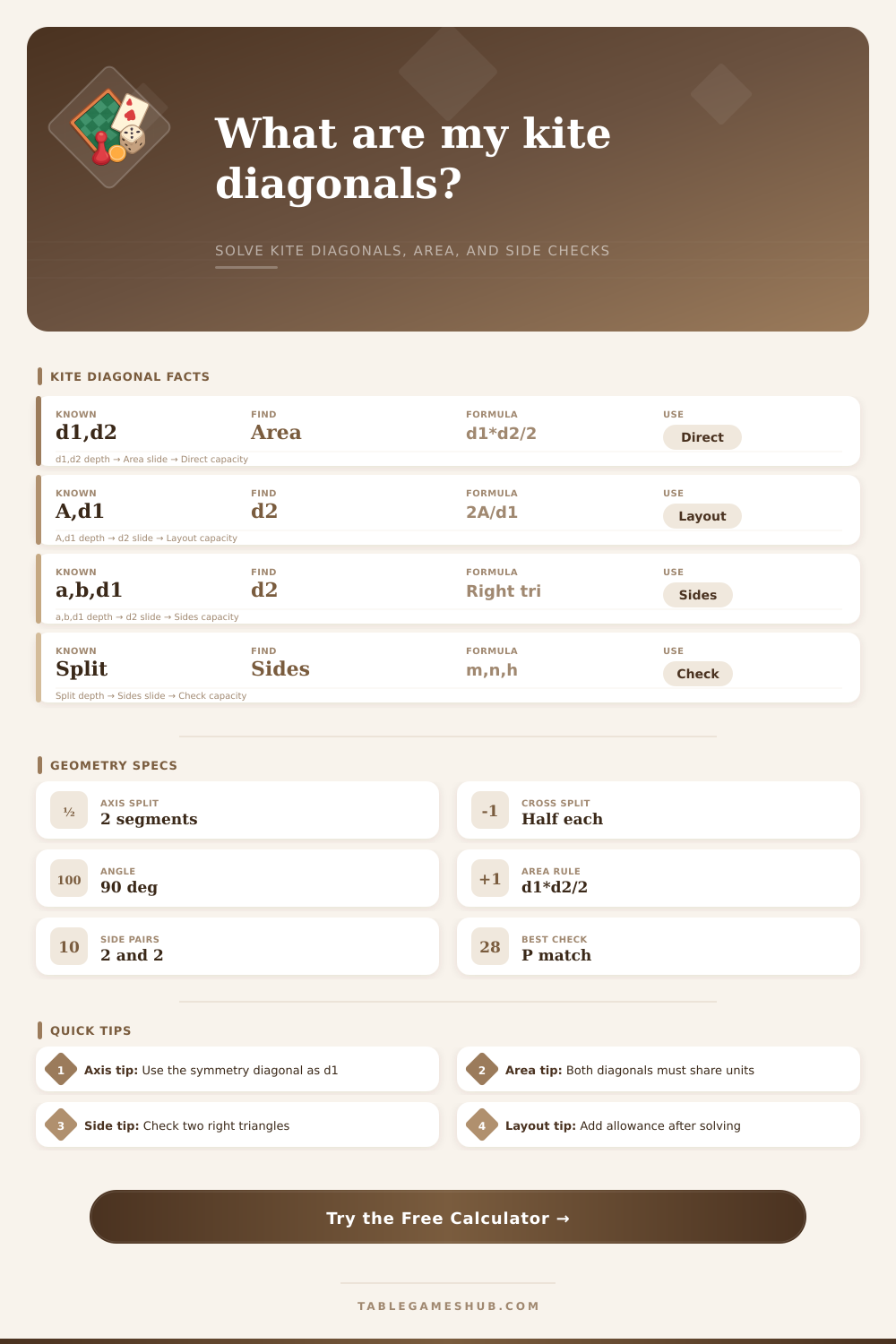
| Both diagonals d1 and d2 | A = d1 × d2 ÷ 2 | Area | Fast area verification |
| Area A and symmetry diagonal d1 | d2 = 2A ÷ d1 | Cross diagonal | Finding layout width |
| Area A and cross diagonal d2 | d1 = 2A ÷ d2 | Symmetry diagonal | Finding layout height |
| Side pairs a, b and axis d1 | m = (d1² + a² - b²) ÷ 2d1 | Split and d2 | Checking side-built kites |
| Kite Part | Symbol | Relationship | Geometry Note |
|---|---|---|---|
| Symmetry diagonal | d1 | d1 = m + n | Bisects the cross diagonal |
| Cross diagonal | d2 | h = d2 ÷ 2 | Creates two equal half-widths |
| Upper side pair | a | a² = m² + h² | Top right-triangle hypotenuse |
| Lower side pair | b | b² = n² + h² | Bottom right-triangle hypotenuse |
| Layout Scale | Suggested Rounding | Useful Allowance | Practical Check |
|---|---|---|---|
| Worksheet sketch | Nearest 0.1 unit | 0% | Formula equality |
| Grid or graph paper | Nearest grid square | 0% to 2% | Segment coordinates |
| Template tracing | Nearest 0.05 unit | 2% to 5% | Diagonal intersection is square |
| Cut or inlay layout | Nearest 0.01 unit | 5% to 10% | Perimeter matches side pairs |
| Preset Type | Typical Known Data | Calculator Mode | Result to Inspect |
|---|---|---|---|
| Area problem | Area and one diagonal | Area + diagonal | Missing diagonal |
| Construction diagram | Side pairs and d1 | Side pairs + symmetry diagonal | Cross diagonal and split |
| Ratio drawing | Side pairs and split percent | Side pairs + axis split percent | Both diagonals |
| Finished template | Both diagonals | Both diagonals are known | Area and perimeter estimate |
A kite is a geometric shape composed of two pairs of equal side with a specific length for each pair of sides. Many individuals attempt to draw a kite by sketching the outer perimeter of the kite first. However, sketching the outer perimeter of a kite can often lead to errors in the construction of the kite.
A kite isnt a square, and specific measurement of the sides of a kite will ensure that the symmetry of the kite is correct. If an amount as small as possible incorrectly makes the measurements of the sides of a kite, the symmetry of the kite will fail, and the resulting quadrilateral will not be a kite but an irregular quadrilateral. A kite contains two diagonals that intersect at a 90-degree angle.
How to Draw and Measure a Kite
One of the diagonals is the symmetry axis of a kite, and this symmetry axis will divide a kite into two identical shape. The other diagonal is referred to as the cross diagonal of the kite. The symmetry axis will divide the cross diagonal into two identical segments.
A kite can be thought of as a quadrilateral composed of four right triangles. If you know the lengths of the diagonals of a kite, you can determine the side length of the kite. Additionally, the area of the kite can also be determined from the length of the diagonals.
When drawing a kite, one should work from the inside of the kite to the outside of the kite rather than working from the outside of the kite to the inside. First, establish a center point. Then, draw the perpendicular axes of the kite.
Finally, connect the points to create the outer perimeter of the kite. When measuring a kite, account for your physical limitation. For instance, if the size of a kite must fit within a rectangular area, set the diagonals of the kite to your primary measurements for the craft project.
However, if the amount of available material for constructing the kite is a concern, set the length of the sides of the kite to your primary measurements. However, working with the side lengths of a kite is more difficult then working with the diagonals. The split percentage of a kite is the location of the intersection of the cross diagonal and the symmetry axis of a kite.
If the split percentage is 50%, the resulting kite will be a rhombus. However, if the split percentage is another number, such as 80%, the resulting kite will have a long shape and a short tail. Using the split percentage allows an individual to alter the shape of a kite while maintaining it’s symmetry.
When measuring out a project in a workshop, account for the physical thickness of the tools that will be cutting the kite. Include a layout allowance in the measurements for the project. A layout allowance ensures that the finished kite will be the correct size after the cutting of the kite along the drawn lines.
If the layout allowance is not used for the measurements, the finished kite may be too small for the individuals plans. If the kite will be used for a proof or placed on a coordinate grid, focus on the segments of the symmetry axis. Knowing the length of the upper and lower segments of the symmetry axis will allow an individual to plot the points of the kite.
The area of the kite can also be determined by multiplying the length of the two diagonals and dividing the product by 2. This calculation ensure that the area of a kite is mathematically correct. Additionally, by focusing on the diagonals of a kite and the triangles that make up the kite, an individual ensures that the symmetry of the kite is absolute.
You should of checked the math alot to recieve teh right result.