Horseshoe Pit Dimensions Calculator
Dial in lane width, stake spacing, apron, sand depth, and border run so we can shape a horseshoe court that feels intentional, drains cleanly, and leaves the right amount of safe space around the pit.
| Type | Spacing | Width | Note |
|---|---|---|---|
| League | 46 ft | 6 ft | Classic |
| Junior | 40 ft | 5 ft | Shorter |
| Backyard | 40-46 | 6-8 ft | Flexible |
| Tourney | 46 ft | 6 ft | Sharp |
| Depth | Feel | Drain | Use |
|---|---|---|---|
| 3 in | Firm | Fast | League |
| 4 in | Soft | Balanced | Casual |
| 5 in | Deep | Slow | Practice |
| 6 in | Loose | Best | Weather |
| Material | Ht. | Thk. | Note |
|---|---|---|---|
| 2x6 | 3 in | 1.5 in | Simple |
| Steel | 4 in | 0.25 in | Tough |
| Timber | 6 in | 2 in | Rustic |
| Curb | 8 in | 3 in | Heavy |
| Lane | Apron | Buffer | Use |
|---|---|---|---|
| 1 | 8 ft | 3 ft | Compact |
| 2 | 10 ft | 4 ft | Family |
| 2 | 12 ft | 6 ft | Club |
| 3 | 12 ft | 6 ft | Event |
| Layer | Depth | Mix | Result |
|---|---|---|---|
| Base | 2 in | Compacted | Stable |
| Drain | 1 in | Rock | Quick |
| Bed | 3 in | Sand | Classic |
| Top | 1 in | Fine | Finish |
| Use | Size | Buffer | Note |
|---|---|---|---|
| Backyard | 6x46 | Small | Easy |
| Club | 6x48 | Medium | Formal |
| Park | 6x50 | Large | Open |
| Portable | 5x40 | Trim | Light |
When building a horseshoe pit, people has to plan the dimensions of the horseshoe pit carefuly. The dimensions of the horseshoe pit will determine how many space that the horseshoe pit will occupy within the backyard. Many people make the mistake of only measuring the distance between the stakes for the horseshoe pit.
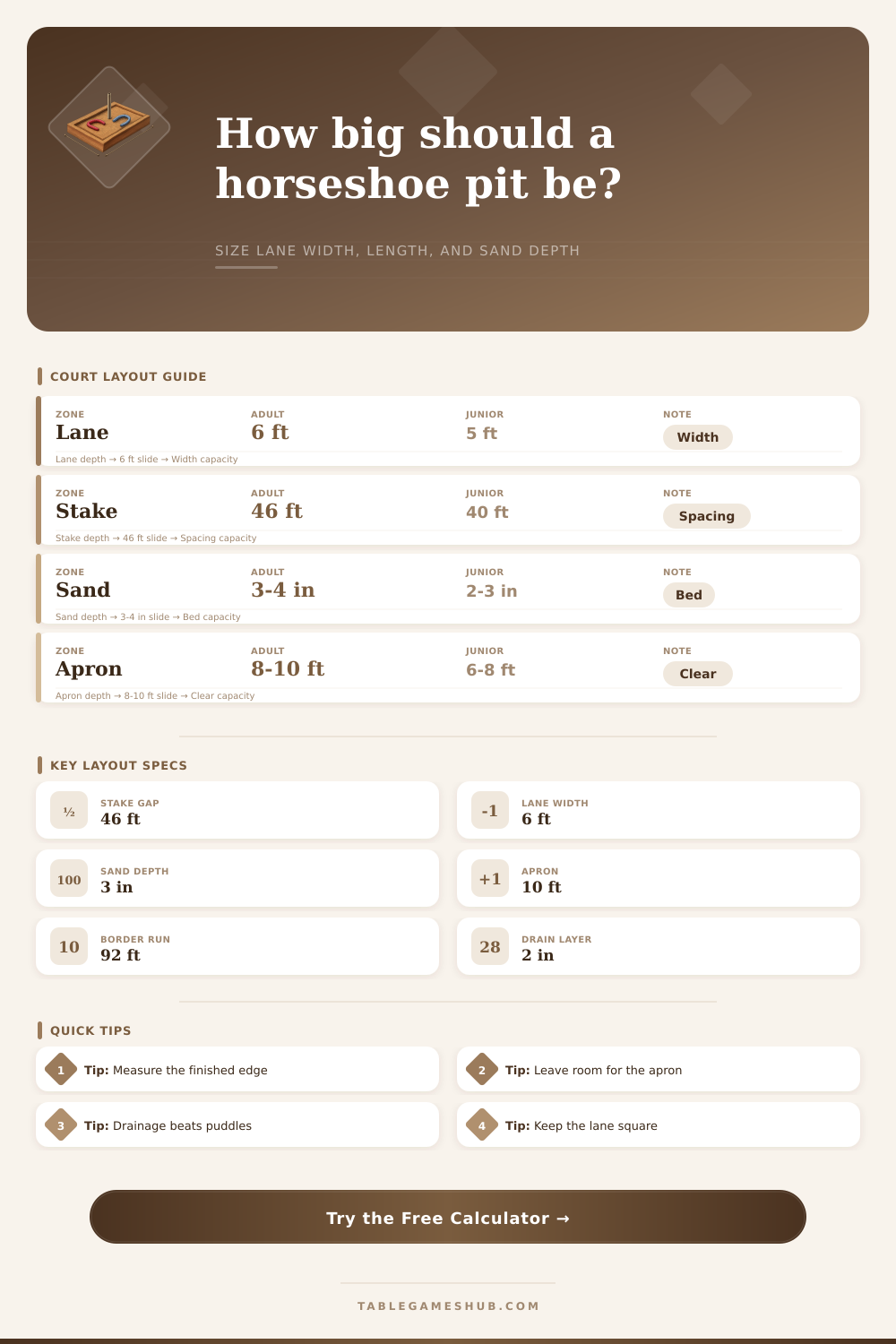
However, the horseshoe pit will require extra space for the players to approach the horseshoe pit and to avoid any fences or object in the yard. The distance between the stakes for the horseshoe pit is one of the primary measurement that will be used for the horseshoe pit. For regulation horseshoe pit, the distance between the stakes will be forty-six feet.
How to Measure and Plan a Horseshoe Pit
This distance allow for the horseshoe to follow the arc that it is meant to follow when the players toss the horseshoe into the designated pit. However, if you are to build the horseshoe pit for children, the stakes may be shorter than forty-six feet. This would require changes to the amount of space that would be needed for the horseshoe pit for the players to toss the horseshoe into the designated spot.
Another of the measurements for the horseshoe pit will be the width of the lane in which the horseshoe pit will be tossed into the target spot. The width of the lane for horseshoe pits should be six feet in width. This measurement allow the players to swing there arms to toss the horseshoe into the target spot.
If the width is less than six feet, the players may hit the borders of the horseshoe pit with their elbows. If the width of the lane is more than six feet, then the horseshoe pit may take up more space within the yard. The horseshoe pit will also require the inclusion of front apron and rear buffer.
A front apron for the horseshoe pit will be an area that is at least ten feet in width and will be located in front of the pitch line. This area allow the players to plant their feet and to move within the horseshoe pit without trip. The rear buffer for the horseshoe pit will be an area that is located behind the stakes for the horseshoe pit.
This area prevents the horseshoes from landing within the gardens or fences within the yard. These areas will require extra space for the horseshoe pit to be built. The depth of the sand within the horseshoe pit and the composition of the base for the horseshoe pit are another of the measurement and specifications for the horseshoe pit.
The depth of the sand within the horseshoe pit should be between three and four inches deep. Three inches of sand will be firm while four inches of sand will be soft within the horseshoe pit. If the depth of the sand within the horseshoe pit is to be deep, then a gravel base will be required for the horseshoe pit beneath the sand.
Without the gravel base, the sand within the horseshoe pit will become muddy after it rain which can make raking the sand difficult. The borders for the horseshoe pit will be used to contain the sand within the horseshoe pit. Timber or steel can be used to build the borders for the horseshoe pit.
These borders will keep the sand from spilling out of the horseshoe pit onto the ground. The lane width of the horseshoe pit has to be measured from the finished edge of these border. The borders may take up extra space within the horseshoe pit; therefore, if the horseshoe pit is to be narrow in width, the borders cannot be too thick.
If they are too thick, there will not be enough space for players to toss the horseshoe pit into the target spot. The type of soil within the yard in which the horseshoe pit will be built and the weather pattern for that area will have an effect upon the dimensions and the construction of the horseshoe pit. For instance, if the soil in the yard is clay, the ground will pack more tight than if the soil was sandy loam soil which may require the borders for the horseshoe pit to be thicker to contain the sand within the horseshoe pit.
The direction in which the wind blow may have to be considered when building the horseshoe pit so that the flight of the horseshoe pit can be accounted for. Finally, maintenance will be required for the horseshoe pit once it is built. The sand within the horseshoe pit should be raked every week to ensure that the sand remain even within the horseshoe pit.
Furthermore, you will have to replace the sand within the horseshoe pit every year. With proper maintenance of the sand and the drainage system within the horseshoe pit, it will remain functional for a long time. Through proper maintenance, the dimension of the horseshoe pit will remain consistent for all player of the horseshoe pit.