Archery Arrow Weight Calculator
Build a cleaner grain budget from shaft, point, and tail weights.
| Component | Light | Typical | Heavy |
|---|---|---|---|
| Shaft 31 in | 7.0 gpi | 8.8 gpi | 11.5 gpi |
| Point | 70 gr | 100 gr | 140 gr |
| Insert | 8 gr | 15 gr | 25 gr |
| Fletching | 7 gr | 11 gr | 15 gr |
| Bow Style | Light Band | Sweet Spot | Heavy Band |
|---|---|---|---|
| Compound | 7.0-8.0 | 8.0-9.0 | 9.0-10.0 |
| Recurve | 7.5-8.5 | 8.5-9.8 | 9.8-11.0 |
| Longbow | 8.5-9.5 | 9.5-10.8 | 10.8-12.0 |
| Hunting | 9.0-10.0 | 10.0-11.5 | 11.5-13.0 |
| Use | FOC Range | Front Bias | Notes |
|---|---|---|---|
| Indoor | 9-12% | Mid | Keep it calm |
| 3D | 10-14% | High | Stable in wind |
| Field | 11-15% | High | Hold line well |
| Hunting | 12-16% | Very high | Penetration bias |
| Preset | Total | GPP | Verdict |
|---|---|---|---|
| Indoor Recurve | 360 gr | 8.1 | On band |
| Target Compound | 410 gr | 8.4 | Stable |
| Field Day | 445 gr | 9.0 | Solid |
| Hunting Build | 520 gr | 10.2 | Heavy |
Arrow weights is one of the most critical factors in archery as the weight of the arrows will determine how the arrow will fly and react to the wind. If the arrow is too light or too heavy, it will not provide accurate shot to the target. While many archers feel that there bow is the problem with accuracy in their shots, it is often the weight of the arrow that is the real cause of inaccurate shooting.
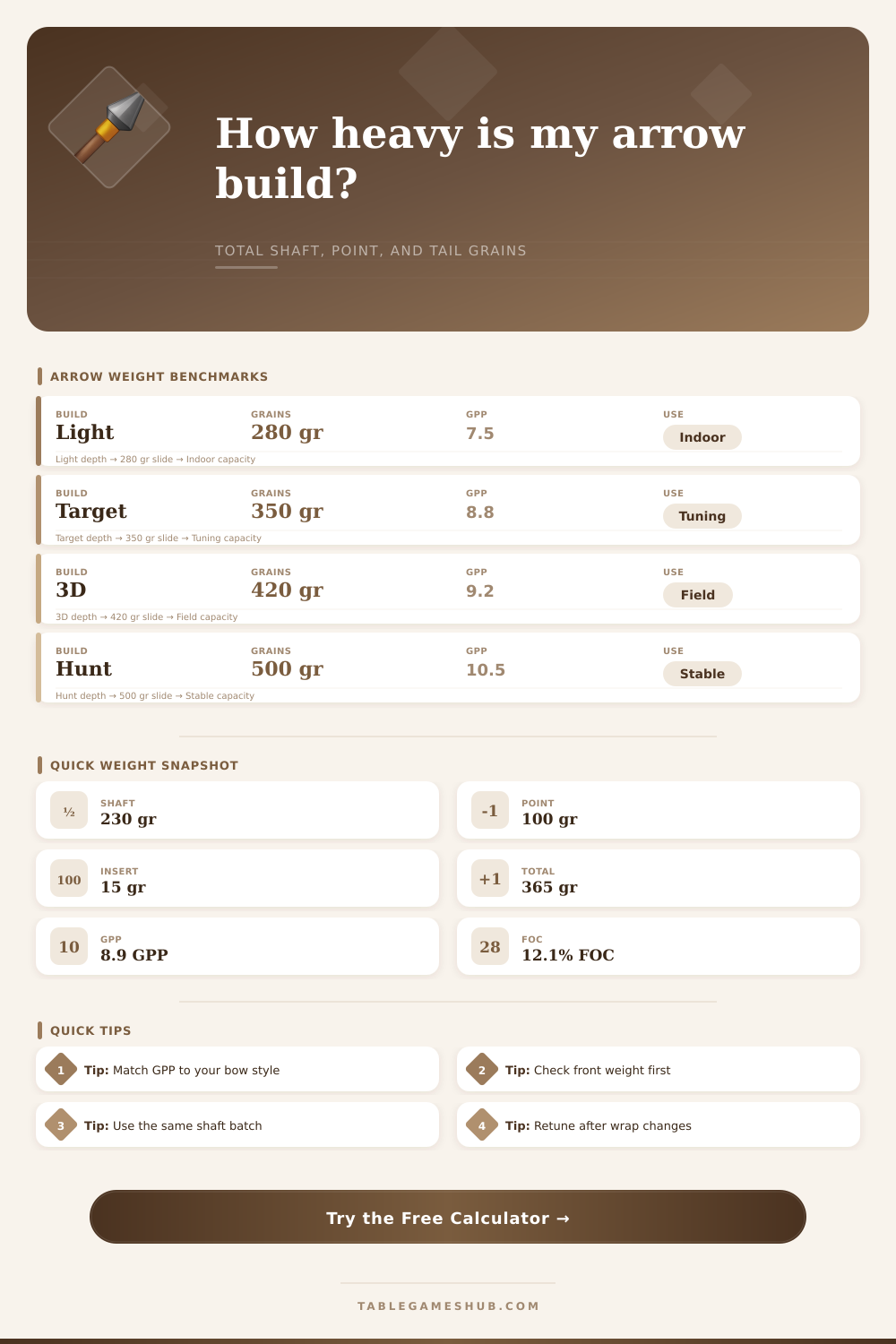
Arrow weight is calculate through a measurement of grains per pound, or GPP. An archer determines the GPP by dividing the weight of the arrow in grains by the draw weight of an archers compound bow. For instance, for an archer using a 55 pound compound bow with an arrow that weigh 467.5 grains, the arrow would have a GPP of 8.5.
How Arrow Weight Affects Accuracy
For archers using arrows that are too light (under 7 GPP), the arrows may vibrate and may bend easy with the wind. For archers using arrows that are too heavy (over 10 GPP), the arrows will be more stable but will have less speed. The GPP needed for different types of bows can vary; for instance, recurve bows may require arrows with a lower GPP then long bows due to the inherent way that long bows tend to oscillate when shooting arrows.
Another important measurement of arrows is the shaft density of the arrow. Shaft density is measured in grains per inch, or GPI. Shaft density is a measurement of the weight of the arrow in grains per inch of the shaft.
Arrows with a lower GPP will have lighter shafts that travel at higher speeds but require more precision with the arrow spine; arrows with higher GPP will have more weight to the arrows and be more forgiving in inaccuracies in the archer’s shooting form. Additionally, the Front-of-Center (FOC) balance of the arrow should be considered. For indoor archery, a value of around 10% is preferred.
Field and 3D archery require an FOC value of between 12 and 14%. For hunting archery, a value of 15% or higher is preferred. Arrow weight can be calculated as the total weight of the arrow, which is comprise of the shaft, point, insert, nock, and fletchings.
For example, inserts add around 15 grains to the arrow; nocks add 6 grains; three fletchings add 12 grains. Finally, the weight of the adhesives and wraps of the arrow add to the total weight of the arrow. An imbalance of the weight of the arrow can cause the arrow to fishtail when shot (too much weight at the tail) or to behave more like a weather vane (too much weight at the front of the arrow).
Additionally, changing the point of the arrow from a 100 grain point to a 125 grain point will change the FOC of the arrow without changing the bow. Common mistake in archery regarding arrow weights include mixing batches of arrow shafts (which can have varying GPI measurements), ignoring the weight of the adhesives for the arrow, adding wraps to the arrow, ignoring the actual weights of the arrow components rather than relying on the weights specified on the components, and shortening the shaft of the arrow after installing the point. Each of these actions will change the total weight of the arrow or its FOC.
Depending upon the type of archery that an archer perform, the weight of arrows can change. Indoor archery may use arrows that weigh around 280 grains. Target compound archers use arrows that weigh around 350 grains.
3D archery may use arrows that weigh around 420 grains. For hunting archery, arrows may weigh as much as 500 grains. While arrows outside of these weight ranges may be used, the weights within these ranges is a helpful guideline to archers of different types of ranges.
Finally, the archer may check the accuracy of the arrow by tuning the arrow to ensure that the GPP and FOC are set to the correct values for the archers bow. If the GPP and FOC of the arrow are correct, the arrow will be in harmony with the archers bow; if not, the arrow will be imbalanced. Additionally, accuracy in the arrow can be checked by seeing how well the arrow travels in the wind.
An arrow that is built with the correct weight will be the constant variable that ensure that the archer hit their target accurately.