Archery Distance Calculator for Slope and Wind
Blend slope, wind, speed, and face size into a cleaner aiming number.
🏹Range Inputs
🏁Range Factors
📊Reference Tables
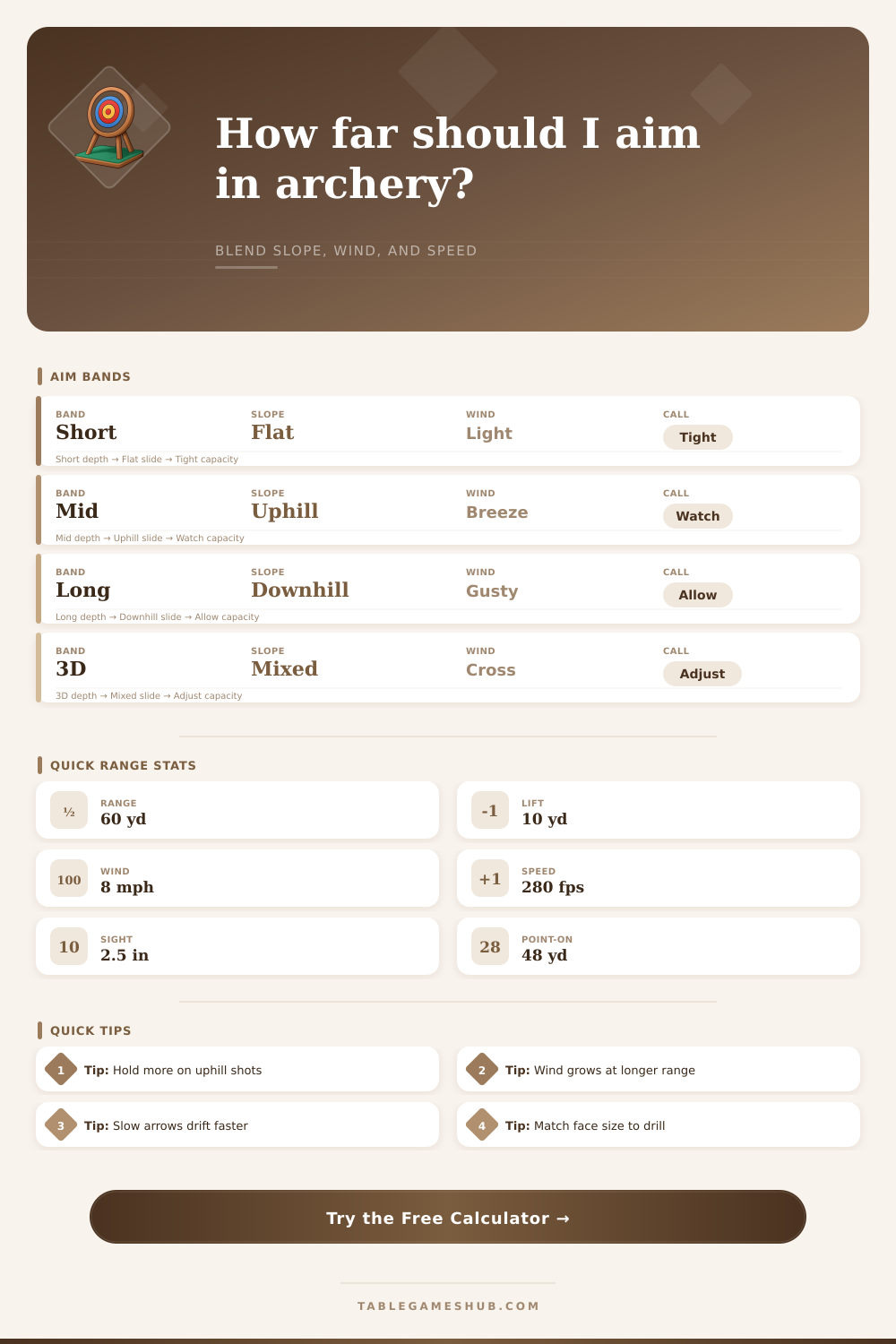
| Distance band | Slope | Wind | Call |
|---|---|---|---|
| 20-30 yd | Flat | Light | Tight |
| 40-50 yd | Uphill | Breeze | Watch |
| 60-70 yd | Downhill | Cross | Allow |
| 80-90 yd | Mixed | Gust | Adjust |
| Wind speed | 20 yd | 50 yd | 80 yd |
|---|---|---|---|
| 2 mph | Low | Low | Low |
| 5 mph | Mid | Mid | High |
| 8 mph | High | High | Very high |
| 12 mph | Very high | Very high | Severe |
| Slope rise | Lift | Hold | Band |
|---|---|---|---|
| 0 yd | None | Base | Flat |
| 5 yd | Small | +1 mark | Gentle |
| 10 yd | Medium | +2 marks | Steep |
| 15 yd | Large | +3 marks | Sharp |
| Face size | Style | Drift | Use |
|---|---|---|---|
| 40 cm | Target | Tighter | Indoor |
| 60 cm | Field | Moderate | Outdoors |
| 80 cm | 3D | Wider | Animal |
| 122 cm | Line | Wide | Long |
🔧Component Grid
💬Tips
Archery involve many different variable that can affect the way that the arrow travels from the archer to the target. Many archery professional must understand how arrow speed, wind, sight height, and slope affect the arrow’s path to the target. If these variable are not accounted for, the arrow will not hit the target.
A thorough understanding of these variable allows archery professionals to make adjustments to the bow to ensure that the arrow hits the target. Arrow speed is one of the primary variables in archery. Arrow speed is the velocity of the arrow as it leaves the bow.
Things That Affect an Arrow’s Flight
Fast arrows are more effective than slow arrows because fast arrows are better at fighting the effect of gravity. Fast arrows also drift less in the wind than slow arrows. For example, an archer using a bow that shoots arrows at 280 feet per second will have arrows that drift less in the wind than an archer using a bow that shoots arrows at 260 feet per second.
Because arrow speed affect an arrow’s drift in the wind, the archer must measure the velocity of the arrow with a chronograph after tuning the bow. Sight height is another variable that can impact the archer’s accuracy with the bow. Sight height is the distance between the archer’s peep sight and his pin sight.
If the sight height change, the archer’s point-on distance will change. The point-on distance is the distance at which the arrow will hit the center of the target. Sight height will impact the archer’s point on distance.
Therefore, the archer should account for sight height when calculating the archer’s shots. Wind is a variable in archery that can impact the arrow’s path to the target. Wind can be a crosswind that push the arrow sideways.
The effect of the wind increases with the distance between the archer and the target. For example, the same light wind that pushes the archer’s arrows off of there path at a short distance will push the arrows further at a distance of sixty yards. Slow moving arrows are affected more by the wind than fast moving arrows.
This is because slow arrows take more time to travel to the target. The wind has more time to impact the arrow’s path. Archers can practice shooting arrows into the wind at half the distance of the target to study the movement of the arrow caused by the wind.
Slope is another variable that impacts where the archer should aim his arrow. The slope of the land between the archer and the target can require the archer to aim either above or below the target. When aiming at an uphill slope, the archer must aim higher with his bow since gravity will pull the arrow less on an uphill trajectory.
On the other hand, when aiming at a downhill slope, the archer must aim lower since the arrow will drop at a more higher rate on a downhill slope. In either situation, the archer must calculate the effective range of the arrow. If he does not account for slope, he will miss his target.
Target face size is a variable since it indicate the archer the allowance for error in the arrow’s aim. If the target face is small, there is little margin for error. If the target face is larger, there is more error allowed.
The archer should adjust his aim according to the size of the target to ensure accuracy. Shot consistency is a variable of archery that measure the archer’s steadiness with the bow. Shot consistency is important for accuracy because if the archer is not consistent in his draws and shots, his arrow groups will be large.
If an archer has poor shot consistency, the archer will have large groups of arrows that do not hit his targets at long distance. Tools can be used to calculate the arrow’s variable to help determine the archer’s vertical hold, windage drift, and effective range. Archery professionals should avoid common mistakes to maintain the arrow’s accuracy.
One of the most common mistake is increasing the speed of the arrow without checking the arrow’s spine. If the archer increases arrow speed without a proper arrow spine, the arrows may fishtail in the wind. Another of the most common mistake is to neglect to recheck the sight height after installing a new peep sight.
If the archer does not recheck the sight height, his aim will be incorrect. Finally, do not use a small target face when practicing with the bow if the target face in the competition will be of a larger size. To improve archery skills, an archer should establish a baseline for his arrow’s variables.
Finding the baseline pins for the arrow at flat ground will allow the archer to account for slope and wind in his aim. Additionally, the archer should also check the arrow speed for the bow frequent since the arrow speed can change over time due to the bow’s string stretch. If an archer practices with the bow in the same condition as his target range, his skills will improve.
Additionally, practicing the archery form will allow the archer to maintain his shot consistency even when tired.