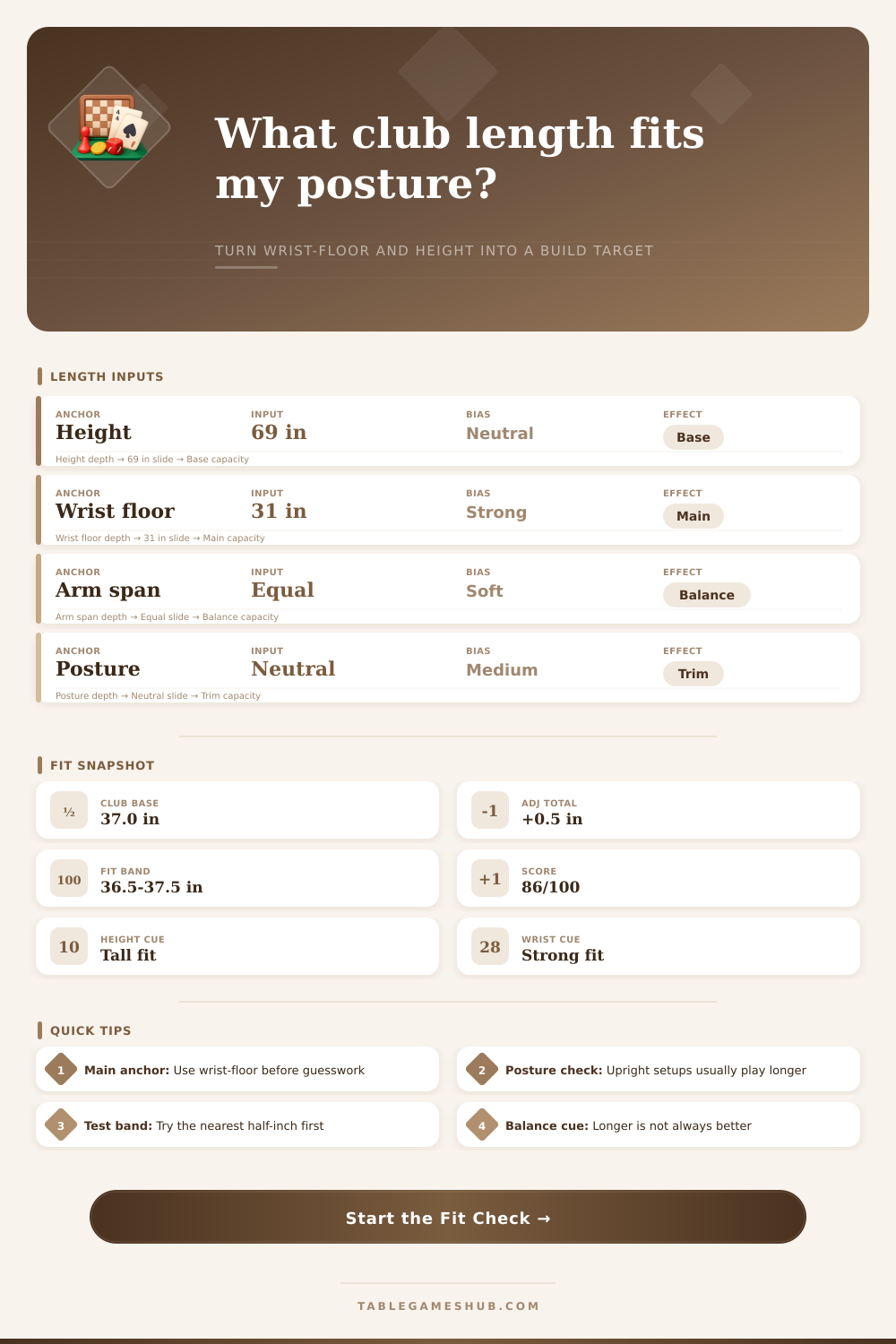
Golf Club Length Calculator for Wrist-to-Floor Fit
Build a cleaner club-length target from body measurements, posture, and club type.
Use height, wrist-to-floor span, arm reach, and setup posture to translate body fit into a club-length build target for drivers, irons, hybrids, and wedges.
| Wrist-to-floor band | Typical profile | Length move | Fit cue |
|---|---|---|---|
| 28-30 in | Compact build | -0.5 to -0.25 in | Short handle, tight posture |
| 30.5-32 in | Neutral build | -0.25 to +0.25 in | Start near standard length |
| 32.5-34 in | Tall balance | +0.25 to +0.5 in | Need more handle room |
| 34.5+ in | Long reach | +0.5 to +0.75 in | Consider a longer build |
| Club family | Baseline length | Anchor point | Why it matters |
|---|---|---|---|
| Driver | 45.0 in | Longest handle | Controls top-end reach |
| Fairway wood | 42.5 in | Mid-long build | Balances strike radius |
| Hybrid | 40.0 in | Transition club | Needs stable setup |
| 7-iron | 37.0 in | Reference iron | Classic fit benchmark |
| Setup cue | Length bias | Contact tendency | Build note |
|---|---|---|---|
| Upright posture | Longer | Handle sits higher | Add a touch of length |
| Athletic posture | Shorter | Handle sits lower | Trim a small amount |
| Steep plane | Shorter | More downward delivery | Keep it compact |
| Shallow plane | Longer | Flatter handle path | May need extra reach |
| Player profile | Main signal | Likely result | First test |
|---|---|---|---|
| Short reach, upright | Wrist-floor | Shorter build | Go half-step down |
| Tall, relaxed posture | Height | Longer build | Compare to base |
| Long arm span | Arm reach | Slightly longer | Check balance |
| Compact setup | Posture load | Near-standard | Test standard first |
Club length are a critical factor in the game of golf. Club length determine the swing path that a person will take with each club. If a person use a club with the wrong length, the person will have incorrect posture with their club.
This incorrect posture will translate into a poor swing path for that round of golf. A poor swing path can result in the person hitting a slice or a fat shot with the club. To avoid these issue, a person must ensure that the club length matches the persons body measurement.
How to Find the Right Length for Your Golf Clubs
A person can determine the club length for themselves by measuring a few different aspect of their bodies. Height is not the only measurement of importance when gauging club length. The wrist-to-floor distance is one of the most important measurement to take.
The wrist-to-floor distance can demonstrate if a person has short or long wrists. If a person have short wrists, they may need clubs with shorter length. If they have long wrists, they will likely need clubs with longer length so that they dont have to reach for the ball with their clubs.
Arm span is another measurement that can help to indicate club length. A person with a long arm span may need clubs with longer length. Standard clubs are made for people whose arm span is roughly the same than their height.
If a person ignores their arm span, they may find that clubs do not feel correct with their body. A person’s posture can impact the length of clubs that they will need. If a person has an upright posture, they will have clubs that need to be longer so that the person does not need to bend excessive at the joint between the torso and the arms.
A person that crouches with the body may require clubs with shorter length. The type of club that a person will use will impact the length of clubs that they use. Drivers will have longer clubs than irons or woods.
Drivers may measure to forty-five inch. Wedge clubs will be shorter than drivers. A 7-iron is often used for clubs to balance the clubs so that they are use for even contact with the ball.
The club that a person uses will also determine the length of the club. Clubs within the same group will have similar length but may not all be the same length. A person may think that clubs with a longer length are better for increasing the distance that the ball is hit.
However, longer clubs are not always better. Although a longer club will increase the arc of the club swing, the club may create more distance in some case but may cause a person to flatten the club with the ball. This may result in loss of control of the clubs.
Clubs with shorter length may allow a person to have more control over the clubs but will require more speed with the club swings. The best club length will likely be within a small range around the standard clubs lengths because a standard club length allows for the player’s hand to rest at the ball when using the clubs. By using some specific example, a person can see how body measurements will impact clubs length.
A person that is very tall may have long wrists that will force clubs to stoop with their irons. If the clubs are half an inch longer, the person may be able to turn their shoulders more easily in their swing. A person that is shorter with a more compact build who may crouch over the clubs will have issue with their lies and the divots that they may make on the club.
In this case, trimming a quarter-inch from the club length may fix the persons clubs divots. A person should avoid clubs that are estimated by sight. Clubs that are estimated by sight are likely to be inaccurate.
A person’s height alone will not provide the correct clubs length for their body because a person’s arms may be different length than their height. Another test that a person can perform is using a lie board to determine if the club will contact the ground with the toes or heels of the club. If the toes of the club lift off of the ground, then the club need to be longer.
If the heels of the club dig into the ground, the club length needs to be shorter. By using these different methods to determine clubs length, a person can find the perfect clubs length for the persons body to allow for proper clubs posture and contact.