Golf Handicap Adjustment Calculator
Turn handicap index, slope, rating, and format allowances into a clear playing handicap for singles or team formats.
Calculation Breakdown
Stroke Play
Full course handicap with no team sharing. Best for medal play and solo net rounds.
Match Play
Usually a slight allowance cut. Net holes are compared one hole at a time.
Four-Ball
Partner format with lower allowance to keep scoring balanced between teammates.
Scramble
Team format with a much smaller handicap share because many shots are shared.
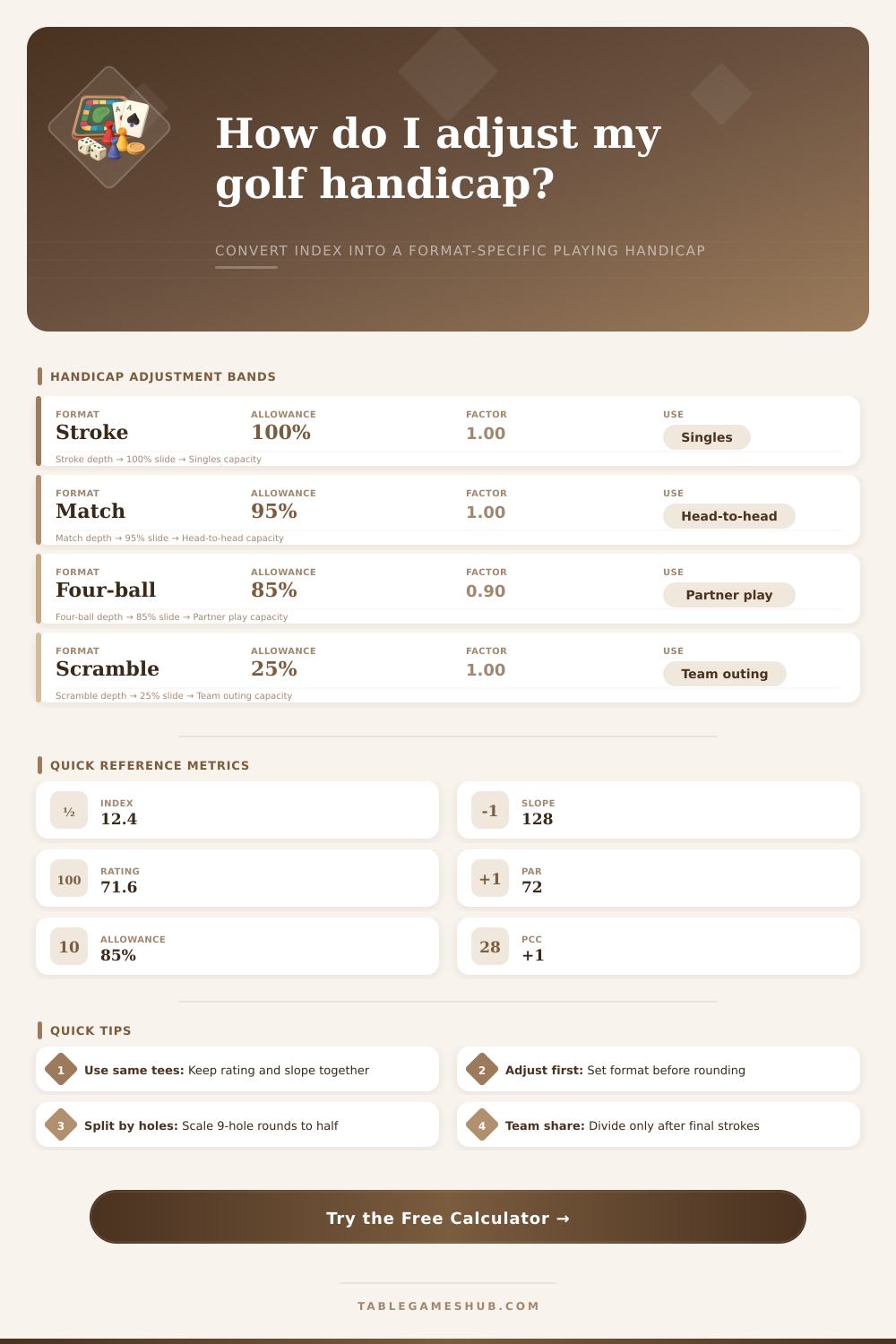
| Format | Allowance | Factor | Typical Use |
|---|---|---|---|
| Stroke Play | 100% | 1.00 | Singles |
| Match Play | 95% | 1.00 | Head-to-head |
| Four-Ball | 85% | 0.90 | Partner play |
| Scramble | 25% | 1.00 | Team outing |
| Slope Band | Difficulty | Impact | Notes |
|---|---|---|---|
| 55-95 | Easy | Small lift | Local tees |
| 96-113 | Standard | Baseline | Neutral setup |
| 114-130 | Tricky | Extra strokes | Champ tees |
| 131-155 | Hard | More strokes | Tournament tees |
| PCC | Meaning | Effect | When to Use |
|---|---|---|---|
| -1 | Favorable | Light edge | Easy scoring |
| 0 | Neutral | No change | Normal day |
| +1 | Firm | Small buffer | Blustery day |
| +3 | Severe | Big buffer | Major disruption |
| Holes | Scale | Stroke Share | Use Case |
|---|---|---|---|
| 9 | 0.50 | Half round | Short league |
| 12 | 0.67 | Two-thirds | Mixed event |
| 18 | 1.00 | Full round | Standard play |
| 27 | 1.50 | One and a half | Extended day |
A handicap index are a number that represents a person’s skill level with the sport of golf. Handicap indices is used to adjust a person’s score when they play to ensure that people of different skill levels can compete against one another on a fair field. A person’s handicap index is calculated by taking the average of their best score differential for golf courses of vary difficulty.
However, a person’s handicap index isnt the same as their playing handicap, which represents the number of strokes a person will receive on a specific golf course. A handicap index can be adjusted to a course handicap by using two measurement of the golf course: the slope rating and the course rating. A golf course’s course rating represent the level of difficulty of a course for a scratch golfer, which is a player with a handicap of zero.
How Golf Handicaps Work
The slope rating represent the level of difficulty of a golf course for a golfer who is not a scratch golfer. If a golf course have a slope rating of 113 or higher, it is considered to be more difficult for most golfers. By multiplying the handicap by the slope rating and adjusting for the course rating and the par of the course, a person can determine their course handicap.
A person’s handicap index can also change based on the game format in which they are competing. For stroke play, a person will receive 100 percent of their course handicap. For match play, a person will receive 95 percent of their course handicap.
For four ball games, each player on a team will receive 85 percent of their course handicap. For scramble games, a person will receive only 25 percent of their course handicap. These different course handicap allowance are provided for team games so that they remain balanced.
Without these allowances, players with low handicaps would win most of the team games. Playing condition for a round of golf can also change the number of strokes that a person receives with their playing handicap. Playing conditions, such as weather, can alter the difficulty of a course for a player.
The playing conditions calculation for golf, or the PCC, range from -1 to +3. A score of -1 means that the playing conditions were difficult for a golfer, and the score of +3 means that the playing conditions were the easiest possible for golfers. In these cases, strokes will be added to or subtracted from a player’s playing handicap.
If a player is playing only nine holes of the course, the number of strokes that they receive will be halved. In order to calculate a player’s playing handicap, care must be taken to ensure that the calculations are rounded correct. All calculations should be performed with decimal numbers.
Only the final playing handicap should be rounded to the nearest whole number. For instance, if a person calculate that their handicap index is 12.4 and the slope rating of the course is 128, a person will have a course handicap of 14 stroke. For stroke play, the player will use all 14 strokes as their playing handicap.
For four ball games, the player will use 85 percent of 14, or approximately 12 stroke. Many people make mistake when they calculate their playing handicap. The most common error may result from incorrect data or incorrect game formats.
Using the wrong data for a player’s handicap calculation is one of the most common mistake. A person must use the slope rating, the course rating, and the par of the course that they are to play. Incorrect game format is another common error.
A player must ensure that they know the game format that they will be playing prior to the game begins. Using the wrong handicap allowance will result in either receiving too many stroke or not enough stroke to play a fair game with their opponent or team. Adjustments to a player’s handicap is important to ensure equity in the game of golf.
Because of handicap adjustments, people of different skill levels can play together. For example, a high handicap player can compete against a low handicap player in a best ball game. Without handicap adjustments, the low handicap player would win the game each time that the two player compete.
Therefore, handicap adjustments ensure that all players have an equal chance of winning their game of golf.