Ten Pin Bowling Handicap Calculator
Set league handicap, cap rules, and team totals with clear formulas and bowling-specific breakdowns.
Calculated Handicap Results
Full Breakdown
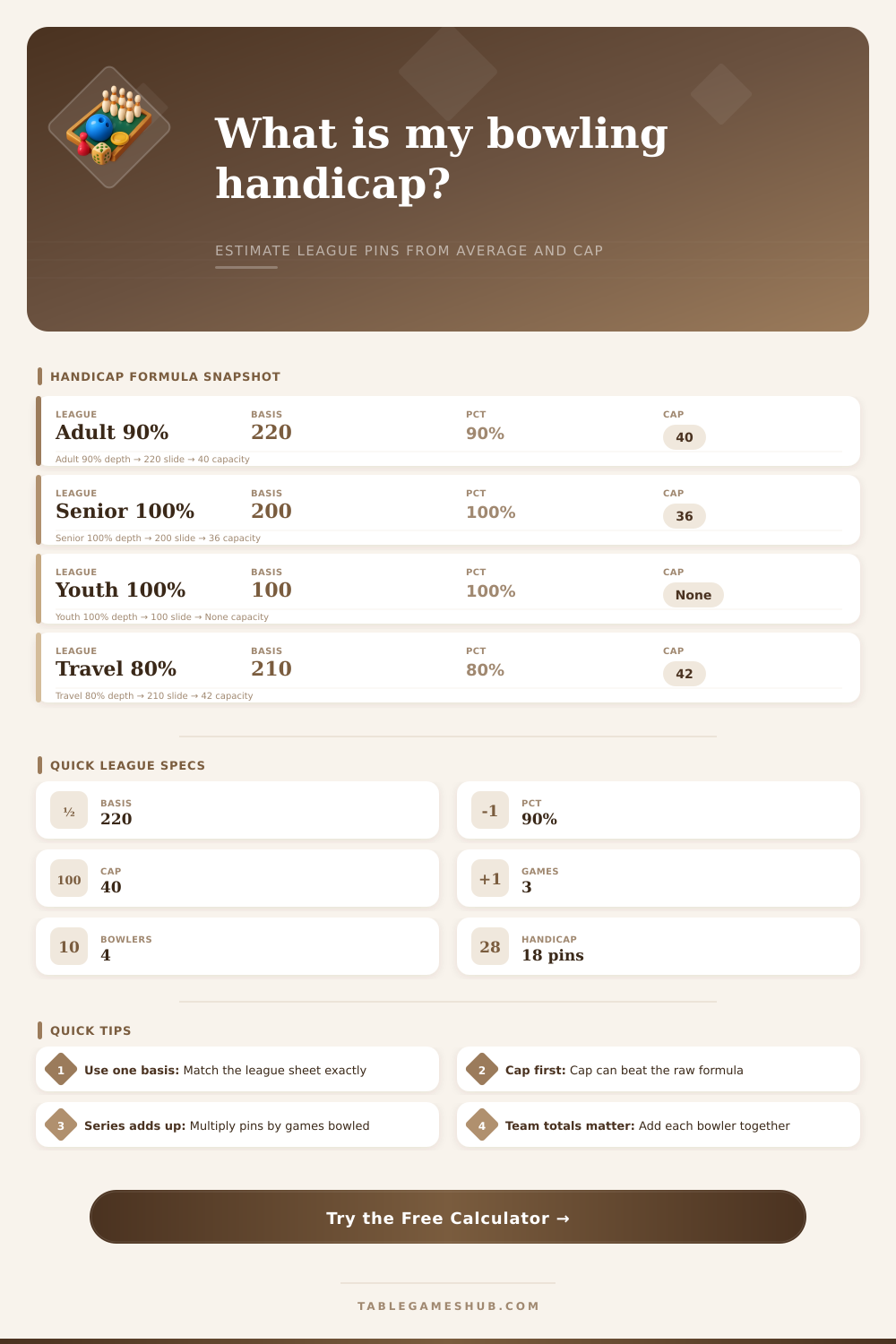
| League Style | Basis | Percent | Typical Cap |
|---|---|---|---|
| Adult mixed league | 220 | 90% | 40 pins |
| Senior league | 200 | 100% | 36 pins |
| Youth development | 100 | 100% | No cap |
| Travel or tournament | 210 | 80% | 42 pins |
| Average Band | General Tier | Typical Gap | Score Effect |
|---|---|---|---|
| 100 to 139 | New league bowler | Large gap | Higher handicap share |
| 140 to 169 | Mid league range | Moderate gap | Usually near cap |
| 170 to 189 | Strong league pace | Small gap | Often below cap |
| 190 and up | Scratch-adjacent | Very small gap | Low or no handicap |
| Format | Games | Handicap Use | Best Fit |
|---|---|---|---|
| Singles night | 1 | Per game | Practice or pot games |
| Standard league | 3 | Series total | Weekly team play |
| Doubles event | 3 | Combined pair | Two-bowler lineup |
| Four-person team | 3 | Full team total | Mixed handicap league |
A bowling handicap is a calculation that allows for a person to compete against others with different skill levels in the sport of bowling. A bowling handicap work by adding a specific number of pins to a bowler’s actual score; this additional score helps to even out the playing field between those with high average and those with low bowling averages. To calculate a bowling handicap, each bowling league must determine three element: the league basis, the percentage, and a maximum pin cap.
The league basis is the set number of pins that will be used as the starting point for calculating each bowler’s handicap. In many leagues for adults, the basis is set at 220 pins. To determine the initial difference between each bowler and the league basis, the league subtracts that basis from the bowler’s personal bowling average.
How to Calculate a Bowling Handicap
For instance, if the league basis is 220 pins, but the bowler score an average of 165 pins, the difference is 55 pins. The league multiplies that difference by the league percentage to determine the bowler’s per-game bowling handicap. The maximum pin cap can be used to ensure that the calculated number of pins does not become too highly; if the calculated pins are, for instance, 45, but the pin cap for that league is 40, the bowler’s pins will be 40.
Bowling leagues may use different value for each of these three elements. For instance, leagues for those aged 50+ years may use a lower league basis, such as 200 pins, and a higher percentage, such as 100%, to encourage those players to earn more pins with their scores. Youth leagues may use a league basis of 100 pins for example, and may not use a maximum pin cap; youth leagues desires to encourage young bowlers to develop confidence in its skill.
Additionally, travel teams may use a lower percentage, such as 80%, to ensure that team members do not gain an advantage in competitions compared to other teams with higher handicaps. Each league will have specific specification regarding these three elements; using any other number than those specified will result in incorrect bowling handicap. A bowling handicap may be used for either a single game or a series of games.
For single games, the number of pins will be added to one bowling game; for a series of games, the total number of pins will be added to a set of bowling games. Most leagues consist of three game of bowling; therefore, the per-game bowling handicap is multiplied by three to determine the total number of pins to be added to a bowler’s total score for a series of three games. Furthermore, adding the individual series of bowling handicaps for each member of that team calculates the total number of pins for a team.
For instance, if a team consist of four bowlers, the total number of pins for that team is the sum of the series of bowling pins for each of those four bowlers. The total team handicap can help a bowler to understand how the pins that their team will score will compare with another teams pins. A bowler’s handicap will change based off the bowler’s average.
Should a bowler increase there average, the difference between the league basis and the bowler’s average will decrease; therefore, the total bowling handicap will also decrease. Should the average of a bowler drop, the difference between the league basis and the average will increase; thus, the bowling handicap will increase. The bowling handicap can be used to project the total number of pins that a bowler will score prior to the start of a match.
To project the total number of pins for a player, the player’s expected scratch score can be obtained and the player’s bowling handicap can be added to that scratch score. The scratch score is the number of pins that a bowler scores without any added pins from the player’s bowling handicap. By knowing both the scratch score of a bowler and the bowler’s calculated bowling handicap, the total pins that the bowler will score can be projected.
This projected score could of help to establish goals for the bowler’s upcoming bowling match.