🏏 Bowling Economy Calculator
Measure runs per over, clean pace, dot-ball control, and wicket pressure from any cricket spell.
| Measure | Input | Result | Note |
|---|
| Economy band | Label | Read | Typical feel |
|---|---|---|---|
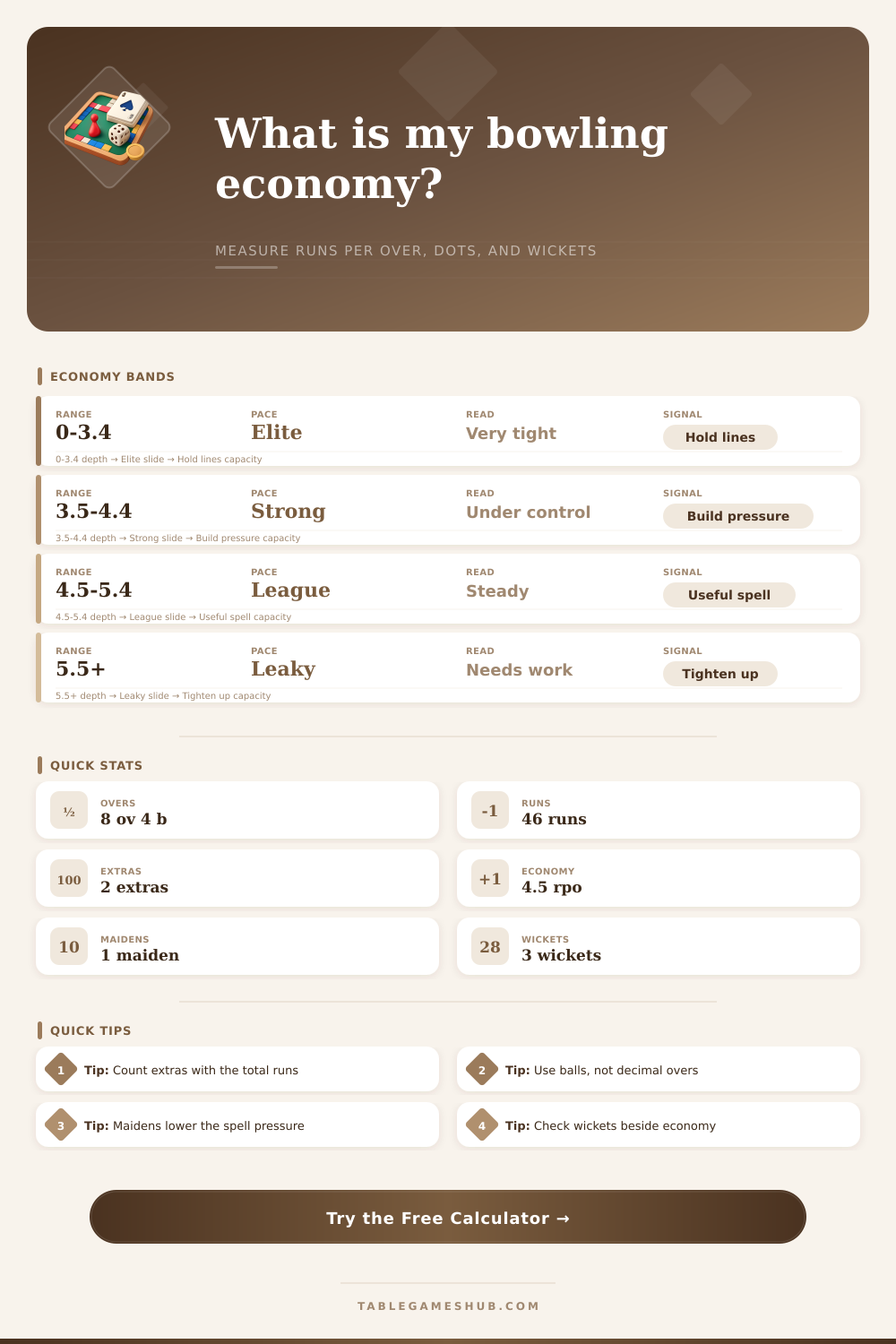
| 0-3.49 | Elite | Very tight | Batters struggle to score |
| 3.50-4.49 | Strong | Under control | Good scoring denial |
| 4.50-5.49 | League | Steady | Useful in many formats |
| 5.50+ | Leaky | Needs work | Runs arrive too easily |
| Format | Balls/over | Target rpo | Spell note |
|---|---|---|---|
| T20 powerplay | 6 | 5.0-6.5 | Fielding ring is tight |
| T20 middle | 6 | 4.0-5.5 | Dots and wickets matter |
| ODI control | 6 | 4.0-5.2 | Build pressure patiently |
| Test spell | 6 | 2.5-4.0 | Long control stretches |
| Spell length | Balls | Overs | Use case |
|---|---|---|---|
| Short burst | 12 | 2 overs | New-ball or final overs |
| Standard spell | 24 | 4 overs | Common club rhythm |
| Long spell | 30 | 5 overs | Holding one end |
| Stamina spell | 60 | 10 overs | Full match sample |
| Control mix | Dot rate | Wicket read | Signal |
|---|---|---|---|
| Maiden-heavy | High | Steady | Hard to score |
| Dot-heavy | High | Mixed | Pressure is building |
| Wicket-heavy | Mid | Strong | Attack is working |
| Extra-heavy | Low | Weak | Discipline needs a reset |
Use balls, not decimal overs
A spell with 10 overs and 4 balls is 10 ov 4 b, not 10.4 overs in math.
Keep extras in the total
Economy always counts extras, so wides and no-balls matter as much as bat runs.
Use this bowling economy calculator to turn overs, runs, extras, maidens, and wickets into a clean read on control, pressure, and spell quality.
Economies is a metric that is used in cricket to indicate the number of runs that a bowler concede per over. To determine the economy rate of a bowler, the number of runs that a bowler allow during a specific period of play are counted. In determining the economy rate of a bowler, the runs scored from the bat is counted, as are the extras.
Extras are given to the batting side in instances such as when a bowler bowl a wide or bowls a no-ball. The extras is added to the total number of runs scored by the batting side. Bowlers who concede many extras will have a more higher economy rate than those who concede fewer extras.
What is the Economy Rate in Cricket?
A low economy rate for a bowler mean that the bowler limits the number of runs that the batting side score. When a bowler has a low economy rate, it is difficult for the batting side to scoring many runs. A high economy rate indicate that the bowler allows the batting side to score many runs.
When a bowler allow the batting side to score many runs, the batting side gains momentum during the inning. While many bowlers focus on the number of wickets that they take, there is a difference between taking wickets and maintain a low economy rate. It is possible for a bowler to take many wickets yet have a high economy rate.
The economy rate that a bowler maintain may differ during various phase of the game. During the powerplay phase, the economy rate that a bowler maintains should be low because of the restrictions on the field. During the middle overs of the game, bowlers should aim to maintain a low economy rate by bowling many dot ball.
Dot balls are balls that do not result in the batting side scoring any run. When bowlers bowl many dot balls, they increase the pressure on the batter to make mistake. During the death phase of the game, a bowler may allow an increased economy rate because the batters attempt to score more runs during this phase of the game.
An economy rate of around 7 or 8 during the death phase is typical and may not be indicative of a failure on the part of the bowler if they also take many wickets during this phase of the game. The economy rate that bowlers target may also differ based off the format of the cricket game that is being played. Test cricket matches require bowlers to maintain a low economy rate.
The ideal economy rate is between 2.5 and 3.5 runs per over in these case as there is more time for the bowlers to bowl and contain the number of runs that is scored by the batting side. In One Day Internationals, the economy rate is slightly higher than Test cricket games. Twenty20 games require bowlers to allow more runs per over as the games last for only a few over.
Twenty20 games also require bowlers to target an economy rate of around 4.5 as they bowl many dot balls. By keeping performance statistics regarding your bowling performances, you can analyze your performance. By logging how many runs you concede per over, as well as how many dot balls you bowl and how many extras you concede, you can analyze your performance.
If your economy rate is high, you can analyze your performance to determine if your high economy rate is due to many extras that you concede or if you concede many boundary. If you concede many extras, you must work to improve your control of the cricket ball. If you concede many boundaries, you must work to improve your bowling lines and length.
Finally, you can analyze your performance in relation to the strike rate that you display. The strike rate is the number of balls that a bowler bowl to secure a wicket. Bowlers with a low economy and strike rate are known as defensive bowler.
Bowlers with a high economy and high strike rate is known as attacking bowlers. Elite bowlers has a low economy and high strike rate. Both statistics should be used to obtain a complete understanding of the performance of a bowler.