🎳 Bowling Speed Calculator
Measure lane pace, pin-deck speed, and shot retention from one clean roll.
| Metric | Input | Output | Meaning |
|---|
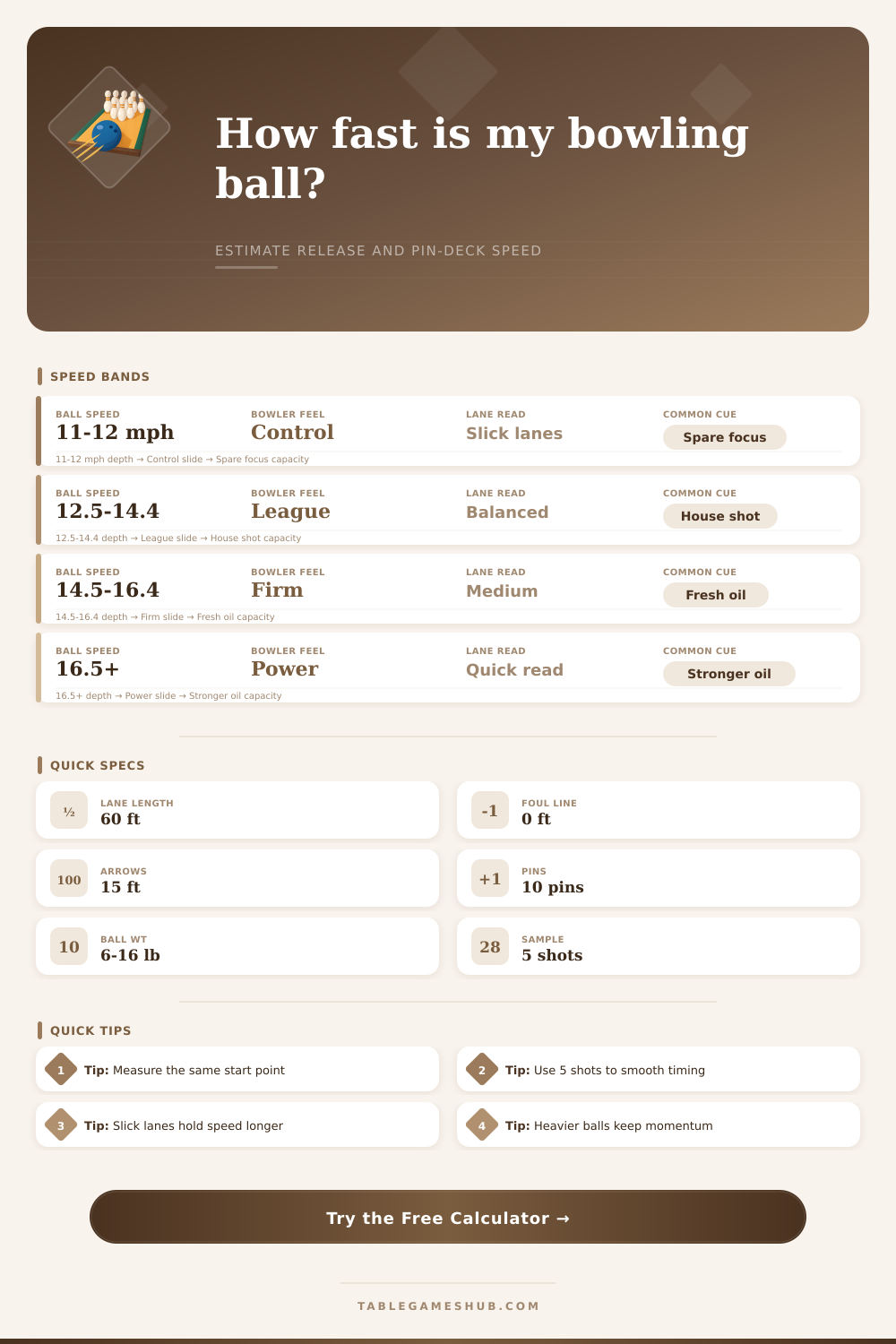
| Ball speed | Bowler feel | Lane read | Common cue |
|---|---|---|---|
| Under 12.5 mph | Control line | Slick lanes | Spare focus |
| 12.5-14.4 mph | League pace | Balanced hold | House shot |
| 14.5-16.4 mph | Firm pace | Medium read | Fresh oil |
| 16.5 mph + | Power pace | Quick response | Stronger oil |
| Segment | Distance | Share | Why it matters |
|---|---|---|---|
| Release to arrows | 0-15 ft | 25% | Early hand speed is visible here. |
| Arrows to breakpoint | 15-40 ft | 42% | The ball begins to read friction. |
| Breakpoint to pins | 40-60 ft | 33% | Speed retention decides carry. |
| Head pin zone | Last 6 ft | 10% | Impact timing changes pin action. |
| Ball weight | Common use | Speed feel | Carry note |
|---|---|---|---|
| 10-12 lb | Youth or spare | Easy swing | Lower momentum |
| 13-14 lb | Control blend | Balanced pace | Clean lane match |
| 15 lb | League norm | Firm pressure | Common strike setup |
| 16 lb | Power option | Heavy roll | Best with clean timing |
| Release style | Rev rate | Loft | Best fit |
|---|---|---|---|
| Stroker | Low to mid | Small | Smoother ball speed |
| Tweener | Mid | Moderate | Balanced lane read |
| Cranker | High | More | Power and carry |
| Urethane | Lower control | Tight | Shorter pattern play |
Measure the same point
Keep the start and finish consistent so the time-to-speed math stays honest from shot to shot.
Watch the lane reaction
Slicker conditions keep more speed, while grabby fronts pull the pin-deck number down faster.
Use this bowling speed calculator to compare average lane pace, pin-deck speed, and shot retention, then match your roll to a speed band that fits the lane.
Bowling speed are a measurement of how fast the bowling ball will travel from the release point to the pins. Bowling ball speed is important in that the speed of the ball will determine the amount of momentum that the ball will have when it reach the pins. If the bowling ball has too much speed, it may travel too far down the lane and leave the pins standing.
If the bowling ball has too little speed, it may hook too early and lose all of it momentum before it reaches the pins. Thus, a person must understand bowling ball speed if they desires to achieve strikes on the pins. Lane conditions have an effect upon the speed of the ball.
Bowling Ball Speed and Why It Matters
The condition of the lane can change the friction of the ball. For instance, oil on the lane will slow the ball, as will the humidity in the lane. A bowling ball may leave a bowlers hand at a fast rate of speed, but it may lose that speed due to the oil on the lane.
Additionally, heavier bowling balls will maintain their roll down the lane in the presence of oil more better than lighter bowling balls. Finally, the loft of the ball will provide an early boost to the ball as it travels down the lane. Additionally, the number of revolutions or “revs” that a bowling ball make will add to the lift of the ball.
Bowlers may attempt to guess the speed at which there ball is traveling. However, guessing the speed at which the ball is traveling isnt an accurate means of measuring that speed. On slick lanes, a bowler may not realize the loss of speed of the ball.
Conversely, on “grabby” lanes, a bowler may think there ball has more speed than it realy does. To find the accurate bowling ball speed, a bowler should find the average speed of several shot of the ball. The speed of the ball should be measured over the standard distance of 60 feet.
By measuring the speed of the ball over this distance, the average speed of the ball can be found. Pin-deck speed is the speed of the ball as it make contact with the pins. The pin-deck speed is important in that the speed of the ball will determine whether the pins will scatter after contact with the ball, or whether the pins will remain standing.
The retention of the speed of the ball can be measured, as well. For instance, the pins may take 5% to 10% of the speed of the ball on a house shot pattern, but take more speed from the bowling ball on a sport bowling ball pattern. Finally, the impact index measure the strength of the bowling ball.
For instance, if the bowling ball has a high entry angle, or if it is a heavy bowling ball, the impact index will be high for that ball. Different bowling style require different speeds of the ball. For instance, strokers typically bowl at speeds of under 13 miles per hour.
Additionally, two handers typically use bowling ball speeds of at least 16 miles per hour. Those that utilize urethane balls use less revolution. Finally, youth bowlers use lighter bowling balls, such as 10 or 12 pound balls.
Most league bowlers use speeds between 13 and 14.5 miles per hour. A person can identify various range of bowling ball speeds. For instance, a bowling ball speed under 12.5 indicates that the bowler is concentrating upon bowling balls needed for the collection of spares.
A bowling ball speed between 12.5 and 14.4 is the typical speed for most house. A bowling ball speed between 14.5 and 16.4 is used for lanes that contain medium oil. Finally, a bowling ball speed over 16.5 is typically used on oil lane and requires a bowler to quickly read the lane.
A bowler may make mistake in the management of their bowling ball speed. For instance, using too much speed will cause the ball to rush the pins and leave the 10-pin. Too little speed will cause the ball to overreact and hit the 7-pin.
Additionally, if a person overlooks the loft of their ball, they may add to the skid of the ball without adding to its power. Finally, the weight of a ball can impact its behavior on the lane. A 16 pound ball will behave differently on the lane than a 14 pound ball.
A person can employ a few different methods to improve their management of bowling ball speed. For instance, watching the arrows at 15 feet can provide cue regarding when to release the ball for the best speed. Using a stopwatch on a phone can allow the bowler to video their ball to ensure that they have the proper amount of time for the ball to travel from the foul line to the pins.
Practicing the loft of the ball will allow a bowler to achieve more even carries of the ball down the lane. Additionally, taking sample of five or six shots will allow the bowler to find their average bowling ball speed. Finally, if a bowler learns how to adjust their speed, revolutions and entry angle, as well as the conditions of the lane, they can begin to turn their collected spares into strikes.