🎯 Darts Probability Calculator
Calculate hit probability, checkout routes & scoring odds for any darts scenario
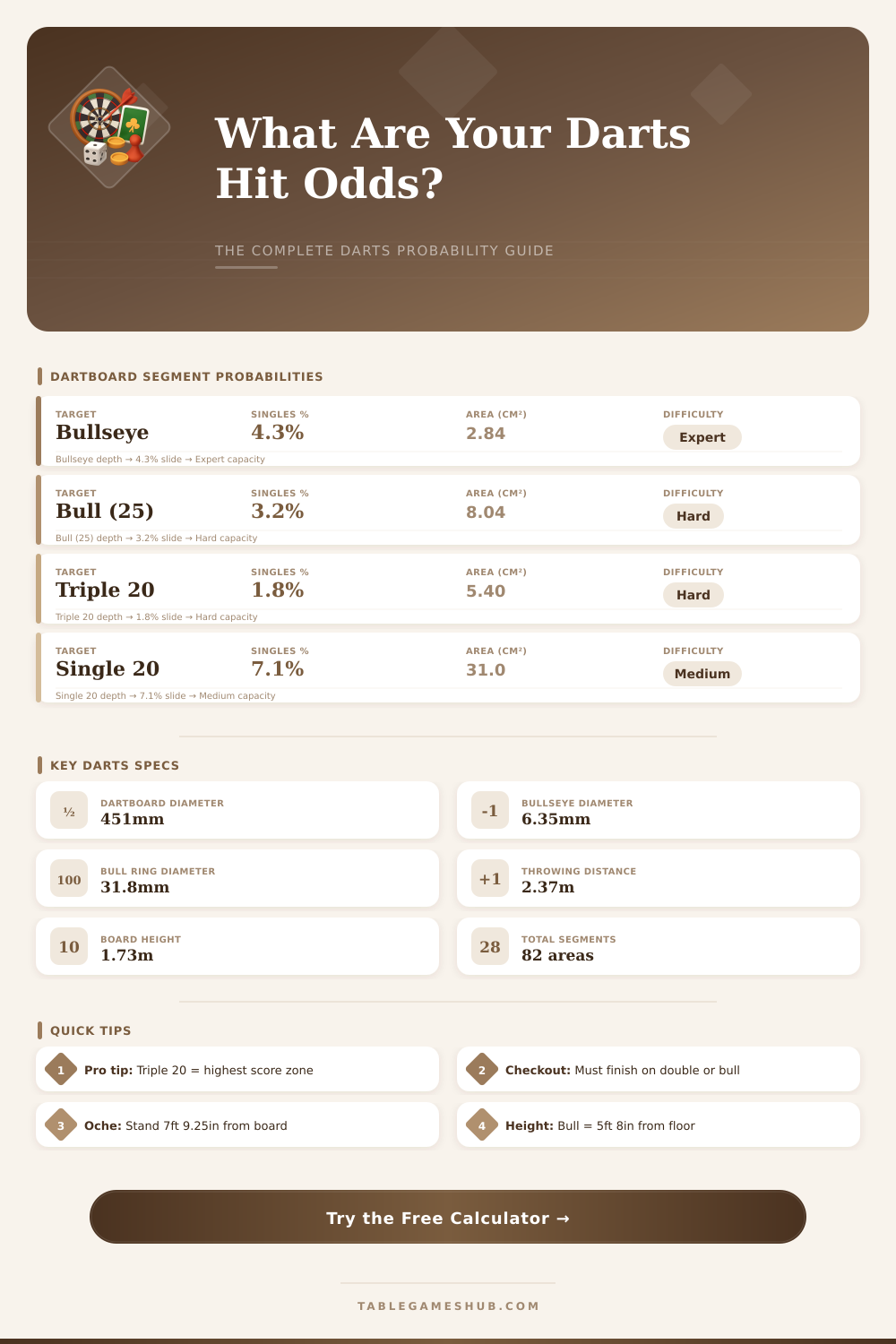
| Target | Area (cm²) | % of Board | Random Hit Prob. | Difficulty |
|---|---|---|---|---|
| Double Bullseye (50) | 0.32 | 0.10% | 1 in 1000 | Expert |
| Single Bull (25) | 4.91 | 1.62% | 1 in 62 | Very Hard |
| Triple 20 (60) | 5.40 | 1.78% | 1 in 56 | Hard |
| Triple 19 (57) | 5.40 | 1.78% | 1 in 56 | Hard |
| Double 20 (40) | 2.76 | 0.91% | 1 in 110 | Hard |
| Double 16 (32) | 2.76 | 0.91% | 1 in 110 | Hard |
| Single 20 (20) | 31.0 | 10.20% | 1 in 10 | Medium |
| Single 19 (19) | 31.0 | 10.20% | 1 in 10 | Medium |
| Any Single Segment | ~17.5 | ~5.75% | 1 in 17 | Low–Med |
| Score | Darts Needed | Route (3 Darts) | Difficulty | Alt. Route |
|---|---|---|---|---|
| 170 | 3 | T20, T20, Bull | Expert | — |
| 167 | 3 | T20, T19, Bull | Expert | — |
| 160 | 3 | T20, T20, D20 | Expert | T20, T20, D20 |
| 121 | 3 | T20, 11, D25 | Hard | T17, T10, D20 |
| 100 | 2 | T20, D20 | Hard | T16, D26 |
| 81 | 2 | T19, D12 | Medium | T15, D18 |
| 40 | 1 | D20 | Medium | — |
| 32 | 1 | D16 | Medium | — |
| 16 | 1 | D8 | Low | — |
| 2 | 1 | D1 | Low | — |
| Skill Level | 3-Dart Avg | T20 Hit Rate | Double Rate | Bull Rate | Checkout % |
|---|---|---|---|---|---|
| Beginner | 30–50 | 5–10% | 8–15% | 3–6% | 10–25% |
| Intermediate | 51–80 | 15–30% | 20–35% | 8–15% | 30–45% |
| Advanced | 81–100 | 35–55% | 40–55% | 18–28% | 50–65% |
| Professional | 95–110 | 55–75% | 55–70% | 28–45% | 65–85% |
| World Class | 100+ | 75%+ | 70%+ | 45%+ | 85%+ |
| Target Number | Marks to Close | Int. Hit/Dart | Adv. Hit/Dart | Exp. Darts (Int.) |
|---|---|---|---|---|
| 20 | 3 | 28% | 52% | ~11 darts |
| 19 | 3 | 27% | 50% | ~11 darts |
| 18 | 3 | 26% | 48% | ~12 darts |
| 17 | 3 | 25% | 46% | ~12 darts |
| 16 | 3 | 24% | 44% | ~13 darts |
| 15 | 3 | 23% | 42% | ~13 darts |
| Bull | 2 | 10% | 22% | ~20 darts |
Darts involve the use of probability and skill to achieve the best outcome for a players. A player must decide whether they would like to focus upon building there score or focusing on finishing there score. Building a score involve hitting trebels to reduce the amount of points that a player must score during their turn.
Building a score, however, also introduces the risk of bustting. Finishing a score, on the other hand, involves hitting doubles to reach 0 point for that players turn. Hitting doubles is required for the game of darts to require players to finish on a double.
Risky or Safe Ways to Score and Finish in Darts
A player must understand the difference between each of the two routes that can be taken to reach their desired score. An aggressive route involve a player attempting to hit trebels to reduce there score to a low number. An aggressive route is beneficial for players who are scoring high numbers, but can lead to a bust.
A bust occur when a player either scores more points than there current score, or leaves there score in a way that cannot be finished on a double. A safe route, in comparison, involve a player aiming to leave an even number of points. A safe route can be beneficial for players because even numbers (like 32 or 40) can typically be finished on a double without leaving a score that is difficulty to finish.
Probability becomes a factor in darts in that a player hit rates will change with the different targets that they aim for on the dart board, as well as the pressure that they feel during the game. For instance, a player may have high hit rates for single numbers on the dart board, but they may have lower hit rates for trebels and doubles. The pressure that a player feels during a game may also impact a player hit rates for doubles and trebels; the more higher the pressure, the lower the hit rates for these targets.
Consequently, a player must be able to calculate the expected points that they can earn from a visit to the dart board. Calculations can assist a player in determining which route is the best route to take to their remaining score. For instance, if a player has a score of 170, they may choose to hit trebels in an effort to get to a score that can be finished on a double.
If a player has a score of 81, however, they may choose to hit a treble of 19 to leave a score of 12. A player must be careful with odd numbers, as those odd numbers could lead to a difficult scoring situation. For instance, if a player leaves 19 points, they must hit a single 3 to leave 16 points, a double.
The ability to manage risk during their turn is the factor that separates players of different skill levels within the game of darts. A skilled player will have high hit rates for trebels, as they are required to hit those targets often during their turn. A player of lower skill levels, however, should utilize safe routes in order to minimize there risk of busting.
A primary consideration for all players is the expected leave for a players turn. Aiming for a clean leave (an easy score to finish) is one of the primary goal of players of darts. In order to play darts effectively, a player must use probability to determine the best route for that players turn.
A player can choose to utilize either an aggressive route or a safe route. Each route has its benefits, as well as its risks. By focusing upon even numbers and scores that can be finished on a double, a player can even increase there probability of win each leg of darts.