🃏 Chicago Bridge Score Sheet
Score four-deal Chicago rounds with deal order, dealer side, carryover, and the Chicago bonus structure.
| Measure | Value | Build | Sheet note |
|---|
| Deal | Vuln | Game | Note |
|---|---|---|---|
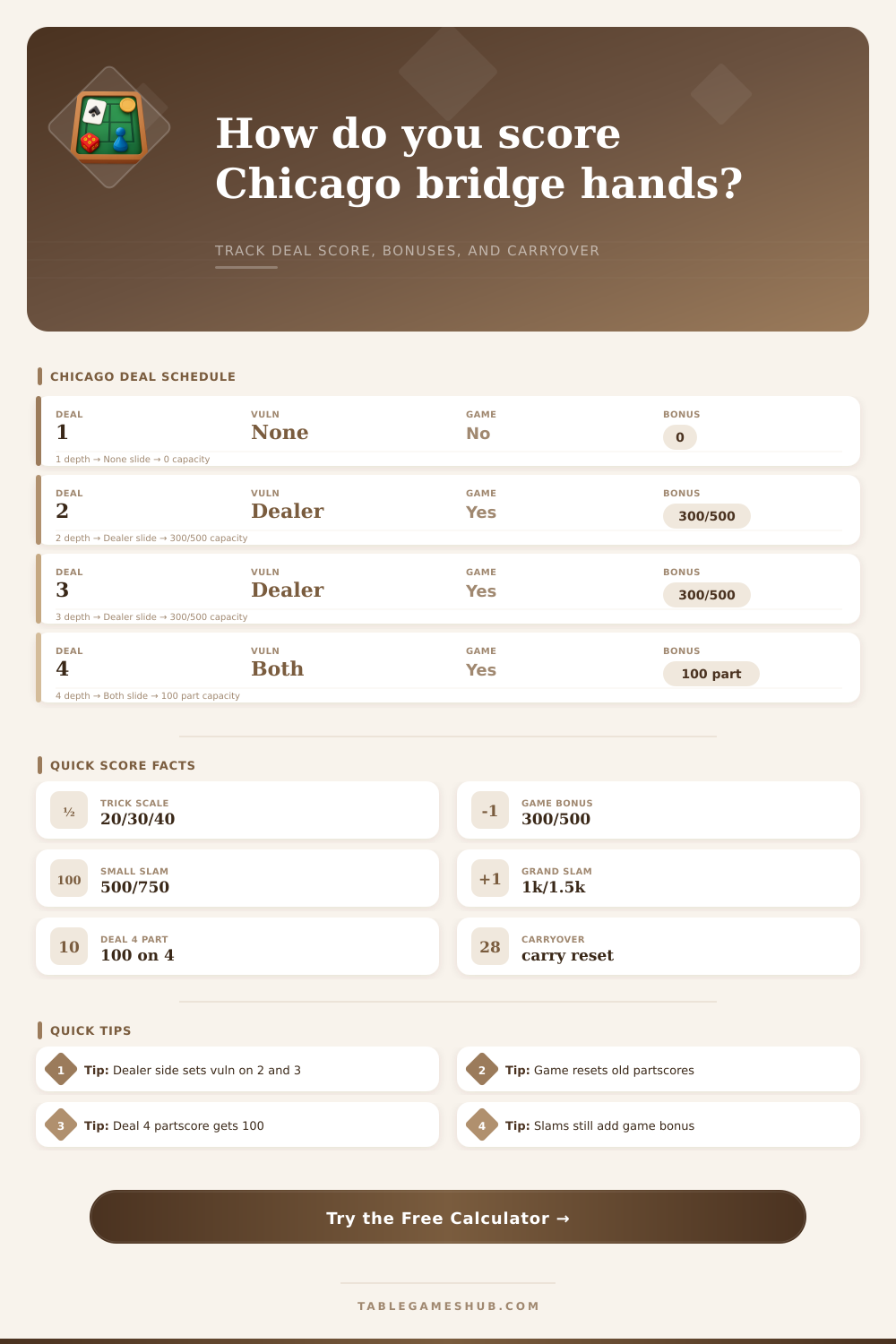
| 1 | None | No | Open |
| 2 | Dealer | Yes | Side vul |
| 3 | Dealer | Yes | Side vul |
| 4 | Both | Yes | 100 part |
| Strain | Per trick | Game line | Notes |
|---|---|---|---|
| C/D | 20 | 100 | Minor |
| H/S | 30 | 100 | Major |
| NT | 40+30 | 100 | 40 first |
| Dbl | x2/x4 | 100 | Insult |
| Bonus | NV | Vul | When |
|---|---|---|---|
| Game | 300 | 500 | Made game |
| Small slam | 500 | 750 | 6-level |
| Grand slam | 1000 | 1500 | 7-level |
| Deal 4 part | 100 | 100 | Below game |
| Status | NV | Vul | Note |
|---|---|---|---|
| Undoubled | 50 ea | 100 ea | Per under |
| Dbl down1 | 100 | 200 | First step |
| Dbl down2 | 300 | 500 | Cumulative |
| Rdbl down1 | 200 | 400 | 2x dbl |
Mark the dealer first
Deals 2 and 3 follow the dealer side for vulnerability, so the X at the top matters.
Watch deal 4 closely
If the hand stays below game, the final deal gets a 100-point partscore premium.
Chicago bridge scores each hand separately but still lets partscores carry forward. Use this sheet to track contract points, game bonuses, and the final-deal premium with less table math.
Chicago bridge is a form of bridge that consists of a four-deal cycle. Within this cycle, there is carry over points from one deal to the next deal within the cycle. These carry over points are known as below-the-line points, and these below-the-line points is scored towards the 100-point threshold that is required to score a game bonus in bridge.
When a person reaches 100 points through trick scores within the deal, that person earns a game bonus. When the game or slam is completed within a deal, the carry over points are reset to 0, and these carry over points dont carry over into the next deal of the cycle. The vulnerability change within the four-deal cycle of Chicago bridge.
How to Score in Chicago Bridge
In the first deal of the cycle, there are no sides that is vulnerable. During the second and third deals of the cycle, the dealer side is vulnerable to penalties and bonuses. During the fourth deal of the cycle, both sides of the bridge are vulnerable.
If no one has earned a game during the fourth deal, then each person have the potential to earn a partscore premium of 100 points. Each player earns this partscore premium only if they have not earned a game by the end of the fourth deal of the cycle. The carry over points are essential in that they allow for players to have points move from one deal to the next deal within the cycle.
Only the trick scores earned by the declarer side of the bridge and under 100 points are carried over to the next deal. For instance, if the declarer scores 60 points during the first deal, they will earn those 60 points as carry over points for the second deal. If the declarer scores 120 points during the third deal, the declarer will have earned 60 points from the first deal and 120 points from the third deal for a total of 180 points.
Since 180 points is 100 points more than the threshold for a game bonus, the declarer will earn a game bonus. However, overtricks are scored above the line, and overtricks do not carry over to the next deal. Contracts that are doubled and redoubled will change the scoring of penalties and bonuses.
Undoubled contracts will award 50 or 100 points for each undertrick. For doubled contracts, the first undertrick will cost 100 points for non-vulnerable players, or 200 points for those who are vulnerable to the contract. For redoubled contracts, the penalties or bonuses is doubled again.
Additionally, the strain of the contract may change the point values of each suit. Each minor suit contain 20 points for each trick of that suit, each major suit contains 30 points each for each trick of the suit, and no-trump suits contain 40 points for the first trick and 30 points for each trick after that. It is possible to make mistakes playing Chicago bridge if you are not mindful of both the dealer side of the bridge and the declarer side of the bridge.
The dealer side of the bridge will determine which sides are vulnerable during deals two and three of the cycle. The declarer side will determine the vulnerability for bonuses and penalties. Therefore, any mistake in calculating which side is vulnerable will result in the awarding of the wrong number of bonuses or penalties.
In addition, one must monitor for 100 points during deal four of the cycle. Should a person reach 100 points during deal four, they will score a game bonus and have a carry over of 0 points to the next deal. However, if a player does not reach 100 points by the end of deal four, they will earn the partscore premium of 100 points.
Chicago bridge is a game that can be used to learn about bidding and vulnerability in bridge. Chicago bridge, for instance, can teach a player when to bid for a game and when to stop bidding so as to save there carry over points. A score sheet can be used to keep track of the dealer number, the vulnerability of each side, the trick scores under the line for each player, and the carry over points for each player.
Carefuly keeping track of the carry over points with such a score sheet will help a player to understand how the math for the four deal cycle work. Following the rules for each deal will ensure that each player scores their game correctly within the four deal cycle for Chicago bridge.