🀄 Mahjong Discard Calculator
Rank every cut by efficiency, safety, and pressure for riichi hands.
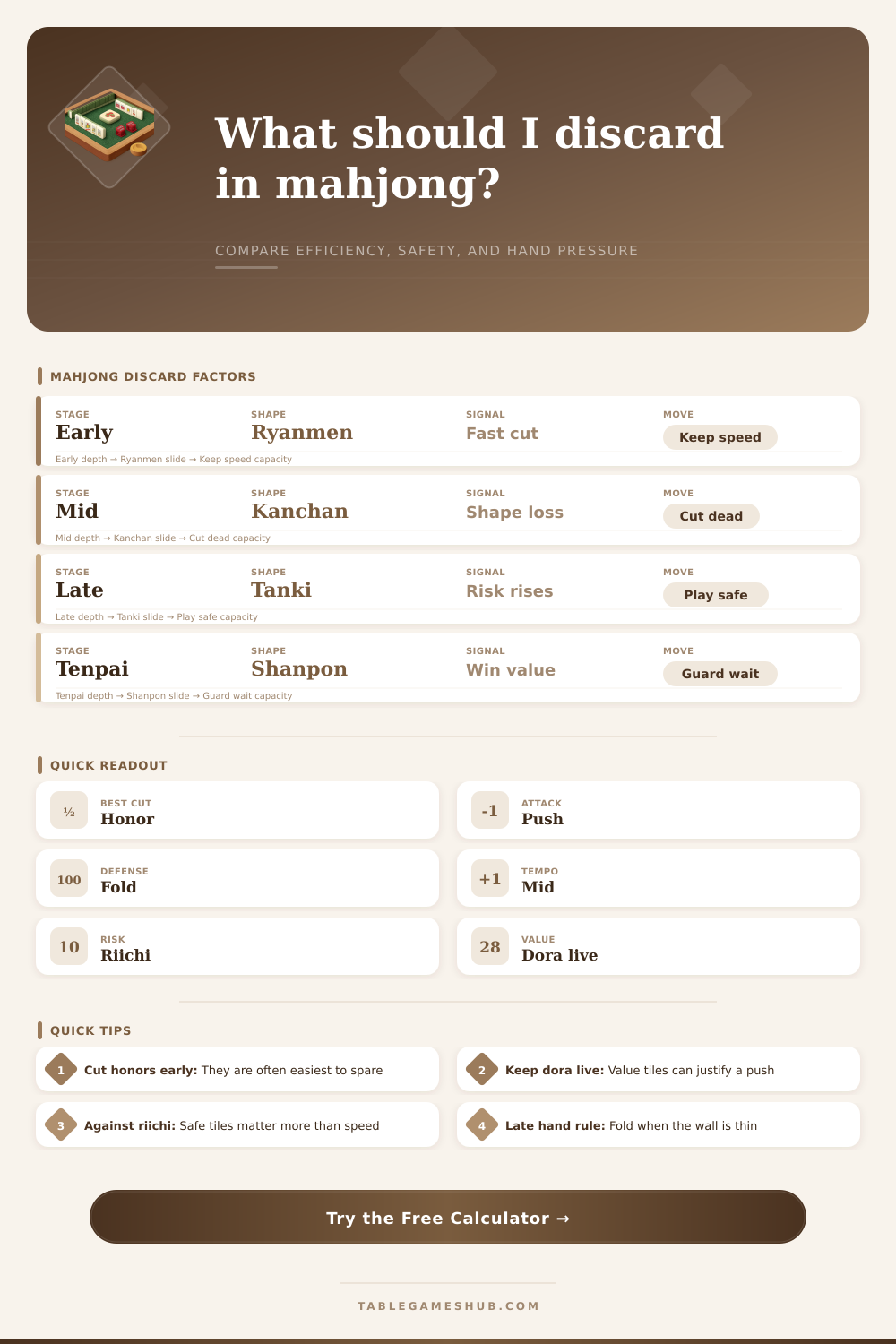
| Step | Value | Meaning | Effect |
|---|
| Stage | Shanten | Pressure | Default move |
|---|---|---|---|
| Early | 3+ | Low | Trim honors |
| Mid | 2 | Medium | Keep shape |
| Late | 1 | High | Cut safe |
| Tenpai | 0 | Max | Guard wait |
| Shape | Flex | Ukeire | Cut note |
|---|---|---|---|
| Ryanmen | Best | High | Keep speed |
| Shanpon | Good | Mid | Protect pair |
| Kanchan | Weak | Low | Trim dead |
| Penchan | Weak | Low | Cut edge |
| Threat | Safety bias | Tempo | Cut style |
|---|---|---|---|
| Calm | Low | Fast | Push shape |
| Watchful | Mid | Steady | Mix cut |
| Dangerous | High | Slow | Choose safe |
| Riichi | Max | Very slow | Fold hard |
| Group | Count | Role | Discard note |
|---|---|---|---|
| Suits | 108 | Connect | Keep runs |
| Honors | 28 | Safety | Cut early |
| Terminals | 28 | Edges | Low flex |
| Dora | Varies | Value | Protect live |
Cut safe honors first
When your shape is weak, honor tiles usually give the cleanest early discard.
Respect riichi pressure
If the table gets hot, safety can outrank speed for the next discard.
In mahjong, you must decide which of the available tile to discard when a tile does not suit the hand that you are trying to complete. The decision that you make during this stage of the game will impact the speed with which you can complete your hand, your safety with which you can complete your hand, and the pressure that you feel from other players at the table. You must find a balance between wanting to complete your hand as quick as possible while also wanting to ensure that you are safe in the process.
The stage of the game will dictate your priorities regarding the games speed. During the early stage of the game, there is still a relatively high degree of availability of the available tiles in the wall of the mahjong set. Because of this, speed is the most important factor in this stage of the game.
How to Decide Which Tile to Discard in Mahjong
You should discard any of the tiles that do not assist in the building of your hand quick. You should discard honor and terminal tiles during this stage of the game because they dont tend to contribute to the development of long run of tiles. During the midgame, there are relatively few remaining tiles in the wall.
During this stage of the game, you should focus on the shape of your hand and the ukeire that you have. The ukeire will help to indicate the number of ways in which you can eventually reach tenpai. You can have a variety of different wait shapes for your hand.
A ryanmen wait is a wait on both ends of your sequence of tiles. This type of wait is valuable in that more tiles will be pulled into your hand naturaly. A shanpon wait is a wait on a pair; this is more valuable if the tiles in your hand are the dora tiles.
A tanki wait is for a single tile in your hand; this is dangerous in the later stage of the game if there is a chance that your opponents may win. A penchan wait is one that you have on the edge of the tiles in your hand; this type of wait can be risky as it quickly closes your option. If you have any open melds from your calls of pon or chi, you will have limited flexibility in your hand.
This limits your options for the shape of your hand; you must prioritize the speed with which you can complete the remaining closed hand. Safety is defined as the discard options that do not help the dealer in building their hand. During the early stages of the game, there are many option for safe tiles to be discarded.
Many of these will be honor tiles as the other player have already discarded these. As there are fewer remaining tiles to be drawn from the wall, there are fewer option for safe discards for players. It is essential to be careful when playing in the late stage of the game as the honor tiles that were thought to be safe may no longer be safe.
One of the most important factor of the game is the dora tiles as they will add to the value of the players hand. Players with many of these in their hand will have a higher chance of attacking in the game. One of the most common mistake that players make is to ignore the stage of the game and to focus solely on their ukeire.
While pursuing their ukeire is a desired goal for the players, it isnt the correct pursuit in the later stages of the game. The other most common mistake is to hold onto honor tiles for too long. While they may seem safe, honor tiles can negatively impact the ability of the players to build their suited tile.
Therefore, players should discard their honor tiles early on in the game unless they are also forming a pair with the tiles, or if those tiles are dora. Players must also pay attention to the discard of the other players at the table. If another player discards a terminal tile, for instance, they may be working towards completing a tanyao.
In these instance, you should use your ukeire as a means of playing more aggressively if the other players are not exhibiting the same level of aggression. If another player declares riichi, for instance, you should play more defensively as the chance of there winning is high. In order to assist with making these decision, many players use presets and reference table.
Presets allow them to practice the different decision that must be made at different point in the game. These reference tables allow them to remember which tiles will help to form suited tiles and that the honor tiles will ensure that they are safe in the early game. When evaluating your hand, it is essential to weigh the benefit of your ukeire against the stage of the game and the shape of your hand.
You can use this to make decision about whether you should attack or defend your hand. A push can be played if you have many dora tiles, for instance. A fold, on the other hand, should be played in the face of high riichi pressure.
While this is by no means an exact science, these parameter will allow a player to make the same decisions as the professional in the game. Another factor to consider is your position at the table and the atmosphere of the game. If the table is relatively calm and there is low threat of winning for the other players, then it is beneficial to pursue ryanmen shapes in order to increase your speed to complete your hand.
If the table is dangerous for your hand, prioritizing safety over speed is a better idea. If you have any open melds in your hand, you have limited flexibility in your hand. Therefore, you will want to focus on the more closed hand to increase the likelihood of winning.
If your shanten count is zero, you should protect your wait. However, if your shanten count is three or more, you can discard any tile that you like to increase your speed.