🎲 Shadowrun Dice Probability Calculator
Compare standard rolls, Push the Limit bursts, Second Chance rerolls, Close Call safety, and bought hits.
Formula notes
Rolls that use Push the Limit add Edge dice and switch every die to Rule of Six. Second Chance rerolls misses once, while Close Call removes glitch effects after the roll.
| Hits | Chance | Cumulative | Note |
|---|
Shadowrun Die Faces
| Face | Standard | Exploding | Use |
|---|---|---|---|
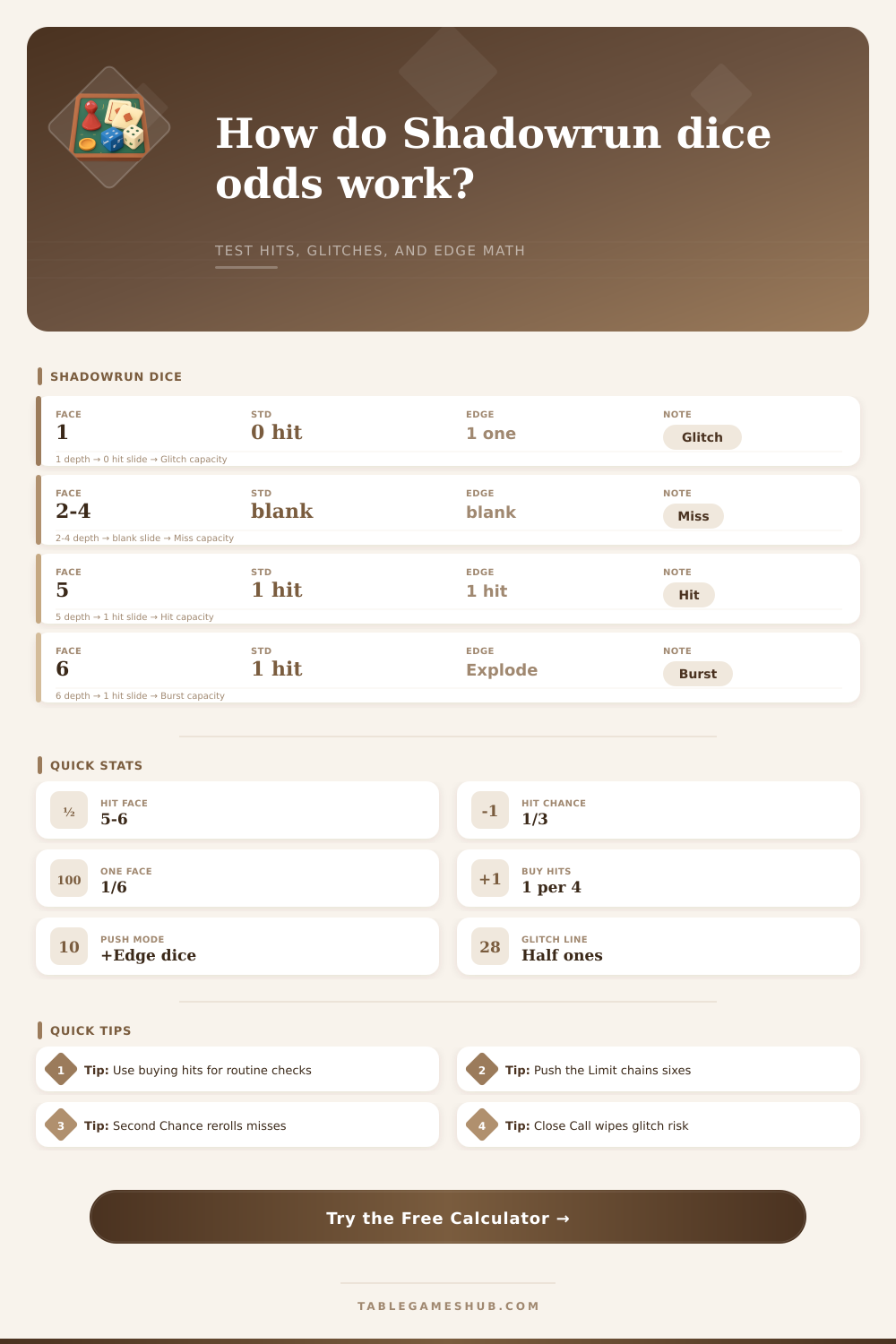
| 1 | 0 hit, 1 one | 0 hit, 1 one | Glitch fuel |
| 2-4 | Blank | Blank | Miss |
| 5 | 1 hit | 1 hit | Hit face |
| 6 | 1 hit | 1 hit + reroll | Rule of Six |
Glitch Line Guide
| Dice | Half or more | More than half | Notes |
|---|---|---|---|
| 4 | 2 ones | 3 ones | Small pool |
| 6 | 3 ones | 4 ones | Lean pool |
| 8 | 4 ones | 5 ones | Solid pool |
| 12 | 6 ones | 7 ones | Strong pool |
| 16 | 8 ones | 9 ones | Large pool |
| 20 | 10 ones | 11 ones | Heavy pool |
Edge Action Reference
| Mode | Formula | Hit effect | Glitch effect |
|---|---|---|---|
| Standard | Pool only | 1/3 per die | Base risk |
| Push the Limit | Pool + Edge | Rule of Six | Still counts |
| Second Chance | Reroll misses | Hits climb | Cannot remove |
| Close Call | Negate one glitch | No hit change | Risk erased |
Buying Hits Benchmarks
| Pool | Bought hits | Safe target | Use when |
|---|---|---|---|
| 4 | 1 | 1+ | Trivial task |
| 8 | 2 | 2+ | Low risk |
| 12 | 3 | 3+ | Steady work |
| 16 | 4 | 4+ | Routine skilled |
| 20 | 5 | 5+ | Long check |
Tip 1
Use buying hits for routine checks where the glitch risk is not worth the roll.
Tip 2
Push the Limit shines when extra Edge dice can chain into more 6s and more hits.
In Shadowrun you use six-sided dice, or D6s. Players cast them to settle tests by means of a dice pool. This pool is made of the amount of skill rank of the character and its trait or state.
For instance, a character with force of 5 and skill of 4 reach a pool of 9D6. While you roll those cubes, you intend to reach hits. A hit happens when a die show 5 or 6. More hits always help more.
How Shadowrun Dice Pools Work
The chance for a hit on one die is 33.33 %, and for six is 16.66 %.
Probabilities depend on the size of the dice pool. For the first three pools, so 1D6 until 3D6, the chances are 0.34, 0.56 and 0.26 against same-size pool of the target. Big results are almost impossible in practice, although anyone can beat some in opposed tests.
So, 10 successes from 10D6 happen only in 0.0017 %, around once in 50 000 tests.
Also bad results matter. A problem comes when the number of ones surpasses the hits. -999 show critical problem with zero hits.
Negative numbers point hits with a problem, while positive show pure hit count. You notice bigger risk for problems and critical in big pools. Some tactics hamper wild cubes, because re-rolling a wild die does not alter it according to SR6 FAQ.
For count those probabilities you need special programs. One utility estimates probabilities for an open pool. Another way is fake many tests, say 100,000 or a million, of N cubes against target to find average successes.
Characters with high skills can note little differences in their pools, as go from 22 to 24 cubes, although it does not alter a lot. Some players even play highly optimized in campaigns with terrific pools. For those interested in math, the formula for other probabilities is 2^hits * 4^(dice-hits) * [dice!
/ (hits! * (dice-hits)!)] / 6^dice.