🎲 Dice Probability Distribution Calculator
Exact sums, range odds, modifiers, and distribution curves for any fair dice pool
Exact sum distribution
Each extra die adds one layer of convolution to the sum curve.
Ways(T) = coeff of (x + x^2 + ... + x^S)^N
Range probability
Add every total inside the chosen window, then divide by all outcomes.
P(a to b) = sum Ways(t - M) / S^N
Target chance
Exact, at least, and at most all reuse the same sum table.
P(T) = Ways(T - M) / S^N
Pick a dice pool to see the distribution summary.
Formula: P(total) = ways / total outcomes.
| Raw | Total | Ways | Exact | Cume |
|---|
| Pool | Min | Avg | Max |
|---|---|---|---|
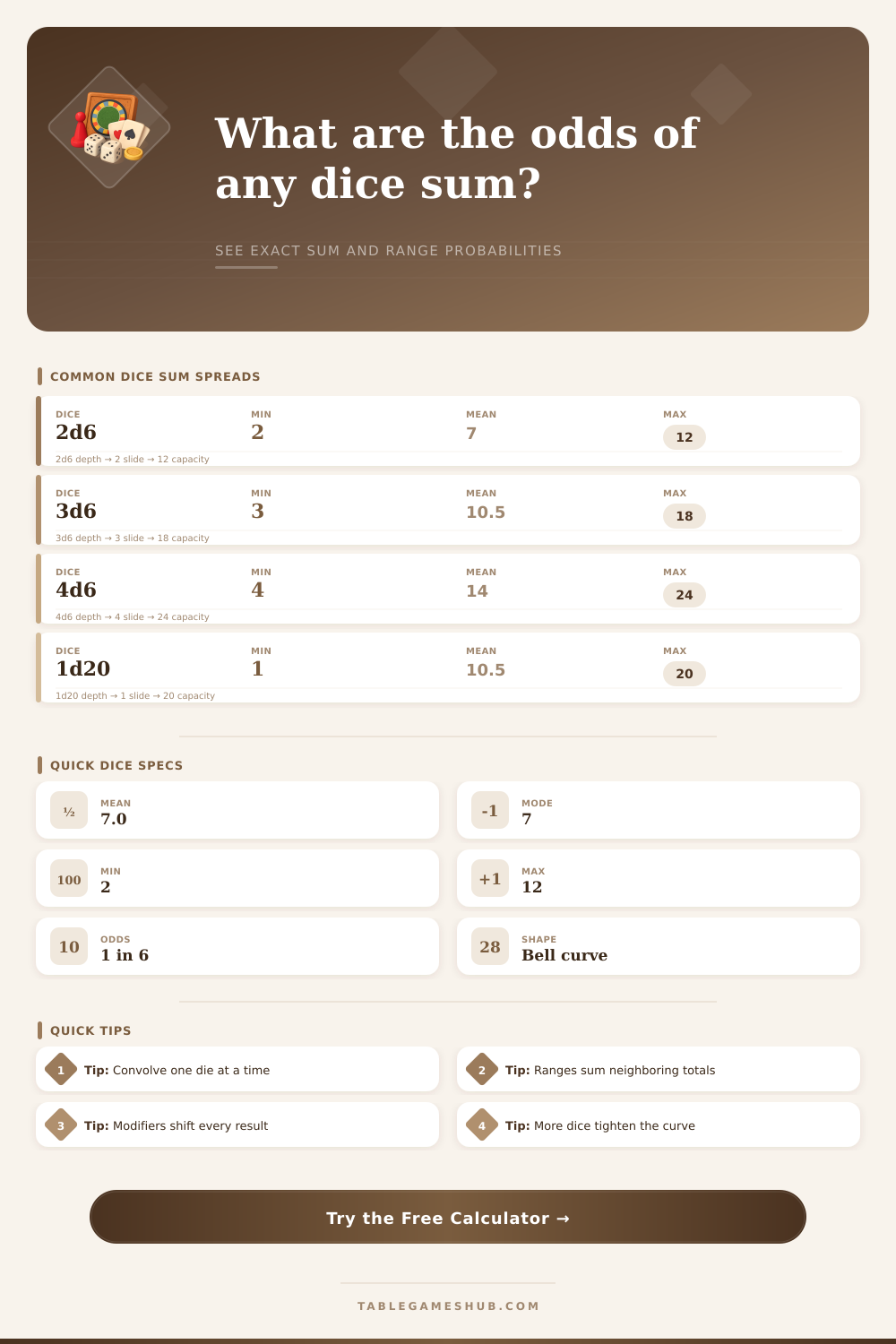
| 1d20 | 1 | 10.5 | 20 |
| 2d6 | 2 | 7.0 | 12 |
| 3d6 | 3 | 10.5 | 18 |
| 4d6 | 4 | 14.0 | 24 |
| Total | Ways | Exact | Cume |
|---|---|---|---|
| 2 | 1 | 2.8% | 2.8% |
| 3 | 2 | 5.6% | 8.3% |
| 4 | 3 | 8.3% | 16.7% |
| 5 | 4 | 11.1% | 27.8% |
| 6 | 5 | 13.9% | 41.7% |
| 7 | 6 | 16.7% | 58.3% |
| 8 | 5 | 13.9% | 72.2% |
| 9 | 4 | 11.1% | 83.3% |
| 10 | 3 | 8.3% | 91.7% |
| 11 | 2 | 5.6% | 97.2% |
| 12 | 1 | 2.8% | 100% |
| Query | Formula | Best for | Note |
|---|---|---|---|
| Exact | P(T) | One total | Single hit |
| At least | P(T+) | Beat a line | Tail odds |
| At most | P(T-) | Stay low | Low tail |
| Range | P(a..b) | Band odds | Sum window |
| Shift | Raw | Final | Use |
|---|---|---|---|
| +0 | 7 | 7 | Pure roll |
| +1 | 7 | 8 | Small bonus |
| +2 | 7 | 9 | Strong bonus |
| -1 | 7 | 6 | Penalty |
Read totals after modifiers
Calculate the raw dice first, then add or subtract the modifier to get the final distribution.
Ranges need both endpoints
For a band, include every total from the minimum through the maximum, then sum those probabilities.
Dice probability distribution is one of those things that always appears in tabletop games. Whether you design an RPG or just want to know how dice rolls work the math genuinely helps.
Three basic probability distributions exist for dice. One, two or three dice together form different shapes. With one alone die, every number has the same chance.
How Dice Rolls Work
Two six-sided dice give 36 possible combinations, each with probability 1/36. But the sums are not equally likely. The number 7 is the most commonly rolled, because there are more ways to reach it.
Two or 12 can happen only by one combination: (1,1) or (6,6). Hence experts know that 7 is the expected result for 2d6. The curve for two dice forms a triangle.
The standard notation NdX is well known in the whole gaming community. In tabletop games you use polyhedral dice, called according to their faces. A die with s faces has a mean (s+1)/2 and variance (s²-1)/12, if it is numbered 1 until s. Mean grows lneia with the number of dice, with μ=3.5n for six-sided dice.
When you roll more dice, the distribution converges to a normal curve due to the central limit theorem. Many dice follow that bell shape. The more dice, the more it looks like the bell curve.
Few games care about the chance of an exact number. More important is if the sum surpasses or falls below a set limit.
Flat distribution, like one d10 or d20, give equal chance to every number. Compare 1d10+5 with 3d6: both cover a similar range, although 3d6 go above 15 and under 6. The d10 is just as flat as d20 or d100.
AnyDice is a powerful online calculator for probabilities of dice, made for roleplaying games. It helps to check if the mechanics make sense during design of an RPG. You can start with a simple roll of one die and reach binomial distributions by way of combinatorics.
That suffices for 99% of the dice systems in RPGs. A random element makes every game unique and helps the game lastlonger. By using conditional rolls you can create complex distributions for rolls.