🎲 D&D 5e Point Buy Calculator
Build ability scores with 27 points — Standard, Array & 2024 PHB modes
Click a score above, then click the ability score card you want to assign it to.
Spending 9 pts on a 15 and 7 pts on a 14 uses 16 of your 27 points on two primary stats. This leaves 11 pts to distribute among four abilities, enough to bring two of them to 11 or 12 for decent secondary coverage.
Score 14 costs 7 pts but score 15 only costs 2 more (9 pts total). If you are going to 14, pushing to 15 is efficient since your race's +1 or +2 ASI can bring it to 16 or 17 — a much stronger modifier than staying at 14.
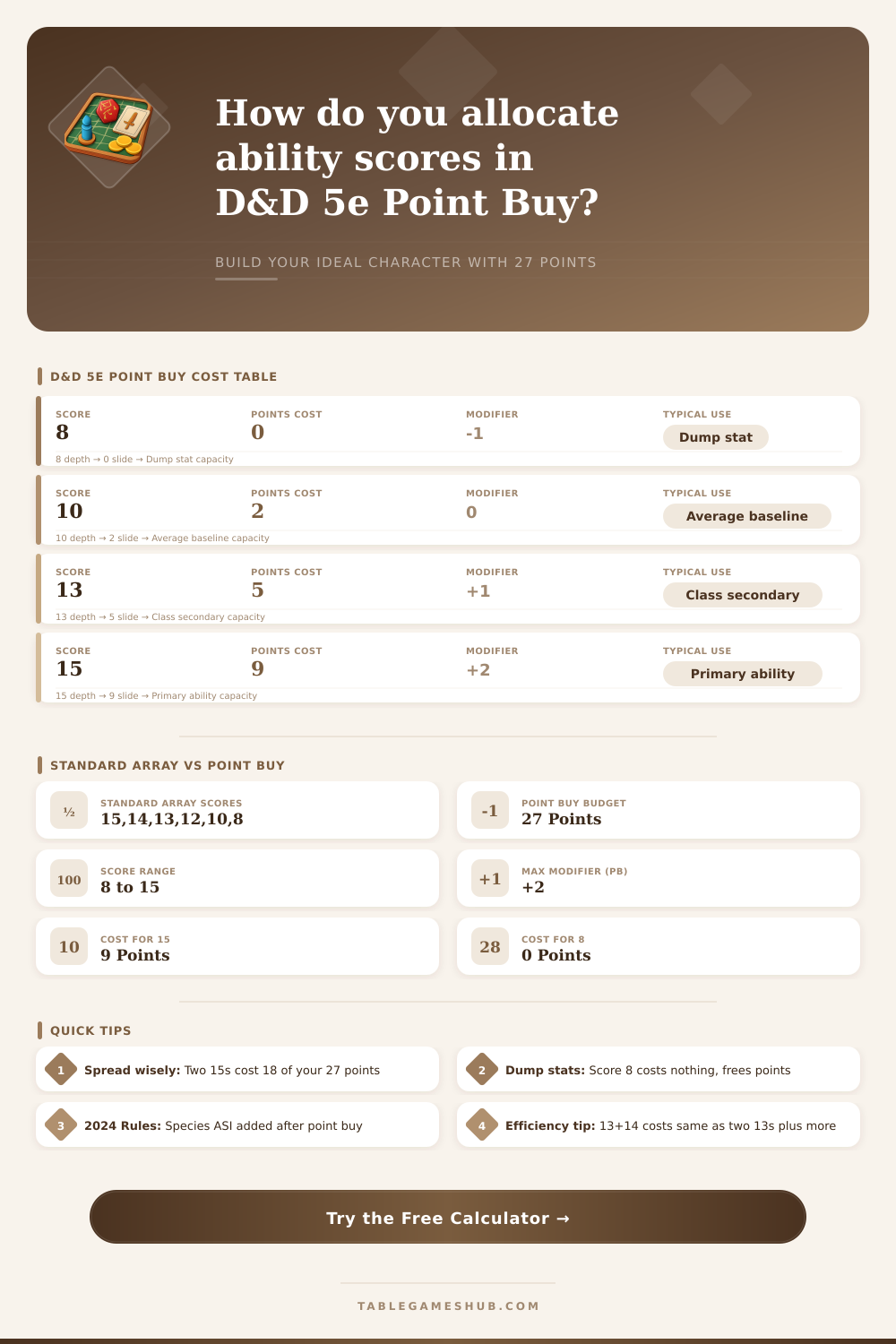
| Score | Cost (pts) | Modifier |
|---|---|---|
| 8 | 0 | -1 |
| 9 | 1 | -1 |
| 10 | 2 | +0 |
| 11 | 3 | +0 |
| 12 | 4 | +1 |
| 13 | 5 | +1 |
| 14 | 7 | +2 |
| 15 | 9 | +2 |
| Feature | Std Array | Point Buy |
|---|---|---|
| Scores Available | 15,14,13,12,10,8 | Any 8-15 |
| Budget | Fixed set | 27 pts |
| Flexibility | Low | High |
| Highest Score | 15 | 15 |
| All 13s possible? | No | Yes (25 pts) |
| Two 15s possible? | No | Yes (18 pts) |
The point buy system in Dungeons & Dragons is a way to set scores without the luck of dice Create a character is one of the most fun parts of D&D, and you can use this method to find the values of your hero. The official Player Handbook describes three ways to set scores, which can confuse newcomers who do not know which to choose.
In 5e, the player or the DM can decide to use the point buy system to give out stats. With this method, no stat can be below 8 or above 15, at least at first. The player gets 27 points to give out.
How the Point Buy System Works in D&D
A stat of 8 costs 0 points, while 15 costs 9. All values start at 8, and you spend your points between them. For values up to 14, you buy extra points at a rate of 1-for-1, but for values higher than 14, the cost is a bit hihger.
The standard array is a fixed list of values. It works for new players, but the points are so evenly spread, that you end with two strong stats, three average and one small gap after you add the bonuses of species or background. Point buy gives more choice and variety.

It allows some classes, that depend on several scores, to shine better or be more viable. For example, playing a Monk is very hard if you use the standard array.
With point buy, you never waste a point. When you roll 4d6 and keep 3 results, you almost always get some weird or bad rolls. Point buy lets you build your character exactly as you want.
When you have chose your species and class, you spend points to buy the specific stats that you need. Prioritize the main score, then the secondary, and spend less on the rest.
Remember that only the modifiers of the scores realy matter. Many new players find the cost table confusing, because it hides the most important part: what modifiers you buy with your points.
For those who want to play the same characters through the whole campaign, you want all heroes to be as balanced as possible. Point buy and the standard array help to do that. A popular house rule is to roll 4d6 (keeping 3), but if the total is less than 70, the player can use point buy instead.
Another option is to let everyone roll, and those who are sad about their results can choose to buy their points. The biggest strength of the point buy system is its flexibility.