🐉 D&D Challenge Rating Calculator
Estimate CR for homebrew monsters using the official DMG method — plus XP budgets & encounter difficulty
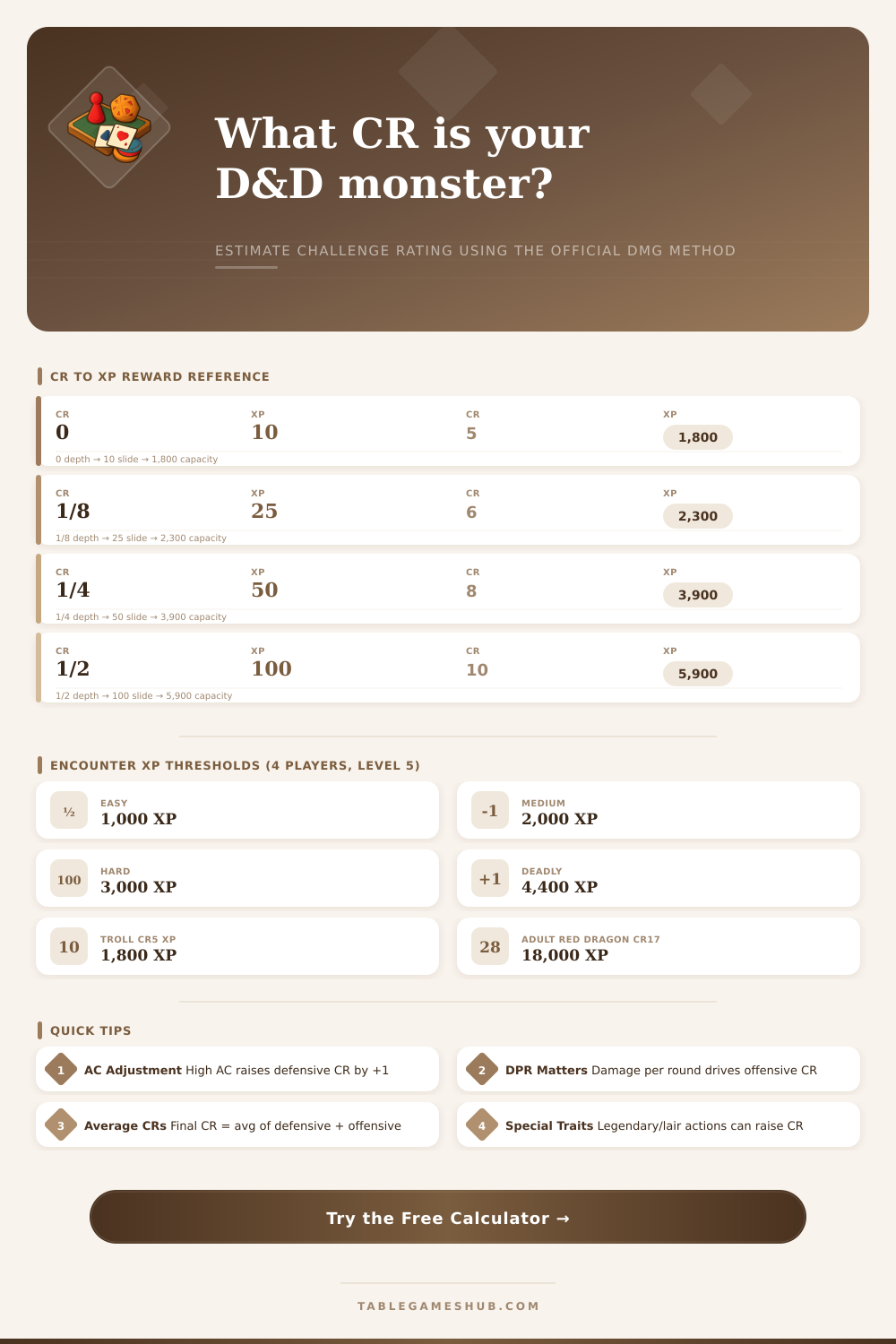
If a monster's AC is 2 or more above the expected AC for its defensive CR, raise the defensive CR by 1. If AC is 2 or more below, lower it by 1. HP and AC work together to determine survivability.
Legendary actions, lair actions, and powerful special traits can significantly increase a monster's effective CR beyond what the math suggests. Use your judgment to adjust upward for iconic abilities.
CR to XP Reward
| CR | XP | Prof. Bonus |
|---|
HP & DPR Ranges by CR
| CR | HP Range | DPR Range |
|---|
When monsters outnumber the party, multiply total XP by a factor (x1.5 for 2 monsters, x2 for 3-6, x2.5 for 7-10). This represents action economy advantages for monsters.
Only use adjusted XP to determine encounter difficulty. Players still receive the actual (unadjusted) XP from monsters. The multiplier only affects how hard the fight feels.
| Level | Easy | Medium | Hard | Deadly |
|---|
Challenge Rating, commonly abbreviated as CR, is a system for the Dungeon Master in Dungeons and Dragons to plan encounters and dangers that fit the player characters. The challenge rating of a monster shows how big a threat it is. CR outlines the danger that the monster presents to a group of four player characters and you compare the CR of the monster with the level of the players If the CR is higher, the monster probably is dangerous.
If the CR is lower, it likely presents only little threat.
What Challenge Rating (CR) Means in D&D
CR is based on a four person group, moderately optimized, but not too optimized. A four person party should find an encounter with CR equal to the party level difficult, but not fatal. Hence CR 4 would be a medium encounter for a group at that level.
Well equipped and well rested party of four adventurers normally could beat a monster whose challenge is equal to their level, without sufferring too much problems. That does not always work perfectly, but it stays a useful guideline.
The lower CRs operate a bit differently. If a monster is CR 1/4, that means that you alone, without the party, would find it a challenge. CR 1/8 means that two such monsters would be a challenge for one individual.
CR 0 monster is not really a challenge for any.
Also the size of the party matters. Six players of level 3 should face one monster of CR 7 to have about the same challenge that three players of level 3 would have against a monster of CR 3. Because the game bases on resources, it also depends on how many resources you spend during a fight.
CR is not very precise, and Dungeon Masters should look at it as a loose guess of the trouble of a monster. Many outside factors can affect the actual trouble past the CR score. Although it is a key mechanic for encounters in DnD 5e, Challenge Rating is commonly misunderstood or misapplied.
All challenge ratings are only rough ratings, and every party differs. If a party has more divine players, they will fight better against undead.
CR does not have sense inside the world. It is simply a numerical abstraction to help the DM determine how challenging would be a separate set of stats and abilities. It is best to stay with smaller numbers of enemies around the level of the players.
If they are level 8 or more, you never put so many CR 1 or weaker enemies in one encounter that it would be a fair challenge.
The CR system is useful to use during construction of encounters, but it is helpful to also verify it. Think about the party and about their skills. Wizards of the Coast used an entirely other way for Challenge Ratings in the rules of 2024, and that could alter things eventually.