🎯 Risk Game Capital Calculator
Calculate troop distribution, territory control, reinforcement rates, and capital placement for Risk board game
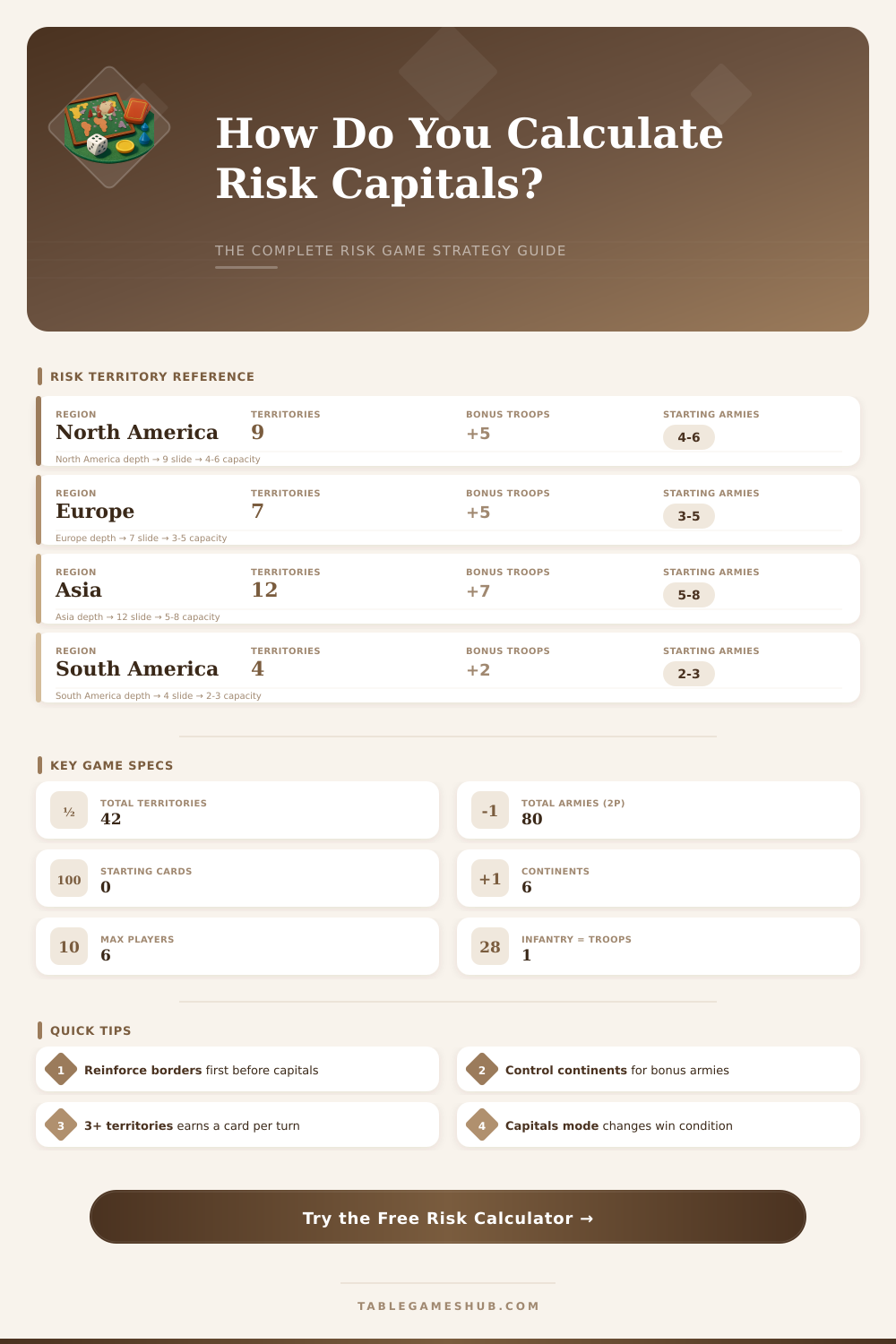
| Continent | Territories | Bonus Armies/Turn | Border Territories | Defensibility |
|---|---|---|---|---|
| Australia | 4 | +2 | 1 (Indonesia) | Very High |
| South America | 4 | +2 | 2 | High |
| Africa | 6 | +3 | 3 | Medium |
| North America | 9 | +5 | 2 | High |
| Europe | 7 | +5 | 4 | Medium |
| Asia | 12 | +7 | 6 | Low |
| Players | Starting Armies Each | Total on Board | Territories/Player | Avg Armies/Territory |
|---|---|---|---|---|
| 2 | 40 | 80 | 21 | ~1.9 |
| 3 | 35 | 105 | 14 | ~2.5 |
| 4 | 30 | 120 | 10-11 | ~2.9 |
| 5 | 25 | 125 | 8-9 | ~3.0 |
| 6 | 20 | 120 | 7 | ~2.9 |
| Set Number | Armies Received | Cumulative Total | Notes |
|---|---|---|---|
| 1st Set | 4 | 4 | Infantry x3 or mixed |
| 2nd Set | 6 | 10 | Cavalry x3 or mixed |
| 3rd Set | 8 | 18 | Artillery x3 or mixed |
| 4th Set | 10 | 28 | +2 bonus if territory owned |
| 5th Set | 12 | 40 | +2 bonus if territory owned |
| 6th Set | 15 | 55 | +2 bonus if territory owned |
| 7th+ Set | +5 each | varies | 20, 25, 30... |
| Attacker Dice | Defender Dice | Attacker Wins (%) | Defender Wins (%) | Split (%) |
|---|---|---|---|---|
| 1 die | 1 die | 41.67% | 58.33% | — |
| 1 die | 2 dice | 25.46% | 74.54% | — |
| 2 dice | 1 die | 57.87% | 42.13% | — |
| 2 dice | 2 dice | 22.76% | 44.83% | 32.41% |
| 3 dice | 1 die | 65.97% | 34.03% | — |
| 3 dice | 2 dice | 37.17% | 29.26% | 33.58% |
Venture capital is foundation money, that one sets aside especially for investments with high Risk, where one can lose everything. The idea is simple: one trades safety for the chance to reach huge profit. But here the main point: one must feel entirely at peace with the idea of losing everything.
Here why venture capital should not pass around 10% or less of the whole investment portfolio.
Why Venture Capital Should Be a Small Part of Your Portfolio
Investments, that fall in that category, carry options, options and future contracts. They are not safe business from any viewpoint. Yes, they carry Risk, but the potential profit can attract genuinely.
Here the secret is, that only money, that one can lose without problems, go in such deals, and only folkw with enough fortune consider getting involved by means of that. And about past results? They not always point the future.
Capital Risk is near, but separate idea, that deserves its own description. It relates to the chance of losing part or the whole of invested capital. Assume, that you lay 10 000 dollars in new business.
You can loose the whole amount. Here your capital Risk is that amount, that, what genuinely is in the game.
Banks struggle with capital Risk also. For them, it means the danger, that the bank will have to take losses. Good bank keeps enough capital to last such blows, although it depends on deposits for funding of loans.
When bank lacks proper capital reserves to cover possible losses, here start problems. There are levels in the system: CET1 capital, Additional Tier 1 and Tier 2 capital, that has different Risk traits.
So there is Risk-based capital, that forms a base for rating. Businesses and insurance companies use it to count the smallest capital, that they need to run well, considering their size and Risk. The report about capital adequacy, sometimes called capital-to-Risk weighted report…
Helps to check, whether bank is financially solid and arethe money of clients well enough kept.
One main challenge for banks is to understand, how different risks relate. Guessing those links and watching them? It is genuinely hard task.
So sometimes one simply skips those links. Imagine bank with capital portions of 30 millions, 20 millions and 10 millions of dollars in various Risk groups. The total regulatory capital simply adds up to 60 millions.
Venture capital works also as support for the duties of company to lenders, what helps to keep its credit standing. Losses come from various sources like believed Risk, when borrower does not repay, and market Risk, when prices move bad.