🎯 Darts Handicap Calculator
Calculate fair handicaps for players of any skill level — supports 501, 301, Cricket & more
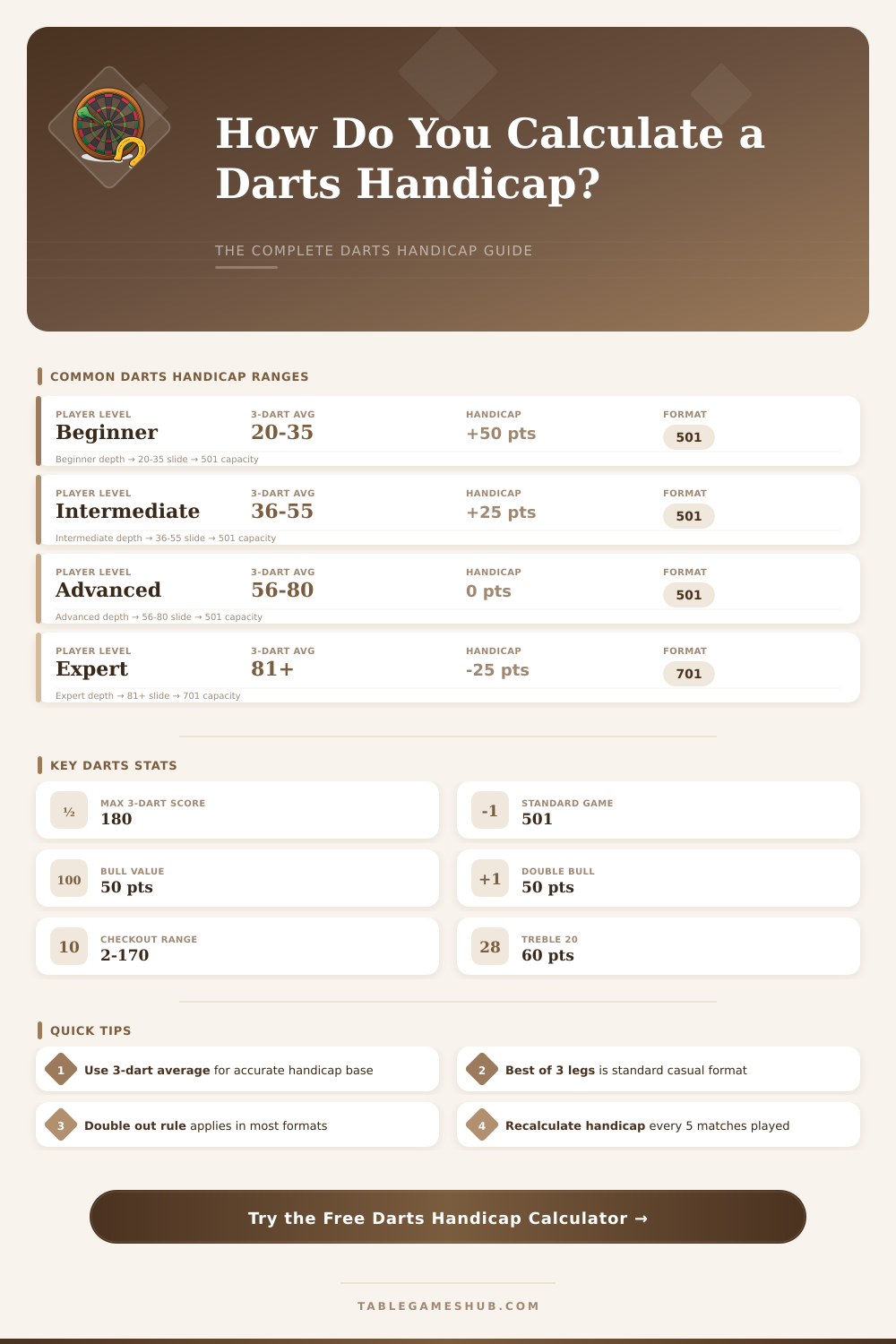
| Skill Level | 3-Dart Average | Points Handicap vs Scratch | Typical Checkout % | Avg Darts / Leg |
|---|---|---|---|---|
| Complete Beginner | 10 – 20 | +150 pts | 2–5% | 90+ |
| Novice | 21 – 35 | +100 pts | 5–10% | 75–90 |
| Improver | 36 – 50 | +60 pts | 10–18% | 60–75 |
| Intermediate | 51 – 65 | +35 pts | 18–28% | 50–60 |
| Advanced | 66 – 80 | +15 pts | 28–38% | 40–50 |
| Semi-Pro | 81 – 95 | 0 pts (scratch) | 38–50% | 32–40 |
| Professional | 96 – 110 | –20 pts (give) | 50–65% | 25–32 |
| Elite / Tour | 110+ | –50 pts (give) | 65%+ | <25 |
| Format | Starting Score | Players | Checkout Rule | Avg Duration |
|---|---|---|---|---|
| 501 Singles | 501 | 2 | Double Out | 5–15 min |
| 301 Singles | 301 | 2 | Double Out | 3–8 min |
| 701 Singles | 701 | 2 | Double Out | 10–25 min |
| Cricket | N/A | 2–4 | Close all numbers | 10–20 min |
| Around the World | 1 | 2+ | Hit each number in order | 5–15 min |
| Killer | N/A | 3–8 | Own double first | 15–30 min |
| Shanghai | N/A | 2+ | Shanghai wins instantly | 10–20 min |
| Average Difference | Points Handicap | Leg Handicap (BoX3) | Dart Handicap | Fairness Rating |
|---|---|---|---|---|
| 0–5 pts | 0 | None | None | Balanced |
| 6–15 pts | +20 pts start | +0.5 leg | +1 dart | Slight Edge |
| 16–25 pts | +40 pts start | +1 leg | +2 darts | Moderate |
| 26–40 pts | +70 pts start | +1.5 legs | +3 darts | Significant |
| 41–60 pts | +100 pts start | +2 legs | +4 darts | Large Gap |
| 60+ pts | +140 pts start | +3 legs | +6 darts | Major Gap |
Darts Handicap exist because of one simple reason: they allow players with very different levels of skill to compete directly against one another, without one simply beating the opponent. Without any fairness a newcomer that faces an expert player would get completely beaten. The whole system aims for equal conditions, regardless of how big the difference in skill really is.
When dealing with play in leagues and tournaments, the percentages of Handicap range a bit. One finds events with 50 %, others get more near 80 %, and even groups that use 90 %. It does depend on what particular tournament or league considers best for itself.
How Darts Handicaps Work
For counting exactly the Handicap, the American Darts Database helps well for finding the involved averages.
Here it becomes a bit more technical. In X01-games, for estimating the average player, one takes all reached points and divides that by the number of thrown Darts in all their games. That results in a pattern that shows, how many points one scores on average each dart.
In cricket it works differently, here enters the MPR (marks per round). The calculation is made up of division of total marks by thrown Darts, later multiplied by three. Assume, that someone ends a game with 46 Darts and 59 marks total.
Then his MPR will be 3.85. Take note: Handicap rounds do not enter in your official statistics.
When Handicap genuinely feed into a game, commonly one sees a player start at 501, while the opponent can start at 420, or maybe even more below like 326. That creates a big difference. It can seem harsh, when one player is in form and the other freezes, because the stronger one gets held back more.
Some argue, that clearly defined levels of skill wood surpass the current MPR- or PPD-systems. Although, any system one builds, many think, that it is unfair. Also exists the problem of sandbagging, players that on purpose play weaker only to lower their Handicap rating.
Some electronic boards have built-in dynamic handicapping, that changes the Handicap during the match progress. One can combine that with standard handicapping, changing the starting score of one player already in the first leg for extra advantage.
In the betting world, Darts Handicap betting works quite similarly to what one sees in other sports. One player receives a head start on paper. For leg or fixed Handicap bets, one adds or takes away a set amount of legs or sets from the final score to decide, does the bet win.
A player with positive Handicap can still benefit even if he loses an equal number of legs. The odds are much better than simply betting on a direct match winner. Combine gameplay with creative bets, Handicap markets, most 180 hits, high checkout bets…
Thatmakes everything much more fun.