🀄 Mahjong Score Calculator
Calculate Han, Fu & total points for Riichi, Hong Kong & Chinese Classical mahjong
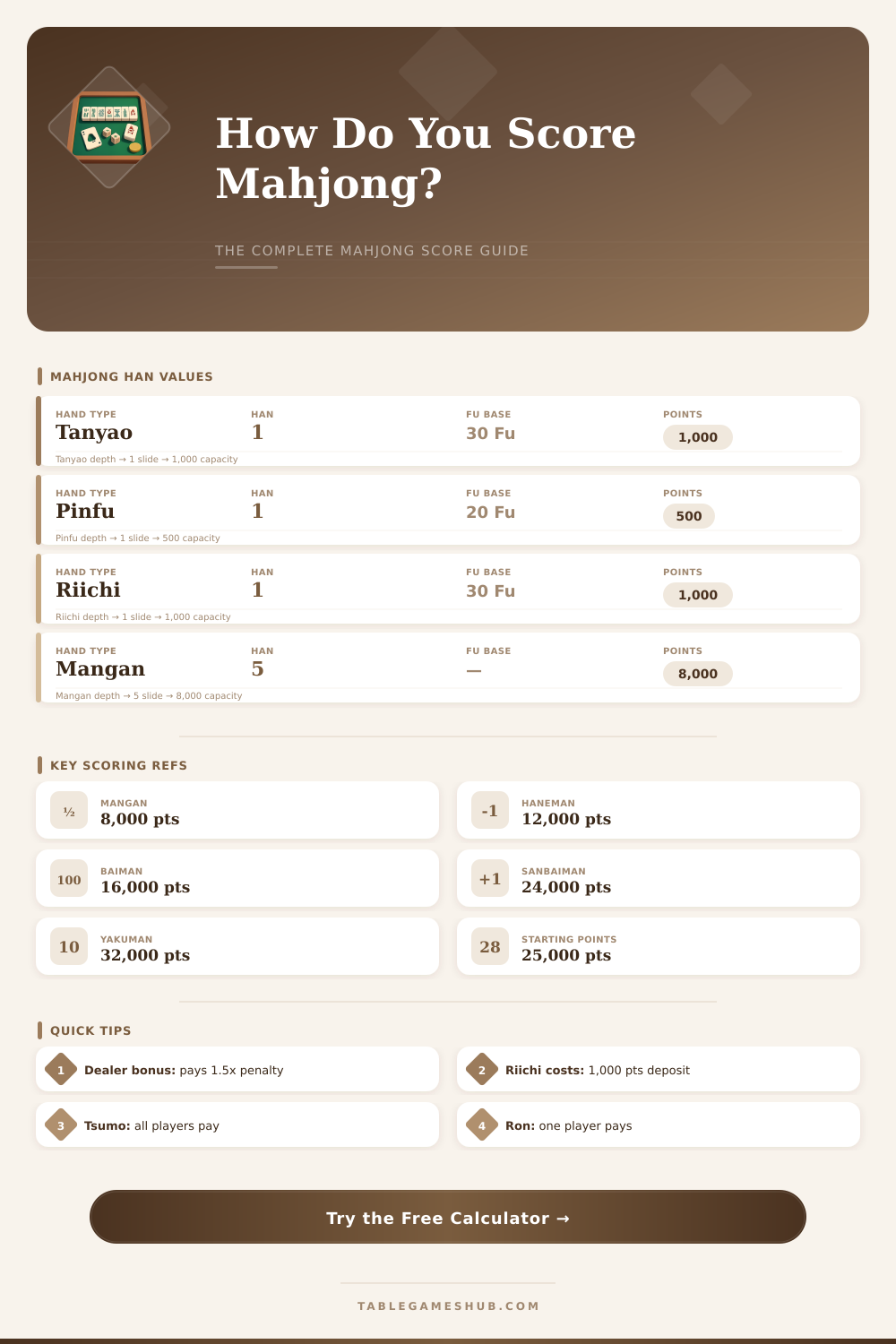
| Han | 20 Fu | 30 Fu | 40 Fu | 50 Fu | 60 Fu | Limit Name |
|---|---|---|---|---|---|---|
| 1 | — | 1,000 | 1,300 | 1,600 | 2,000 | — |
| 2 | 700 | 2,000 | 2,600 | 3,200 | 3,900 | — |
| 3 | 1,300 | 3,900 | 5,200 | 6,400 | 7,700 | — |
| 4 | 2,600 | 7,700 | Mangan | Mangan | Mangan | Mangan |
| 5 | 8,000 — Mangan | Mangan | ||||
| 6–7 | 12,000 — Haneman | Haneman | ||||
| 8–10 | 16,000 — Baiman | Baiman | ||||
| 11–12 | 24,000 — Sanbaiman | Sanbaiman | ||||
| 13+ | 32,000 — Yakuman | Yakuman | ||||
| Hand Limit | Non-Dealer Ron | Dealer Ron | Non-Dealer Tsumo | Dealer Tsumo |
|---|---|---|---|---|
| Mangan (5 Han) | 8,000 | 12,000 | 2,000/4,000 | 4,000 all |
| Haneman (6–7 Han) | 12,000 | 18,000 | 3,000/6,000 | 6,000 all |
| Baiman (8–10 Han) | 16,000 | 24,000 | 4,000/8,000 | 8,000 all |
| Sanbaiman (11–12) | 24,000 | 36,000 | 6,000/12,000 | 12,000 all |
| Yakuman (13+ Han) | 32,000 | 48,000 | 8,000/16,000 | 16,000 all |
| Double Yakuman | 64,000 | 96,000 | 16,000/32,000 | 32,000 all |
| Ruleset | Start Points | Min to Win | Players | Tile Count |
|---|---|---|---|---|
| Japanese Riichi | 25,000 | 1 Yaku | 4 | 136 |
| Hong Kong (HK) | — | 3 Fan | 4 | 136–144 |
| Chinese Classical | — | Any valid | 4 | 136–148 |
| MCR (Competition) | 1,000 | 8 points | 4 | 144 |
| American Mahjong | — | Specific hand | 4 | 152 |
| Taiwanese Mahjong | — | 1 Fan min | 4 | 144 |
| Yaku Name | Han (Closed) | Han (Open) | Description |
|---|---|---|---|
| Riichi | 1 | N/A | Declared wait with 1,000 deposit |
| Tanyao | 1 | 1 | All simples (2–8 tiles only) |
| Pinfu | 1 | N/A | All sequences, non-yakuhai pair |
| Iipeiko | 1 | N/A | Two identical sequences |
| Yakuhai | 1 | 1 | Triplet of honor (dragon/wind) |
| Toitoi | 2 | 2 | All triplets (4 pon sets) |
| Honitsu | 3 | 2 | Half flush + honors |
| Chinitsu | 6 | 5 | Full flush, one suit only |
| Kokushi | Yakuman | N/A | 13 orphans + 1 duplicate |
| Daisangen | Yakuman | Yakuman | 3 dragon triplets |
The Score in Mahjong can seem really hard, especially because of the big number of different versions. Depending on the style that one plays, the scoring systems range a lot. However the main idea stays almost the same for most: hands that are less common and more complicated give more points.
Japanese Mahjong has a Score system that is much more difficult. Every hand almost always has base on two elements, called han and fu. One puts those values in a formula to compile the final spots.
How to Score in Mahjong
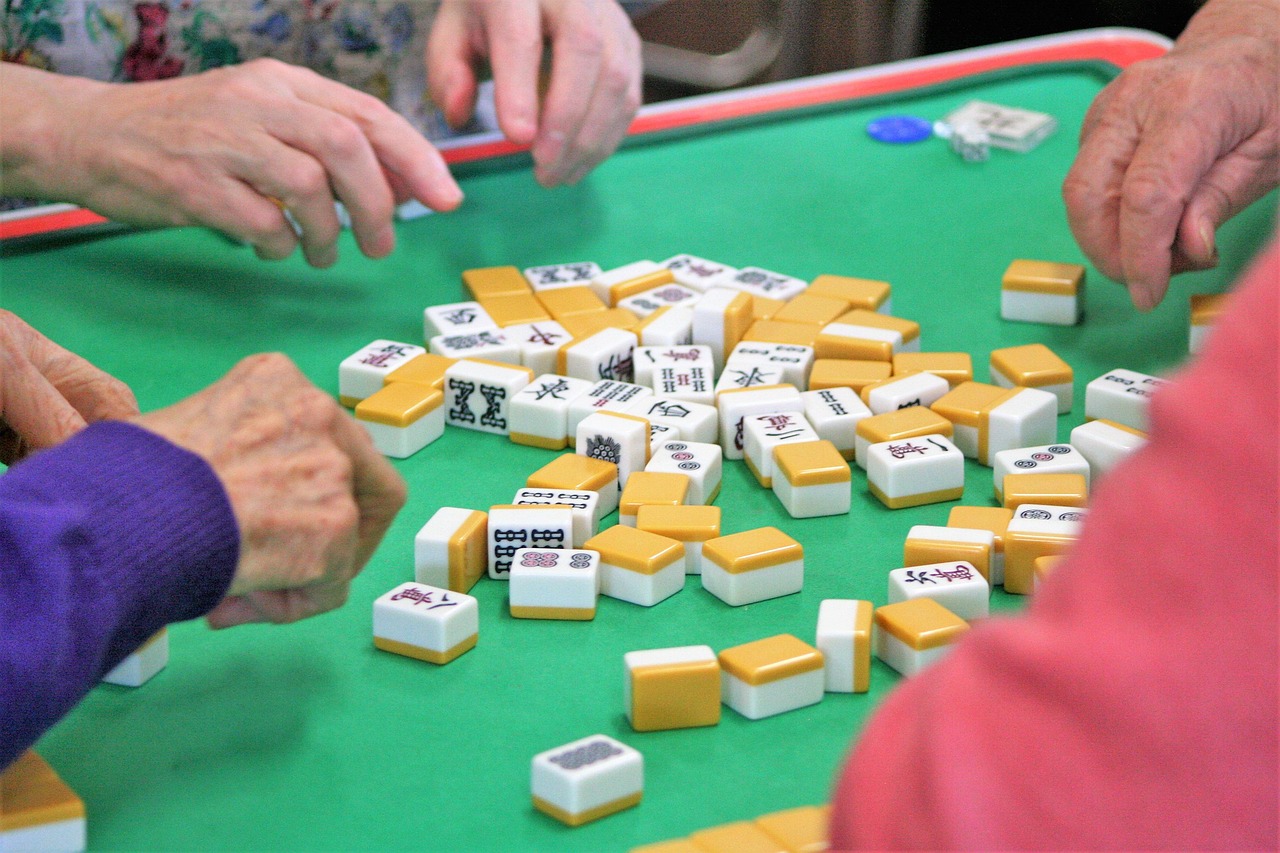
The usual equation appears like this: (20 + extra spots) × 2^ (2 + han). Tables for scoring commonly point the value of a hand according to han and fu, so that the players do not need to do the calculations themselves. One rounds fu to the nearest ten multiples, except in the case of Seven Pairs for the winner.
Hong Kong Mahjong works a bit differently. It usually requires at least three points to beat. The minimal Score limit bans victory by means of simple, boring combinations of tiles after one single turn.
In the lists for Cantonese Mahjong, one arranges the Score parts with their point values together with teh rules about scoring.
The Score patterns in Mahjong can be nice or interesting in any way. Sometimes the beauty lies in the whole of the hand, for instance All Simples or Fully Flush. Hand combinations that are simpler receive fewer points, but more mighty and rare victories give higher numbers.
Every flower or season is worth four spots. Trios can give from two to eight spots, depending weather one formed them by means of discard or by drawing from the wall, and whether the tiles are suits between 2 and 8 or special (ones, nines and winds).
The East player has a central role from the start of the round, with doubling for points and doubling for payments. When the winner ends by means of discard of another, he receives the points of the discarder plus eight basic spots from each other player. For victory by means of own draw, the winner takes eight spots from every player.
There is no single rule for what happens when some player ends his Score. In some groups one immediately stops the match, and the player ahead beats. In other cases, players without Score markers keep playing without risking extra fees.
Mahjong sometimes happens in betting settings. For the final points one finds the difference between the present scores of each and the initial, divides by 100 and adds or removes theattributed bonuses.
Singapore Mahjong does not use basic spots and has a limited series of doublings. It requires at least one double in the hand to announce victory. American Mahjong applies different kinds of hands, each with its own Score value.
The more difficult the hand, the bigger the Score.