🎳 Bowling Lane Oil Calculator
Estimate oil volume, pattern coverage & conditioning needs for any lane setup
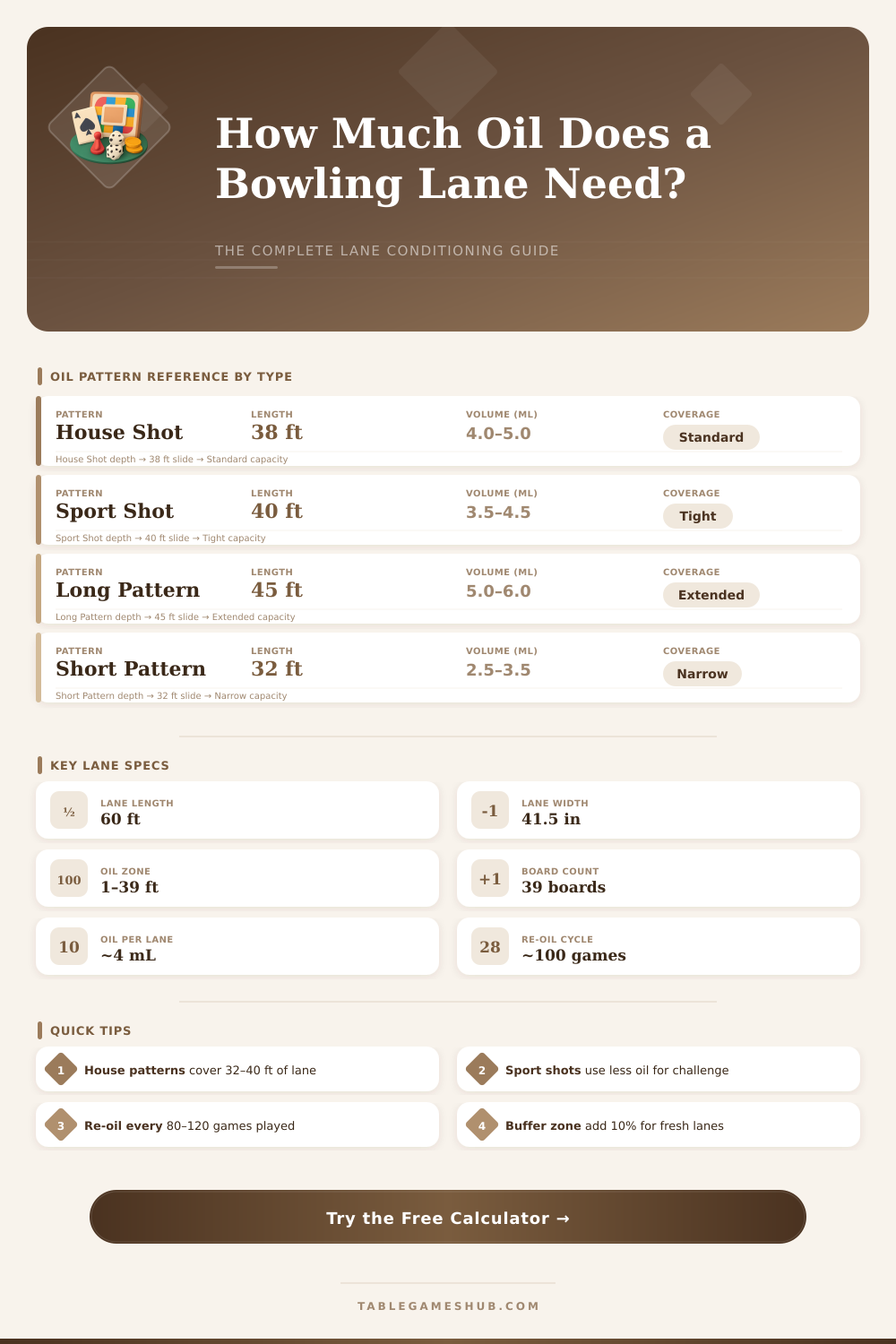
| Pattern Type | Length (ft) | Oil Volume (fl oz) | Coverage Zone | Difficulty | Typical Use |
|---|---|---|---|---|---|
| House Shot | 36–40 | 4.0–5.0 | Boards 3–39 | Beginner | Recreational / Open Play |
| Sport Shot | 38–42 | 3.5–4.5 | Boards 5–35 | Intermediate | Competitive League |
| Long Pattern | 43–47 | 5.0–6.5 | Boards 3–39 | Advanced | Tour & Tournament |
| Short Pattern | 30–34 | 2.5–3.5 | Boards 5–33 | Advanced | Sport/Challenge Events |
| Challenge Pattern | 40–46 | 4.5–6.0 | Boards 7–33 | Expert | High-level Competition |
| PBA Tour Pattern | 39–43 | 3.8–4.8 | Boards 5–35 | Pro | PBA Tour Events |
| Measurement | Imperial | Metric | Notes |
|---|---|---|---|
| Total Lane Length | 60 ft 0 in | 18.29 m | Foul line to pin deck |
| Lane Width | 41.5 in | 105.4 cm | USBC regulation |
| Approach Length | 15 ft min | 4.57 m | Behind foul line |
| Oilable Zone (max) | 1–45 ft | 0.3–13.7 m | From foul line |
| Number of Boards | 39 boards | 39 boards | Numbered 1–39 |
| Board Width | 1.0625 in | 2.7 cm | Each board approx. |
| Pin Spacing | 12 in | 30.5 cm | Center to center |
| Foul Line Width | 1 in | 2.54 cm | Marks start of lane |
| Setting | Games/Trigger | Re-oil Frequency | Lanes | Weekly Oil Use |
|---|---|---|---|---|
| Recreational Center | 80–100 games | Daily | 16–32 | ~2.5 L total |
| League Center | 60–80 games | Before each block | 8–16 | ~1.2 L total |
| Tournament Event | 40–60 games | Every few pairs | 4–16 | ~0.8 L total |
| Pro/PBA | 20–40 games | Strict rotation | 2–8 | Varies |
| Youth League | 100–120 games | Daily/Weekly | 4–8 | ~0.5 L total |
Roll oil on a bowling lane is not the first thing that comes to the mind of folks, but it has an important role in that sport. One lays oil on the lanes for some reasons. It helps that the lanes look good and keeps them safe from damage of all balls that are thrown on them.
Without that oil on the surface of the lane there would be a lot of marks. Using oil, the bond between the ball, the oil and the lane stays fresh always, when the machine goes along the lane. Such benefits extend the use of every gear that is involved.
Why Bowling Lanes Are Oiled and How Much It Costs
So, how much does oiling a bowling lane cost? The prices grew during the years. Around the year 2000 it was about 32 to 38 cents to clean and apply a coating for one lane run.
Since 2007 the cost rose to 40 to 46 cents for one lane run. Those figures come from averages from many centres.
The conditioner itself, so the oil for lanes, cost around 80 to 90 dollars for a 1.25-gallon tin. In a centre with 32 lanes, that uses the machine twice daily and lays 20 millilitres per lane, the daily cost only for conditioner reaches almost 23 dollars and 30 cents. If the centre uses 40 millilitres of oil across 64 lanes, that matches to around 0.67 dollars per use, and one 1.25-gallon tin of conditioner costs about 80 dollars at online sellers.
And then are the machines. The devices for oiling lanes are quite expensive. They first clean and strip the lane on the way down, later apply new oil by means of a system similar to an inkjet.
Such machines cost almost as much as a new car. For instance, a new Kegel machine costs more than a Mercedes. They do not always work perfectly, because they brake at least once during a season, even if one uses them daily.
Assuming a five-year lifetime, with a run of 32 lanes a day while around 270 days yearly with a 50,000-dollar machine, the cost comes to almost one dollar per use.
Kegel machines can be programmed to alter the amount and the distance of any oil plan. Thanks to sensors and thousands of hours of research and testing, the price ends up being very high. Some centres use simpler and less expensive machines, that can not lay a specific pattern league for league, but apply a general coating across the lane.
Today’s bowling lane conditioners hold mineral oil together with other extras like anti-slip agents and lubricating agents. The main goal of those products is to keep the reaction of rolling balls steady and boost the accuracy of oil application. Also the oil plans range.
Medium oiling means 10 to 20 millilitres applied side to side, while heavy oiling means 20 or moremillilitres.
Some bowling centres care only about oiling for leagues and leave the lanes dry between sessions. The management decides when one coats the lanes, and the only real pushing leagues risk to remove their business otherwise, if the conditions do not stay good.