🃏 MTG Deck Power Level Calculator
Score Commander decks by speed, consistency, interaction, and combo density.
| Metric | Input | Derived | Note |
|---|
| Power Band | Label | Typical Turn | Deck Signals |
|---|---|---|---|
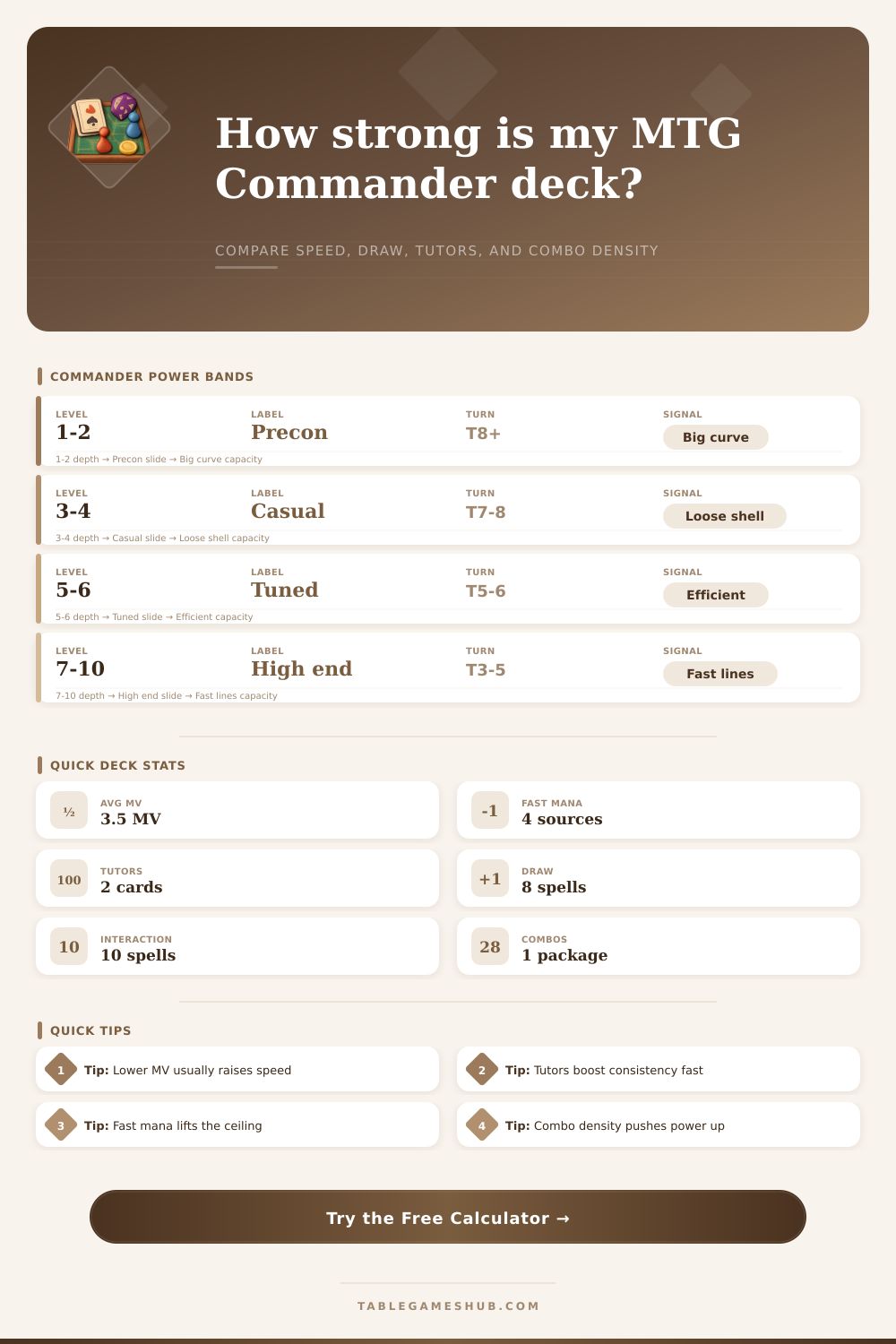
| 1-2 | Precon | T8+ | Big curve, few tutors |
| 3-4 | Casual | T7-8 | Loose shell, moderate draw |
| 5-6 | Tuned | T5-6 | Efficient curve, tighter plan |
| 7-10 | High end | T3-5 | Fast lines, compact wins |
| Package | Casual | Tuned | High Power |
|---|---|---|---|
| Fast mana | 0-2 | 3-5 | 6-8 |
| Tutors | 0-1 | 2-3 | 4-6 |
| Draw | 6-8 | 9-11 | 12-14 |
| Interaction | 6-8 | 9-11 | 12-14 |
| Avg MV | Speed | Feels Like | Typical Build |
|---|---|---|---|
| 2.0-2.7 | Very fast | Turbo or tempo | Low curve pressure |
| 2.8-3.4 | Fast | Efficient midrange | Most tuned lists |
| 3.5-4.1 | Medium | Balanced value | Casual upgrade path |
| 4.2+ | Slow | Battlecruiser | Big spell, long game |
| Base Quality | Taplands | Land Range | Power Effect |
|---|---|---|---|
| Rough | Many | 37-40 | Slower starts |
| Stable | Some | 35-38 | Middle ground |
| Refined | Few | 34-36 | Smoother turns |
| Optimized | Very few | 33-35 | Fast, stable mana |
Count real acceleration
Include rocks, rituals, and treasure bursts, not just mana dorks, when you score speed.
Let tutors guide the ceiling
More search effects usually push a deck from casual toward tuned or high power.
Power level in commander refer to the speed and reliability of a decks game plan against other decks. Several metrics help people understand the power level of there commander deck. These include the average mana values of the deck, the amount of acceleration in the deck, and the amount of interaction in the deck.
A commander decks plan determine the speed and strategy for the commander deck. Battlecruiser decks play large spells and decks take many turn to play the spells, so battlecruiser decks is slow by nature. Combo decks use many tutor and have fast mana sources to win the game quick, so combo decks are fast by nature.
How to Check Your Commander Deck’s Power Level
Midrange decks use many different types of threat and board wipes but can fail if they dont have steady card draw. Stax decks use taxation to control the board. Tempo decks use cheap interaction to rush an opponent.
Choosing a plan for your commander deck that does not align with the rest of your playgroups decks will result in your commander deck underperforming. For example, battlecruiser decks underperform in high-power pods as they will struggle against the speed of combo decks. Fast mana sources is essential for commander decks as they determine the speed of the commander deck.
Fast mana sources include mana rocks, rituals, and treasure maker. Tutors are also important for commander decks as they determine the consistency of the commander deck. Tutors will let the commander player find specific cards to enhance the commander decks consistency.
Interaction is also necessary in a commander deck to respond to the opponents threat. Interaction includes removal spells and counterspells. A commander deck lacking interaction will lose to other commander decks with interaction as they wont be able to stop the other commander decks from win.
The mana base is essential for commander decks as it determines whether the commander will be able to properly cast its spells. A high-quality mana base include dual lands and fetch lands to provide better color and mana fixing to commander players. A high-quality mana base will not allow commander players to mana screw.
A low-quality mana base includes tap lands and poor mana fixing for commander player. Using a low-quality mana base will result in awkward commander game opening and mana screw. Commander players must consider both the land count and land quality when constructing a commander deck.
Most commander decks will have between 34 and 38 land, but the land quality is just as important as the land count. The average mana value determine the speed of a commander deck. An average mana value of under 3.0 is considered aggressive and under 3.4 mana value is fast by most commander player.
An average mana value of over 4.0 mana is considered to be battlecruiser and over 4.2 mana value result in long game for commander players. Another important measure is the density of win conditions or card draw in the commander deck. Casual commander decks will have between six and eight card draw spells and few tutor.
Tuned commander decks have nine or more card draw spells and two or three tutor. For high-power commander decks, there must be 12 or more piece of interaction and four or more tutors. An honest self-assessment of the commander deck is necessary to avoid several mistake.
One of the most common mistakes is overvaluing the pet card in the commander deck. A pet card can be powerful but a burden on the commander deck if the commander do not use it appropriately. Using the goldfish turn can help commander players test there deck.
A goldfish turn let commander players play a game by themselves to determine their commander decks win speed. Goldfish turns will give commander players a reality check on their commander decks win speed when playing against others. Finally, using the Rule Zero conversation will allow commander players to discuss their commander decks power level before they play a game of commander.
Using Rule Zero commander players can avoid power level mismatches between playgroup members. For example, if a commander player owns a tuned commander deck and plays it against a casual commander pod, the tuned commander deck may appear oppressive to the casual players. Another example is playing a casual commander deck against a high-power commander pod.
In this scenario, the high-power commander decks in the pod will soon defeat the casual deck. By using various metrics such as average mana value, fast mana density, and interaction density, commander players can ensure that their commander deck match the power level of the commander players at the table.