Cricket Bowling Strike Rate Calculator
Measure wicket tempo by balls, phase, format, and bowling style.
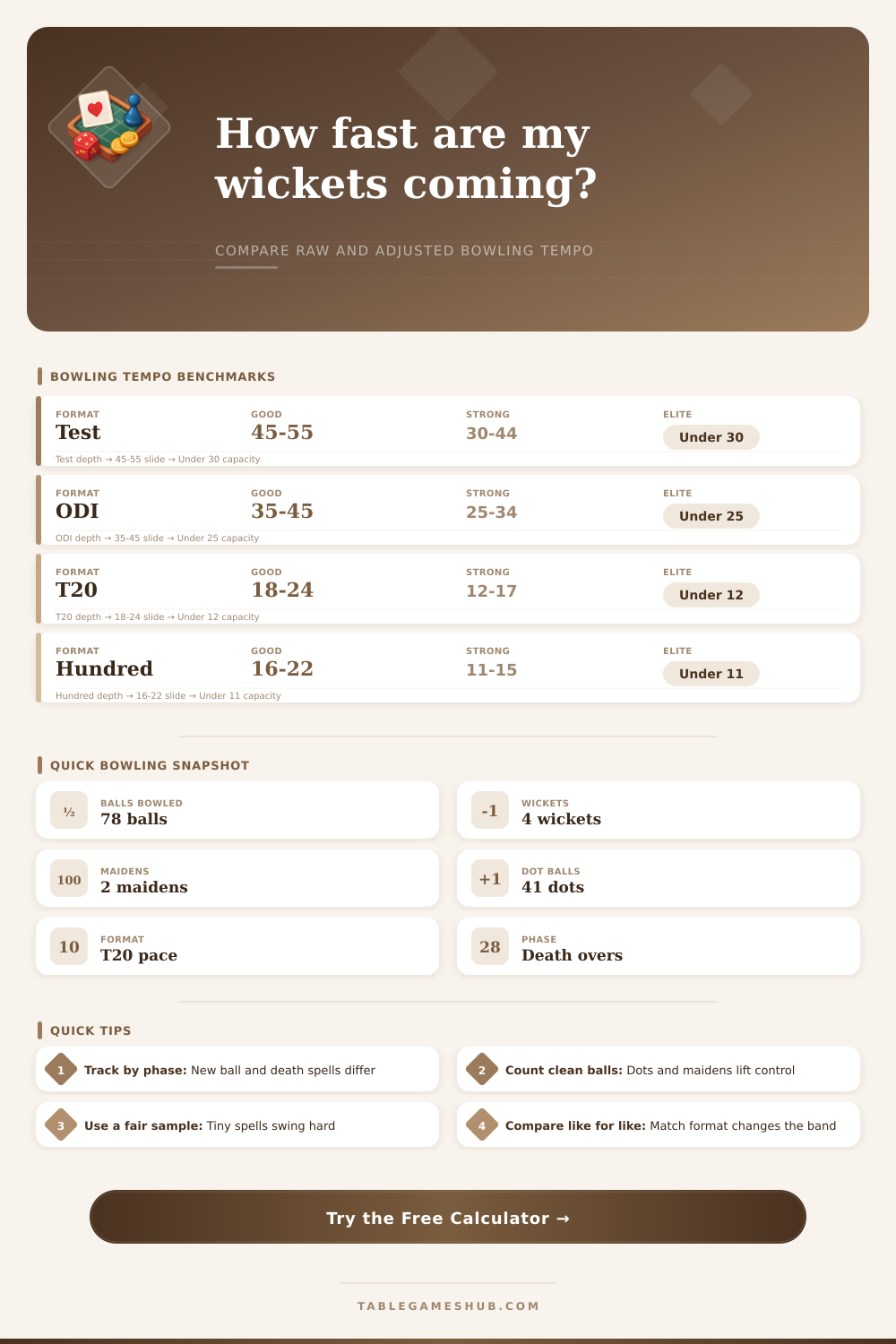
| Format | Steady | Strong | Elite |
|---|---|---|---|
| Test | 45-55 | 30-44 | Under 30 |
| ODI | 35-45 | 25-34 | Under 25 |
| T20 | 18-24 | 12-17 | Under 12 |
| The Hundred | 16-22 | 11-15 | Under 11 |
| Phase | Shape | Tempo note | Use when |
|---|---|---|---|
| New ball | Skiddy | Seam-first | Fresh pitch, hard ball |
| Powerplay | Tight | Field-up squeeze | Taking early risk |
| Middle overs | Measured | Contain then bite | Build pressure walls |
| Death overs | Attacking | Higher variance | Hunt wickets late |
| Bowling style | SR factor | Control feel | Best lane |
|---|---|---|---|
| Pace | 1.05 | Skid + bounce | Hard lengths |
| Swing | 0.94 | Edges first | New ball |
| Seam | 0.98 | Pitch bite | Helpful decks |
| Spin | 0.97 | Dot pressure | Middle overs |
| Adjusted SR | Read | Signal | Next check |
|---|---|---|---|
| Under 15 | Elite | Wicket storm | Keep the same lane |
| 15-24 | Strong | Healthy bite | Hold pressure shape |
| 25-39 | Steady | Workmanlike | Look for new plans |
| 40+ | Loose | Need a reset | Shift field and pace |
Bowling strike rate are a measurement of the number of balls a bowler bowls to take a wicket. Divide the total number of balls bowled by the total number of wickets taken to calculate the bowling strike rate. A lower bowling strike rate is better because it mean the bowler takes wickets more frequent.
For example, a bowler who takes a wicket every 20 balls has a better bowling strike rate than a bowler who take a wicket every 40 balls. A lower bowling strike rate is beneficial because it forces the opposing batters to continualy build up there innings. The context of a cricket match can alter the bowling strike rate that an individual should calculate for their bowler.
What is bowling strike rate?
The bowling strike rate for a Test match can differ from a T20 match. Test matches require a bowling strike rate between 45 and 55 balls per wicket. However, for T20 matches, a bowler must has a strike rate that is much lower.
For T20 matches, a bowling strike rate under 24 balls per wicket are required to be considered solid work. The best bowling strike rates are under 12 balls per wicket for T20 matches. A bowling strike rate that is too high for a T20 match will force the team captain to replace that bowler with another player.
Bowling strike rates work alongside other control marker in a cricket match. Control markers include dot balls and maiden overs. Dot balls are balls that score no runs for the batting team.
Maiden overs score no runs for the batting team. If a bowler bowls many dot balls during the game, the bowler is in control of the games tempo. Therefore, team captains and bowlers should monitor the number of dot balls and maiden overs to determine the true quality of a bowlers bowling spell.
The phase during a bowling spell will also alter the bowling strike rate calculation that is made for that bowler. In the start of a cricket match, bowlers use swing to take wickets. Therefore, a higher bowling strike rate is used during this phase of the match.
Middle overs for a cricket team require the bowler to build up the pressure on the batters to take wickets. Finally, during death overs for a cricket team, the bowling strike rate can be much more inconsistently as the batters are attempting to score as many runs as possible for their team. The bowling strike rate that is used for each of these phase is different than each other.
A bowler should use the bowling strike rate to make in-game adjustments to their bowling spell. For instance, if a bowler notices that their bowling strike rate is moving towards a higher number then the target bowling strike rate for that spell, they can always change their field settings or the pace of their bowled balls. However, if the bowler finds that their bowling strike rate is lower than the target rate, they should continue on the same bowling strategy.
Many bowlers focuses on chasing wickets rather than controlling the game. However, chasing wickets without control can lead to a high number of runs that the opposition team score for their innings. A good bowler will find a balance between their bowling strike rate and control markers to create scoreboard pressure for their team.
Finally, the bowling strike rate that is calculated for each bowler should be observed live while they are bowling in the game. An elite bowler will use the bowling strike rate in T20 cricket to determine when to attack the batters and when to maintain control of the game. For a T20 game, if the bowling strike rate is between 15 and 24 balls per wicket, the bowler should maintain the bowling spell that they have created.
However, if the bowling strike rate is above 40 balls per wicket, the bowler should tweak their field or change the pace of their bowling spell. By keeping track of the bowling strike rate that is produced throughout each phase of their bowling spell, the bowler can transform a good bowling spell into a win bowling spell for their team.